One of the major drawbacks of wind energy, one of the renewable energy sources with the greatest potential in our country, is the unpredictability of its production, which depends on factors such as wind speed and direction. The randomness of the wind poses serious problems for current electrical systems, which calculate generation a day in advance based on projected consumption.
This difficulty in planning for available wind energy in advance can increase the operating costs of the electricity grid and create potential threats to the reliability of the electricity supply.
In fact, says Gianluca Susi, a researcher at the Center for Biomedical Technology (CTB) of the Polytechnic University of Madrid (UPM) and one of the authors of the study, this “inability to accurately predict wind energy generation is slowing it down from becoming a significant contributor to the overall energy market.”
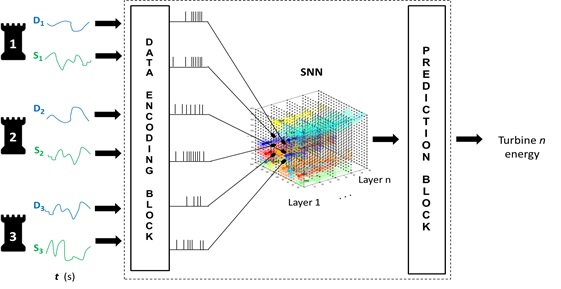
Within this framework, an international team of scientists, including a researcher from the UPM (Technical University of Madrid), has developed a novel method for predicting the energy production of wind farms. The research presents an architecture based on spiking neural networks (SNNs, or third-generation neural networks) to predict the amount of energy that will be generated by a wind turbine, located within a wind farm, in the next hour, taking into account the wind's behavior (intensity and direction) in the preceding hours.
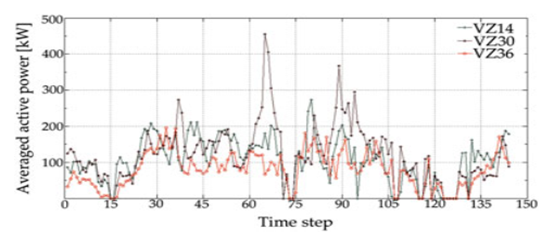
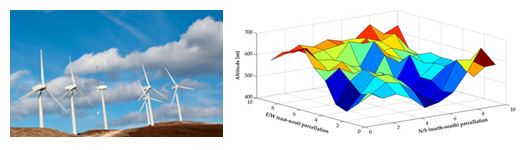 This method, developed in collaboration with the Italian universities of Catania and Messina, has been applied to a large wind power plant, consisting of 28 turbines and 3 anemometric towers, located in the rural area of the municipality of Vizzini in the province of Catania (Italy), which is characterized by a complex orography and an extension of 30 km², with very promising results.
“We believe that the new system brings reliability and optimization to wind power generation, and can be successfully applied for wind power generation predictions in real wind farms, even in the presence of breakdowns,” concludes the UPM researcher.
 S.Brusca, G.Capizzi, G.Lo Sciuto and G.Susi. “A new design methodology to predict wind farm energy production by means of a spiking neural network–based system.” International Journal of Numerical Modeling (Wiley) 2019;32:e2267