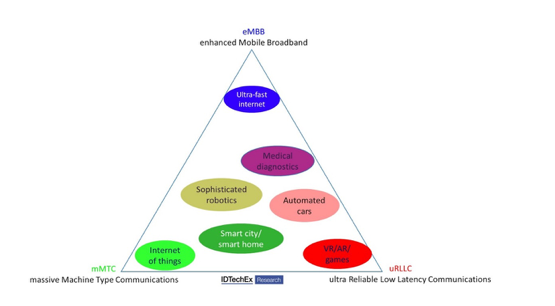
So why are people so interested in 5G? The first 5G efforts have been underway and have focused on three main features (as summarized in Figure 1).
Enhanced Mobile Broadband (eMBB): Telecoms expect 5G to deliver speeds of over 1 Gbit/s. Qualcomm's first 5G chip, released in 2017, successfully achieved this speed, and chips from Ericsson and NTT DoCoMo even reached 10 Gbit/s in the 15 GHz band. The fastest speed achieved so far is 35 Gbit/s by M1 and Huawei in a test in Singapore.
Massive Machine-Type Connections (mMTCs): Massive connections will support a vast number of connected devices, enabling the Internet of Things (IoT) to flourish. 5G will allow more than 1 million device connections per cell site, or per km² (200-400 for current networks).
Ultra-Reliable Low-Latency Communications (uRLLC): uRLLC will focus on virtual reality applications, autonomous vehicles, robots, and remote medical services. Latency can be as low as 1 ms end-to-end (E2E) delay (53 ms for 4G and 64 ms for 3G).
4G isn't 5G's only competitor. A number of newer connectivity technologies, such as NB-IoT, LoRa, and Sigfox, also offer solutions for the emerging IoT market (for more details, see the IDTechEx Research Networks IoT Low Power Wireless Networks and 5G 2019-2029: Global Forecasts, Technologies, Applications report). With its high throughput and low latency, 5G is the most promising technology for addressing high-value areas, including 3D robotic control, virtual reality monitoring, and remote medical monitoring. These are challenges that current technologies haven't yet tackled.
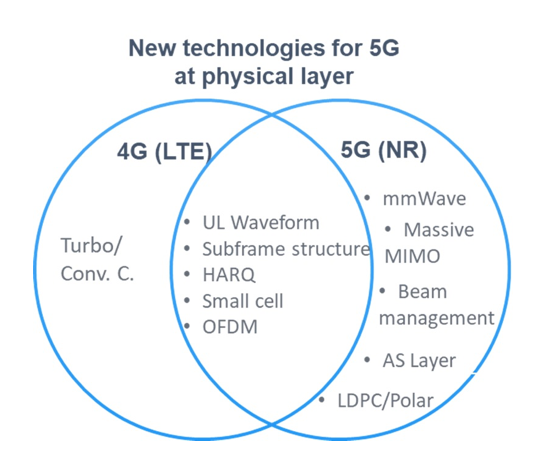 The evolution of mobile communication has never been about simply erasing the previous technology, but rather a gradual process. For example, some 3G algorithms and programming concepts are inherited and adapted in 4G. It took two years from the completion of the 4G standards (2008) to their commercial launch (2010), and another three years to surpass 3G. However, even now, 4G coverage is not yet absolute. We expect a similar evolution for 5G.
5G is never intended to replace 4G, at least not for the time being. In fact, many of the essential techniques are updated versions of 4G. Figure 2 shows some new techniques in the physical layer used for both 4G and 5G, while the latest technologies are only available for 5G. The 4G base station will continue to be used for 5G as the macro base station, and the core 4G infrastructure will remain. Such a 5G network supported by the existing 4G infrastructure is also called Non-Standalone (NSA) 5G, which will be the first to be adopted in the market.
5G is a collection of optimized 4G techniques (both physically and architecturally) and new features resulting from frequency shifts (primarily to two high frequencies, sub-6 GHz or 20-40 GHz) and increased bandwidth. Figure 3 summarizes the relationship between some essential techniques and key features.
The most popular innovations include: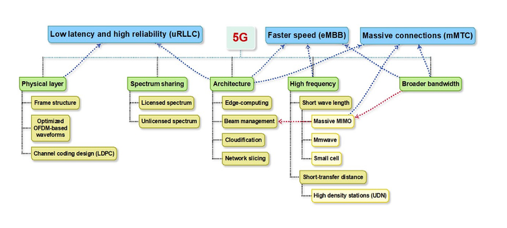
Massive MIMO,
Edge computing and cloudification,
Network slicing
However, IDTechEx Research finds that there is also growing pessimism about the widespread adoption of 5G, coming from many policymakers and telecom companies, including, surprisingly, Huawei, a major contributor to the 5G standard. They argued that 5G will become incredibly expensive for operators to deploy, requiring tens of thousands of new base stations per country and massive investment in upgrading existing infrastructure. Some claim that most consumers wouldn't notice its benefits and that operators would struggle to make a profit. Questions are swirling. Why do we want to deploy 5G when 4G is still not fully deployed? Will there be sufficient reliable 5G coverage, or will it only be available in certain areas, limiting some benefits to specific locations? Is it truly better for IoT, given its power requirements compared to other types of 5G, which may also offer lower data costs due to their cheaper infrastructure? The future of 5G remains uncertain.
With all revolutionary technologies, we can never fully predict what they will bring and how they will change our lives until they already have. Despite all the challenges, 5G standardization has progressed rapidly. 3GPP is expected to approve the first version of all the necessary 5G standards by the end of this year, and the first commercial deployment could arrive very soon. There is no doubt that 5G is here to stay.
The United States and China are the leading countries driving the standard and conducting extensive trials, while Europe is also beginning to engage in the activity. IDTechEx summarizes the latest and most important 5G features and tests in its new report, IoT Low Power Wireless Networks and 5G 2019-2029: Global Forecasts, Technologies, and Applications.
Author: Dr. Luyun Jiang, Technology Analyst, IDTechEx