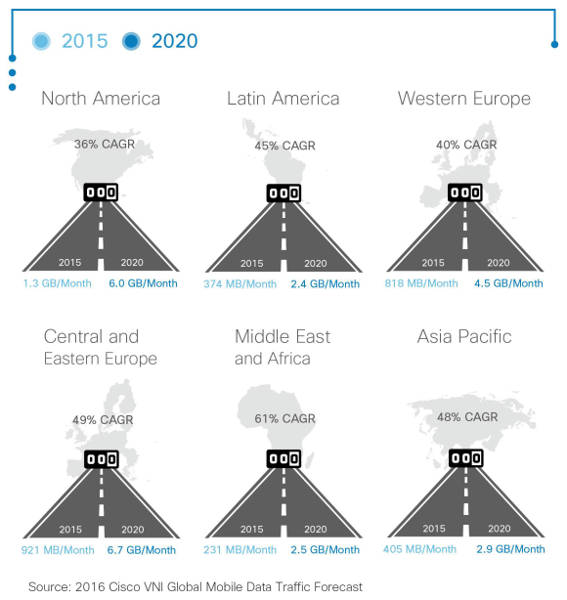
Smartphones and Internet of Things (IoT) connections, along with improved network speeds and increased mobile video consumption, will multiply mobile data traffic sevenfold in the next five years. In Spain, mobile data traffic will increase sevenfold during that period.
 Cisco forecasts that, in 2021:
• Global mobile data traffic will represent 20 percent of total IP traffic (up from 8 percent in 2016). In Spain, mobile data traffic will represent 15 percent of total IP traffic (5 percent in 2016).
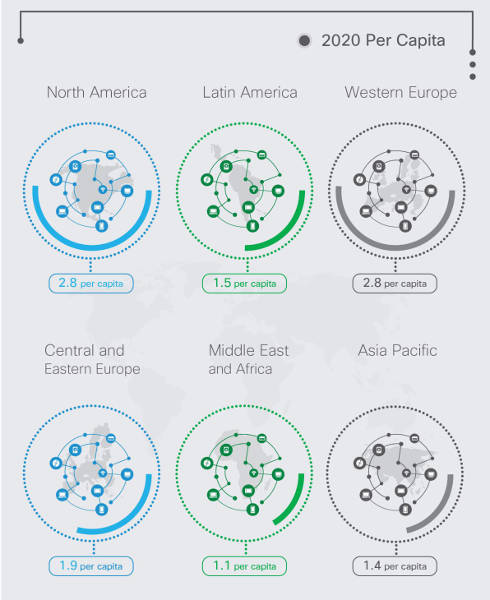
• There will be 1.5 mobile devices per person. Nearly 12 billion connected mobile devices—including machine-to-machine (M2M) modules—for an estimated global population of 7.8 billion (UN), up from 8 billion mobile devices and 1.1 devices per person in 2016. In Spain, there will be 101.4 million connected mobile devices (2 per capita) including M2M modules in 2021.
The average speed of mobile networks will triple, from 6.8 Mbps in 2016 to 20.4 Mbps in 2021. In Spain, the average mobile network speed will reach 27 Mbps in 2021 (12 Mbps in 2016).
M2M connections will account for 29 percent (3.3 billion) of all mobile connections, up from 5 percent (780 million) in 2016. M2M will be the fastest-growing type of mobile connection as a result of the increasing applications of the Internet of Things (IoT) in both enterprise and consumer environments. In Spain, M2M connections will account for 48% (48.3 million) of all connected mobile devices in 2021.
4G networks will support 58% of all mobile connections in 2021 (26% in 2016) and will generate 79% of all mobile data traffic. In Spain, 4G networks will support 64% of all mobile connections in 2021 (37% in 2016) and will generate 95% of all mobile data traffic.
The total number of smartphones (including phablets) will exceed 50 percent of all mobile devices and connections globally (6.2 billion), up from 3.6 billion in 2016. In Spain, the total number of smartphones will reach 45.8 million in 2016 (35.1 million in 2017).
4G and 5G Networks:
The exponential growth of mobile applications and the adoption of mobile connectivity by end users is driving the growth of 4G, which will soon be followed by 5G. Cisco and other industry experts estimate that large-scale 5G infrastructure deployments will begin in 2020. Mobile providers will need the increased speed, lower latency, and dynamic provisioning capabilities expected from 5G networks to meet growing user demand and offer new services in the enterprise and residential segments. Cisco forecasts that 5G will account for 1.5 percent of total global mobile data traffic in 2021, generating 4.7 times more traffic than the average 4G connection and 10.7 times more traffic than the average 3G connection.
Additional Forecasts
1. Growth in Global Mobile Data Traffic
• In 2021, global mobile data traffic will reach 49 Exabytes [1] per month (587 Exabytes annually), representing a 47% year-over-year growth rate between 2016 and 2021. In Spain, mobile data traffic will reach 4.5 Exabytes annually or 378 Petabytes per month in 2021 (47% year-over-year growth rate). The 587 exabytes per year are equivalent to:
122 times more than all global mobile data traffic generated 10 years ago (in 2011)
131 trillion images (such as MMS or Instagram).
2. Growth of Mobile Video
• Mobile video will increase 8.7 times between 2016 and 2021, making it the fastest-growing mobile application category. Mobile video will account for 78 percent of all mobile traffic in 2021. In Spain, mobile video will increase 9 times between 2016 and 2021 and will account for 80 percent of all mobile traffic in 2021 (62 percent in 2016).
• Mobile live video will increase 39-fold between 2016 and 2021, representing 5 percent of all mobile video traffic in 2021.
3. Increase in Virtual Reality (VR) and Augmented Reality (AR)
• Virtual Reality applications are being incorporated into wearables (portable devices) such as headsets/visors, which will grow from 18 million in 2016 to nearly 100 million in 2021 (multiplying fivefold).
• Global VR traffic will increase elevenfold, from 13.3 petabytes per month in 2016 to 140 petabytes per month in 2021.
• AR traffic will increase sevenfold between 2016 and 2021, from 3 petabytes per month in 2016 to 21 petabytes per month in 2021.
4. Wearable devices drive the increase in M2M connections
• Cisco estimates that there will be 929 million wearable devices globally in 2021, almost tripling from the 325 million recorded in 2016. In Spain, there will be 15.7 million wearable devices (5.2 million in 2016), representing a year-on-year growth rate of 25 percent.
• The number of wearable devices with integrated cellular connectivity will reach 69 million in 2021 (11 million in 2016). In Spain, the number of wearable devices with integrated cellular connectivity will be 948,000 in 2021 (139,000 in 2016).
5. Mobile traffic offloaded over WiFi networks
• In 2016, 60 percent of all global mobile data traffic (62 percent in Spain) was offloaded; in 2021, this will increase to 63 percent (71 percent in Spain).
• In 2016, traffic offloaded over WiFi networks monthly (10.7 Exabytes) exceeded monthly mobile/cellular traffic (7.2 Exabytes).
• The total number of public WiFi hotspots globally (including homespots) will increase sixfold between 2016 (94 million) and 2021 (541.6 million). In Spain, the total number of public WiFi hotspots globally (including home hotspots) will increase sixfold between 2016 (2.4 million) and 2021 (13.9 million)
. WiFi traffic from both mobile and WiFi-only devices will account for almost half (49 percent) of all IP traffic globally in 2021 (42 percent in 2016). In Spain, WiFi traffic from both mobile and WiFi-only devices will account for 63 percent of all IP traffic (55 percent in 2016).
6. Growth of mobile data traffic by region (2016-2021)
1. Middle East and Africa: will increase twelvefold (2016: 7.3 Exabytes/year; 2021: 88.4 Exabytes/year)
2. Asia-Pacific: will increase sevenfold (2016: 37.3 Exabytes/year; 2021: 274.2 Exabytes/year).
3. Latin America: will increase sixfold (2016: 5.4 Exabytes/year; 2021: 34.8 Exabytes/year).
4. Central and Eastern Europe: will increase sixfold (2016: 11.1 Exabytes/year; 2021: 63 Exabytes/year).
5. Western Europe: will increase sixfold (2016: 8.8 Exabytes/year; 2021: 50.3 Exabytes/year).
6. North America: will increase fivefold (2016: 16.9 Exabytes/year; 2021: 76.8 Exabytes/year).
According to Doug Webster, Vice President of Marketing for Service Providers at Cisco, “Due to the proliferation of IoT applications, mobile video, and virtual and augmented reality, along with more innovative experiences for businesses and consumers, 5G technology will be key not only for mobility but for networks as a whole. In order to support the greater functionalities that 5G technology enables, networks also require greater programmability and automation capabilities, essential to meet the demands of today and the future.”
Cisco VNI Mobile Report Methodology:
The Cisco VNI Mobile Global Data Traffic Report (2016-2021) is based on independent analyst studies and actual reports of mobile data usage. Cisco's own estimates of mobile application adoption, usage minutes, and transmission speeds are based on this data. Mobile broadband speeds and other factors, such as computing power, are also considered in the Cisco VNI Mobile Report's findings and forecasts. A more detailed description of the methodology is included in the full report.