Through simulations, Fujitsu demonstrated how to harness the power of using HPC resources through a cloud environment to run accurate simulations of complex, large-scale electromagnetic wave problems that could not be solved with conventional approximation algorithms (2).
Fujitsu aims to offer solutions and consulting services related to electromagnetic compatibility testing, leveraging its high-precision electromagnetic wave analysis capabilities as part of its Computing as a Service (CaaS) portfolio by the end of fiscal year 2023 in Japan. The Japanese multinational is further promoting "sustainable manufacturing" to achieve growth through the coexistence of people and the environment as a key focus area under its global business brand, Fujitsu Uvance.
Background
Electromagnetic interference between electronic components and communications equipment presents a constant challenge for manufacturers in a wide range of areas, including electronics, automobiles, and space equipment, and the demand for electromagnetic analysis solutions to determine electromagnetic compatibility is increasing.
Accurate simulations of complex, large-scale electromagnetic wave interference problems require computing power, and users without access to an HPC environment have to perform simulations using conventional approximation algorithms that offer only limited analytical accuracy.
Fujitsu plans to offer its electromagnetic wave analysis solution to address this challenge. The solution, available as a cloud-based application, is based on the FDTD (3) to obtain accurate results and will allow users across a wide range of industries to easily access the multinational's advanced IT technologies.
To verify the effectiveness of its solution as a new cloud service, Fujitsu conducted large-scale electromagnetic wave simulations in the following two areas.
 Summary of verification tests
1. Quantitative assessment of electromagnetic interference problems in the latest X-ray space telescopes (JAXA Space and Astronautics Institute case study)
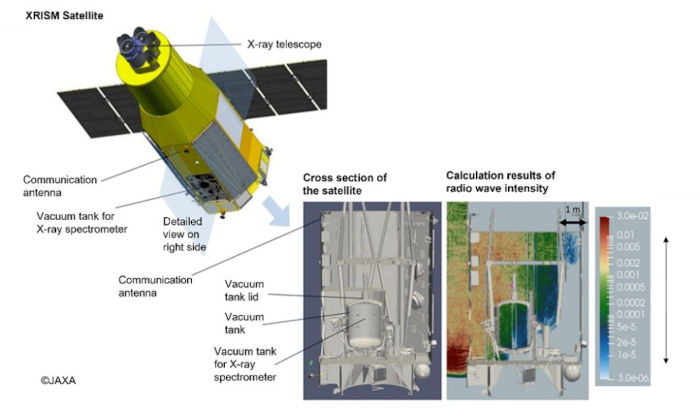
The Japan Aerospace Exploration Agency (JAXA) used Fujitsu's wave analysis solution to conduct large-scale electromagnetic wave simulations that assessed the intensity of radio waves in the X-ray spectrometer (4) of JAXA's XRISM X-ray imaging satellite(5). By using Fujitsu's solution, JAXA was able to generate an experimental environment that simulates observational conditions as in outer space and perform assessments that could not be carried out with traditional computer methods (6).
As a result, JAXA successfully confirmed that the intensity of radio waves in the XRISM X-ray spectrometer is at a level that does not affect the satellite's observation performance, even in orbit.
Simulation details:
- Analysis target: XRISM X-ray spectroscopic imaging satellite.
- Scale of analysis: up to 193.5 billion grid squares -
- Analysis time: 3 hours.
Comment by Masahiro Tsujimoto, Associate Professor at JAXA's Institute of Space and Astronautical Sciences:
"High-frequency simulations utilize CAD models of all satellites, which were difficult to perform using traditional computer methods, but can now be carried out with a single solution thanks to Fujitsu. This represents a significant technical advancement in satellite design. In the XRISM satellite project, the results of this simulation played a crucial role in the quantitative assessment of unverified risks and in confirming the validity of the design."
2. Evaluation of the quality of communication between vehicles and roads using 5G to contribute to safer traffic and the prevention of accidents in urban areas.
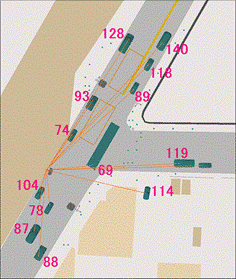
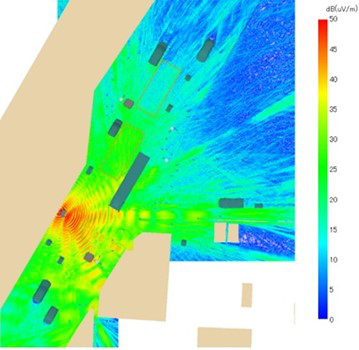 Fujitsu conducted large-scale electromagnetic wave simulations using its wave analysis solution to evaluate the quality of roadside communication (high-speed 5G) between transmitters installed at intersections and receivers installed in vehicles. In the simulations, Fujitsu also observed the effect of obstacles, including surrounding buildings, roadside objects, and other vehicles in urban areas, on communication quality (7).
In addition, Fujitsu directly calculated the intensity and delay dispersion (8) of the radio waves received by the receiving antenna of each vehicle, from the transmitters installed at the intersections and through simulations with the FDTD method to achieve an accurate assessment of the quality of communications.
As a result, the Japanese multinational successfully performed electromagnetic wave simulations by analyzing a model of a large urban area taking into account complex wavelength orders(9) and demonstrated that simulations performed with its wave analysis solution can provide accurate results that incorporate the effect of interference caused by complex obstacles in urban areas.
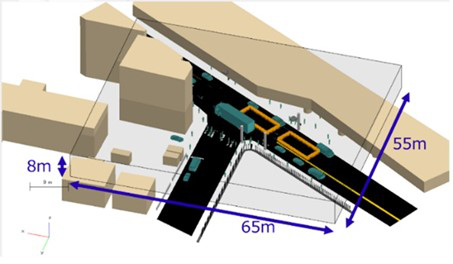 Simulation details:
- Objective of the analysis: City model of the intersection area including a detailed model of the roads and surrounding objects (model of the intersection in front of Musashinakahara Station on the JR Nambu Line in Nakahara-ku, Kawasaki City, Kanagawa Prefecture, Japan).
- Analysis size: 1 trillion grid squares.
- Analysis time: Approximately 3 hours.
Acknowledgments
The analyses mentioned in this press release were carried out within the framework of the "Investigation of an environment for running scientific simulation software on Fugaku," a collaborative research project for a cloud-like usability testing service that utilizes the computing resources of the Fugaku supercomputer, with computing resources provided by the RIKEN Center for Computational Science. (Project #: ra010012).
Notes
[1] Fugaku Supercomputer: A computer installed at RIKEN as the successor to the "K computer". From June 2020 to November 2021, Fugaku ranked first, for four consecutive years, in four of the major high-performance computer rankings. Fugaku was made available for shared use starting March 9, 2021.
[2] Approximation algorithms: A method used to efficiently obtain the best possible solution, in a realistic time, to a problem for which obtaining an exact solution is difficult. However, the approximation is performed under a certain constraint of conditions, and a calculation result close to an exact solution can only be obtained when the constraint of conditions is satisfied. Otherwise, an exact calculation result cannot be obtained.
[3] FDTD Method: "Finite Difference Method in the Time Domain". A method for calculating the behavior of electromagnetic waves using a computer. It is an exact solution of Maxwell's equations, in time and space, by the finite difference method.
[4] X-ray spectrometer: A device that detects electromagnetic waves in the X-ray region by breaking them down into individual wavelengths.
[5] XRISM X-ray Imaging Satellite: X-ray Imaging and Spectroscopy Mission. JAXA's seventh X-ray astronomy satellite project, launched in 2018 in collaboration with NASA and ESA. XRISM is 5 to 6 meters long and has an 8-plane cylindrical shape. It is equipped with an X-ray imager with a wide field of view and an X-ray spectrometer with the best spectroscopic performance in the world, cooled to extremely low temperatures.
[6] The XRISM X-ray spectroscopic imaging satellite, scheduled for launch in fiscal year 2022, is equipped with a wide-field X-ray imager and an X-ray spectrometer cooled to very low temperatures. Since X-ray spectrometers are highly sensitive to even small energy inputs, it is necessary to minimize the effect of noise on the X-ray spectrometers caused by signals other than those from celestial bodies, especially radio waves used for communication with Earth, so as not to affect the performance of celestial body observations. Normally, risks related to electromagnetic interference are verified through testing on satellites before launch, but because X-ray spectrometers cooled to very low temperatures must be kept in a vacuum chamber and cannot be opened on Earth due to atmospheric impacts, the same observational conditions as in outer space cannot be achieved in ground-based experiments, and sufficient verification has not yet been possible. To solve this problem, JAXA used Fujitsu's wave analysis solution to carry out large-scale electromagnetic wave simulations in which the vacuum tank lid was opened based on data modeling of the satellite's complex and detailed structure.
[7] Vehicle-to-vehicle and roadside-to-vehicle communication quality in urban areas is affected not only by the communication distance but also by surrounding buildings, roadside objects, and other vehicles. To achieve stable, high-speed 5G communications, it is important to assess communication quality, as these effects increase with higher communication speeds. Analyzing communication quality has proven difficult so far, as approximation algorithms do not allow for the assessment of the effects of complex buildings, large objects, and other obstacles.
[8] Information diffusion delay: An index that affects the error rate in digital communication. The higher the value, the more likely it is that the communication performance speed will decrease.
[9] Wavelength order: A length close to the wavelength of electromagnetic waves (e.g., at 4.7 GHz, about 6.4 centimeters). If the object's shape has a complexity lower than this length, an approximate solution cannot be used in the electromagnetic wave simulation; instead, it must be solved using an exact solution, such as the FDTD method offered by Fujitsu's analysis solution.