The growth figures are impressive: according to data from the consulting firm IDC [2], the universe of digital data will double every year, reaching 40,000 exabytes in 2020. And this is just the beginning, as more than 50 billion connected devices are expected by 2020, giving rise to the new era of communications known as the Internet of Things (IoT).  Given the vast potential of information behind this enormous volume of data, it is no wonder that "big data" has become one of the main trends in the ICT (Information and Communication Technologies) sector, generating considerable controversy and discussion around how to explore the business opportunities and competitive advantages it represents, as well as the challenges posed by the exponential growth of digital data and its exploitation, at the technological, regulatory, and even legal levels.
Characteristics of Big Data:
“Big data” (whose Spanish translation, though rarely used, would be “grandes datos”) refers to information and communication systems that handle large datasets. The definition established by TechAmerica is [3]: “Big data is a term that refers to large volumes of data that are variable, complex, and moving at high speed; requiring advanced technologies to capture, store, distribute, manage, and analyze the information.” This definition is deliberately subjective: for example, it doesn't specify how large the data volumes have to be (gigabytes, terabytes, petabytes, etc.). Thus, as technology evolves, the amount of data that can be considered “big data” also changes. Furthermore, the size also depends on the sector in question, as a relatively small dataset can still give rise to very complex and varied combinations. For example, the correlation of hundreds of thousands of sensors on an aircraft is “big data,” since although the dataset is not large, each sensor produces measurements at very high speed, and these must be correlated with the others to yield useful information.
“Big data” is often characterized by the well-known four “Vs” [3]:
Volume
refers to the amount of data generated that must be captured, analyzed, and managed to make decisions. The rise of mobile telephony and social networks, along with the growing number of internet-enabled devices (smartphones, tablets, sensors, IP cameras, etc.), generates enormous amounts of data that continue to grow according to Moore's Law.
Velocity
refers to the speed at which data is produced or changed. It is increasingly important, for improving decision-making processes, that data be accessible and analyzed in real time. The increase in velocity is due to the rise in data sources, greater bandwidth in connectivity, and the increased computing power of the devices generating data.
Variety:
The growth of information coming from new data sources, both inside and outside the organization, creates challenges for IT departments. According to several studies, only 15% of current information is structured, meaning it can be easily stored in relational databases or spreadsheets with their traditional rows and columns. In other words, 85% is unstructured (videos, audio, social media, blogs, chat, email, tweets, clicks, sensors, etc.), which poses significant challenges for generating meaning with conventional business intelligence tools.
 Value:
Data quality could be poor or undefined due to inconsistencies, ambiguities, latency, etc. Decisions in big data must be based on reliable, traceable, and justifiable data. Furthermore, it is important to consider the potential for interaction between data produced by different sources, as combinations with unpredictable results can generate very useful information.
Big Data Technology:
Traditional database management systems (DBMS) worked with structured and relational information. Traditional tools were not designed to analyze massive, unstructured datasets from diverse sources, which can reveal hidden patterns, unknown correlations, and so on.
Big data systems represent the natural evolution of these systems, working with more complex information that meets the 4 Vs. Big data programming environments are notable for their power in statistical and graphical analysis. Human decisions will be supported by sophisticated automated simulation algorithms, which will improve the decision-making process, reduce risks, and allow for the detection of valuable insights that would otherwise remain hidden. Through big data, it is possible to test countless "what if" simulation scenarios, considering a wide range of demographic, temporal, geographic, and other data that can adapt to changes in real time.
Clearly, this entails the adoption of new technologies. Thus, the shift from SQL to languages and tools based on MapReduce (originally from Google) [4], such as Hadoop, an open-source programming environment conceived by Yahoo and currently supported by Apache [hadoop.apache.org]. Implementations of MapReduce libraries have been written in various programming languages such as C++, Java, and Python. Furthermore, instead of a single high-performance server, big data utilizes ring-type cluster architectures or similar, with lower-performance standard servers that operate in a distributed manner, aiming to reduce costs and improve availability. When working with distributed data, these technologies do not move the data, which would be very costly and slow. Instead of creating backups, a series of replicas are maintained on different servers. Therefore, instead of processing the data from a central location, the programs are distributed across the different servers and executed in parallel (map), with the results subsequently consolidated (reduce).
Among the leading manufacturers of "big data" applications are: EMC, IBM, Oracle, SAP, Teradata, etc. Specifically, Oracle stands out for its ability to offer complete solutions: storage, servers, virtual machines, operating systems, databases, middleware, applications, etc.; which can be installed in the client's own data centers, in a public or private cloud, or following a hybrid model.
Benefits of Big Data for Telecommunications Operators
The sectors currently benefiting most from big data are information technology and electronics, finance, insurance, and public administration. Large companies and organizations, especially Web 2.0 companies (Amazon, Google, Facebook, LinkedIn, Twitter, etc.), were the first to leverage big data to reduce costs, improve productivity, enhance customer service, develop new products and services, etc. [1]; however, the technology is applicable to virtually any industry and is becoming increasingly affordable for small and medium-sized enterprises (SMEs). Alongside the growth of big data, there has been a boom in the predictive analytics market. Companies understand the opportunity to use big data to increase their knowledge of their businesses, competitors, and customers. Companies can use predictive analytics models to reduce risks, make better decisions, and provide more personalized customer experiences [5].
For telecommunications operators, big data will mean new investments, as it will increase network traffic and the demand for cloud systems. New knowledge, hardware platforms, software tools, and operational and commercial processes will also be necessary. However, big data is also a powerful technology that they can leverage to gain market share, improve customer perception, increase revenue and profitability, and optimize operations. Thus, big data presents significant challenges for operators, but also a great opportunity.
Operators can obtain valuable information about their customers, from location to even personal interests, but for various reasons, they haven't been able to fully extract the strategic value from this data. The data is structured (customer profile, service requests, pricing, technical incidents, etc.), unstructured (documents, videos, images, web content, location, presence, DPI, SIP/Diameter/SS7 signaling, logs, contact center recordings, etc.), and partially structured (customer profiles enriched with CDRs or call data records and external information such as blogs, forums, social media, etc.). Through DPI (Deep Packet Inspection), they can determine how much bandwidth the user consumes, when they connect, which websites they visit, which applications they use, and so on. They could even obtain additional real-time information about the customer's tastes and interests, although they are currently limited by legal issues regarding privacy and confidentiality. All this information acquired from diverse sources must be organized and then analyzed to support decision-making.
The consultancy firm Ovum confirms in a recent report [6] the increasingly important role of big data in the telecom sector. This technology allows operators, for example, to predict and reduce customer churn, boost customer loyalty through special offers and/or bundled products, and provide personalized services. However, this technology still needs to be implemented more widely if operators want to monetize their customer data. In fact, according to Ovum, one of the main challenges for operators is to modernize their traditional IT infrastructure and become more flexible, emulating the model of their OTT competitors [7], who can offer new services quickly and without significant investment.
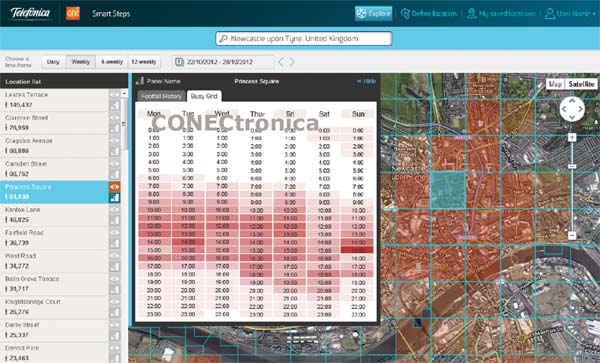
The Spanish operator Telefónica is always one of the most forward-thinking companies, a fact that is being demonstrated once again with its approach to big data. In October 2012, Telefónica Digital created a new global business unit, Telefónica Dynamic Insights, to develop commercial offers for private companies and public organizations, based on the Telefónica Group's own big data.
The first product to be launched, specifically in the UK, is “Smart Steps,” which uses aggregated and fully anonymized mobile network data. This data will allow private companies and public bodies to measure, compare, and understand which factors influence the number of people visiting a particular location at any given time. In this way, businesses can offer targeted promotions tailored to each of their stores and determine the best locations and most appropriate formats for opening new stores. “Smart Steps” will also help local councils assess the impact of various initiatives on foot traffic, such as the public response to the availability of free parking in different parts of the city or the number of people attending fairs and markets. Telefónica Dynamic Insights is also developing analytical products for companies in a wide range of sectors, including fraud protection and smart city technology, including traffic management.
Author:
Author: Ramón Jesús Millán Tejedor
Literature
[1] “Big data: The next frontier for innovation, competition and productivity.” McKinsey Global Institute, McKinsey&Company, May 2011.
http://www.mckinsey.com/insights/business_technology/big_data_the_next_frontier_for_innovation
[2] "For Big Data Analytics There's No Such Thing as Too Big. The Compelling Economics and Technology of Big Data Computing." Forsyth Communications, March 2012.
http://www.cisco.com/en/US/solutions/ns340/ns517/ns224/big_data_wp.pdf
[3] "Demystifying Big Data. A practical guide to transforming the business of Government." TechAmerica Foundation
http://breakinggov.com/documents/demystifying-big-data-a-practical-guide-to-transforming-the-bus/
[4] “MapReduce: Simplified Data Processing on Large Clusters” Jeffrey Dean and Sanjay Ghemawat, Communications of the ACM - 50th anniversary issue 1958 – 2008, Volume 51 Issue 1, January 2008.
http://static.googleusercontent.com/external_content/untrusted_dlcp/research.google.com/en//archive/mapreduce-osdi04.pdf
[5] “The Forrester Wave: Big Data Predictive Analytics Solutions.” Mike Gualtieri, Forrester, January 2013.
http://www.forrester.com/The+Forrester+Wave+Big+Data+Predictive+Analytics+Solutions+Q1+2013/fulltext/-/E-RES85601
[6] “Big Data Analytics and the Telco: How telcos can monetize customer data.” Clare McCarthy and Shagun Bali, Ovum, May 2013.
http://ovum.com/research/big-data-analytics-and-the-telco/
[7] “Over-The-Top vs Operators: Competition Intensifies.” Ramón Millán, Dintel - Senior Management No. III-1, Dintel, 2012.
http://www.ramonmillan.com/documentos/competenciaoperadoresvsott.pdf