But is fiber optic telefeeding a viable option right now? Researchers from Semiconductor Group III-V from the Institute of Solar Energy of the Polytechnic University of Madrid and from Displays and Photonic Applications Group of the Carlos III University They have analyzed it and published a review article on photovoltaic remote power supply via fiber optics (“Beaming power: Photovoltaic laser power converters for power-by-light”) in the prestigious journal Joule (impact factor 41.248).
The article is part of the collaboration between both groups, sponsored by the Community of Madrid within the Call for Synergistic Projects in New and Emerging Scientific Areas through the project “Photovoltaic Feedback by Optical Fiber for Measurement and Control in Extreme Environments, TEFLON-CM“ (http://www.teflon-cm.es). Airbus, Red Eléctrica Española and Tecnalia Ventures are participating as partner companies in the TEFLON-CM project.
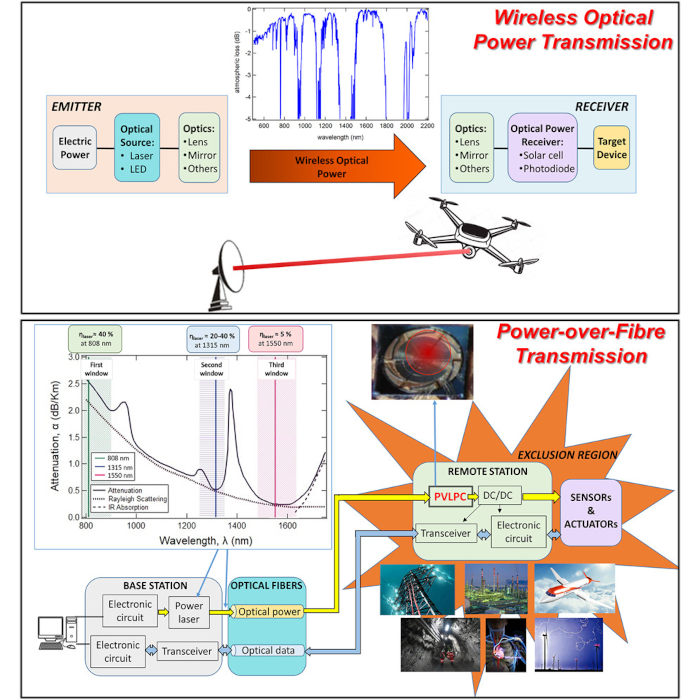
“A fiber optic photovoltaic remote power system consists of a monochromatic light source (usually a laser), a transmission medium (the optical fiber), and a photovoltaic converter,” the researchers explain. “In these systems, the light source converts electrical power (taken from a non-conflict area) into light power, which is sent through the optical fiber to the photovoltaic converter. Both the optical fiber and the converter are located within an exclusion zone. Therefore, the energy is transported in the form of light, and the photovoltaic converter transforms the light power of the laser coupled to the fiber into electricity right in the area of use.”
Furthermore, these systems also allow data transmission via fiber optic cable between the remote unit and the base station. Other options exist for powering remote systems. Using batteries is the simplest. However, their replacement must be done periodically and is costly (labor, price of the new battery, assembly time, etc.). Moreover, replacing a battery within an exclusion zone could be dangerous, expensive, or even impossible. Therefore, some attempts have been made to use microwave energy, but this has proven to be a costly option, and its impact on health is unclear.
For researchers, compared to these options, using fiber optic remote power systems offers numerous advantages, including: electrical isolation between system components on either side of the fiber, immunity to electromagnetic noise, the lighter weight of fiber optic cable compared to copper cable, the elimination of batteries and their maintenance, and flexibility in sensor placement, as a nearby power outlet is not required.
“Photovoltaic remote power supply systems using fiber optics have a multitude of applications in the field of remote measurement and control of processes in extreme environments such as high-voltage lines, gas plants, chemical plants, petrochemical plants, mining, aircraft fuel depots, satellites, nuclear power plants, firefighting, biomedicine, etc.,” conclude the researchers, who remind us that photovoltaic converters for laser light are the devices with the highest photovoltaic efficiency, reaching efficiencies above 60%.
Reference: Carlos Algora, Iván García, Marina Delgado, Rafael Peña, Carmen Vázquez, Manuel Hinojosa, Ignacio Rey-Stolle, Beaming power: Photovoltaic laser power converters for power-by-light, Joule, Volume 6, Issue 2, 2022, Pages 340-368, ISSN 2542-4351, https://doi.org/10.1016/j.joule.2021.11.014.
(https://www.sciencedirect.com/science/article/pii/S2542435121005407)
More information