
In the world's natural ecosystems, complex problems are solved by each organism based on the interaction of adjacent organisms and by providing support to others. By bringing this same concept to the world of IoT, we can begin to bridge the gap between the ecosystems of software development organizations (SDOs) and application developers.
The advent of the Internet of Things (IoT) and associated machine-to-machine (M2M) communication technologies offers an unprecedented opportunity to transform how we live, work, and play. From public healthcare to the automotive industry, there is hardly any aspect of life that will not be altered by the IoT. According to the "2015 Cisco® Visual Networking Index™ (VNI) Forecast," the number of personal devices connected via IP and online M2M connections will grow to more than 24 billion by 2019. Initially, it appears that there are several ways in which this can be achieved. Defining standards that can create a "plug-and-play" protocol to solve interoperability problems, or waiting for a powerful company to develop its own standard and for everyone else to follow suit.
Looking at the path of standardization, there's a disconnect between the communities that produce the specifications and the communities that use them. This divide lies between the standards organizations (SDOs) that define how networks operate and deliver services, and the application developers who create applications and implementations for use across those networks. In other words, there's a gap between the two ecosystems. Traditional standards organizations don't provide adequate support to the developer communities.
Much has changed in the wireless industry since the inception of SDOs such as 3GPP, ITU, and OMA. In the early days of wireless communications and the internet, because the fundamental technology was still being invented, it was imperative for the growth of new markets that standards be established before the large-scale deployment of the technology and related services. The process for developing these standards followed a traditional "waterfall" approach, which helped harmonize (sometimes competing) pre-standard technical solutions into a single, standardized solution to meet market needs.
However, the future of IoT will likely be driven by agile technology development and platform prototyping, often through open-source, collaborative projects, which will have an advantage in writing "code first." From this perspective, the key to IoT success lies with developers and their communities. How can SDOs transform themselves to extend their influence and provide added value to the IoT industry in this rapidly changing world? The IEEE defines standards as "...documents that establish specifications and procedures designed to ensure the reliability of materials, products, methods, and/or service personnel used every day. Standards address a range of issues, including, but not limited to, various protocols that help ensure product functionality and compatibility, facilitate interoperability, and support consumer safety and public health." This definition was created within a different industry paradigm. However, it is still valid to say that only through the use of standards can the requirements for interconnectivity and interoperability of services and products be guaranteed. However, a standard does not provide interoperability on its own. It is the conversion of the standard into source code that ensures interoperability between platforms and devices.
Standardization still provides benefits to the IoT value chain in several ways. First, standards organizations and the multitude of cooperative agreements among them help the industry avoid overlapping work and, therefore, fragmentation within the industry. Second, standards organizations include players from across the IoT value chain, enabling a comprehensive view of the entire system architecture. Without this, some proprietary parts of solutions from multiple vendors are unlikely to work together. Third, legacy standards, such as device management, must continue to evolve as networks evolve, preserving interoperability and backward compatibility. Finally, standards organizations provide a legal and economic framework that ensures equitable practices in licensing, participation rights, publication processes, and dispute resolution. Clearly, standards organizations play a critical role in defining the complex system of M2M networks and services worldwide. As these wireless networks evolve toward an all-IP and cloud-based infrastructure, application developers have emerged as a new community of consumers of these standards. In the highly competitive world of application developers, where open-source software (OSS) is relied upon to produce the more than 1.3 million applications available on iOS alone, The procedures and outputs associated with a traditional standard may be seen as archaic and slow by the market.
The working styles of standards communities and developer communities are very different. In a standards community, the work typically focuses on defining a solution to a relatively complex problem in a way that creates a permanent solution, helping to establish integrity and interoperability at the network or service layer. Once the work is complete, standards development organizations (SDOs) typically produce a specification, often in PDF format, which is published for the wider industry to adopt and adhere to when developing their products or services.
Application developers are often reluctant to use these standards due to a lack of tools that facilitate adoption. Developers work with socially connected tools that allow them to co-opt, adapt, and publish their work and the work of others. Developers access forums that allow them to ask questions, obtain references to tools or code, and collaborate. All of this is far removed from what traditional SDOs provide. The vitality of the entire IoT ecosystem demands that the standards development community and the application development community bridge the gap in working practices and outcomes to ensure efficiency and interoperability across the IoT value chain.
Therefore, the question remains: how can Standards Development Organizations (SDOs) adapt to better enable application developers to leverage the standards they produce?
A growing number of individuals within the SDO community believe that standards development processes and the output of standards bodies can and should evolve to meet the needs of the IoT ecosystem, including application developers. Recent initiatives from standards organizations, such as the Open Mobile Alliance (OMA), provide tools to address this gap. 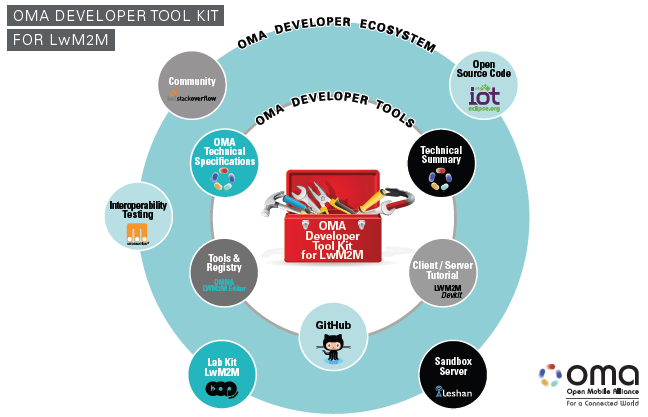 Specifically, the OMA Lightweight M2M Developer aims to provide IoT developers with the tools they need to create innovative services and applications supported by the benefits of a standard. These tools are the result of re-engineering the interface between developers and standards organizations, and include a client emulator, an editor for creating resource objects and models, registry objects and resources, a GitHub code and specifications repository, a bug tracking system, a practice kit of examples on how to use the standards, a sandbox server for test implementations, a user community, and a list of ongoing development projects based on the standards.
https://github.com/OpenMobileAlliance/OMA-LwM2M-Public-Review/wiki
As the IoT value chain continues to evolve toward all-IP networks and a business model that includes the application developer community, standards organizations must also evolve to include them. To do this, standards organizations must provide the application developer community with tools that enable them to adopt the specifications they produce. An IoT ecosystem that incorporates the innovation and creativity common among developers, with the guarantees and interoperability inherent in standards development, offers benefits to the entire value chain. The IoT standards organizations that thrive are those that embrace and address the needs of the developer community.
About Joaquín Prado:
Joaquín Prado is the Technical Programs Director at the Open Mobile Alliance. Before joining the OMA, Joaquín worked for Vodafone UK, where he planned, defined, developed, and implemented new products and services. At the OMA, Joaquín is responsible for formalizing a series of program improvements across the organization. These programs range from reducing the operating costs of the OMA Work Program to incorporating new tools and technologies, such as GitHub, XML validation tools, and more. Joaquín is also responsible for preparing and running the OMA TestFests. For more information, please visit the OMA website: www.openmobilealliance.org.
By Joaquin Prado, Director of Technical Programs, Open Mobile Alliance
[1] http://www.cisco.com/c/en/us/solutions/service-provider/visual-networking-index-vni/index.html
[2] What are Standards? Why are They Important? By Admin in Inside the IEEE-SA, Standards at Work 03/10/2011 http://standardsinsight.com/ieee_company_detail/what-are-standards-why-are-they-important
[3] http://www.statista.com/statistics/263795/number-of-available-apps-in-the-apple-app-store/