The main categories of quantum computing hardware are superconducting, trapped-ion, neutral-atom, photonic, silicon-spin, diamond, and topological. While their specific designs can be incredibly different, much of the fundamental scheme remains the same. Furthermore, optics and photonics play a critical role in many core functions across the various hardware approaches. These include readout, cooling and control, modular connectivity, and data center integration.
Photon and image detectors for reading systems
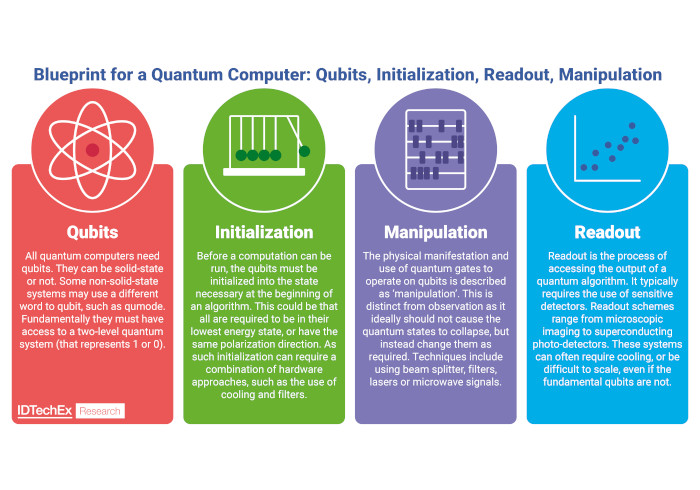
Many methods for reading the solution to a problem solved with a quantum computer use photon detectors or images.
Ironically, within photonic quantum computing itself, single-photon detection is often so highly sensitive that superconducting nanowires are used to achieve it. Consequently, efforts are underway to integrate superconducting nanowire single-photon detectors (SNSPDs) into photonic integrated circuits (PICs). In fact, one of the leaders in photonic quantum computing, PsiQuantum, has revealed that its roadmap includes research into higher-temperature SNSPDs based on manufacturable metals. Ultimately, this represents a broader opportunity to achieve more accurate single-photon detectors for readout purposes in photonic quantum computing, reducing the current trade-offs in cooling power and space for this subsector. These innovations could prove crucial in unlocking the value proposition of the fault-tolerant, large-scale photonic quantum computing subsector, for which its "hot qubits" aim to offer reduced infrastructure complexity compared to their superconducting competitors.
On the other hand, the ease of using established imaging and microscopy methods for readout is a signature advantage of modalities such as diamond, neutral atom, and trapped-ion platforms. For example, Hamamatsu has a range of commercially available photomultiplier tubes (PMTs) and electron-multiplier charged-pair devices (EM-CCDs) for trapped-ion and neutral atom communities, respectively. Meanwhile, the diamond platform pursued by players like Quantum Brilliance XeedQ could utilize even simpler complementary metal-oxide-semiconductor (CMOS) cameras. The ability of these modalities to use established imaging methods for readout could once again prove essential in providing a scalability advantage over their competitors. This is especially true because, for some other modalities, the "wiring challenge" associated with readout increases with the number of qubits, while imaging an entire set of qubits at once is much more efficient.
Laser control and cooling
Did you know that lasers are also an alternative to cryogenics for cooling qubits? While for many, lasers are high-powered beams associated with heat, ignition, cutting, or communications, in the world of quantum computing they are best known for their ability to reduce atoms to very low energy states.
Laser cooling methods vary depending on the approach to quantum computing and the preferences of the companies involved, but ultimately they trap or pinch atoms or ions using multiple lasers firing equally in opposite directions. One of the main advantages of this approach is that it can be achieved using readily available components and can be operated at room temperature. Overall, laser cooling is considered much more energy-, cost-, and resource-efficient than the cryostats required for quantum supercomputing.
Lasers within quantum computers also serve as sources for qubit control and manipulation, as well as for cooling. In this respect, however, there are some indications in the industry that the efficiency of electrical and digital control could be superior in terms of system fidelity (low errors) and scalability. One example is the British company Oxford Ionics, a pioneer in an electronic method for controlling qubits in a trapped-ion system. This strategy, along with others advocating for digital readout, such as SEEQC, may reinforce the fact that, although the use of photonics and optics offers advantages in many cases, the desire persists to pack as many quantum computer components as possible into packages that can be manufactured in existing semiconductor foundries.
Modular connections and integration in data centers
As quantum computer developers continue to focus on scalability, calls have intensified for building repeatable, modular systems that can be interconnected. The reasons for this approach are manifold. To some extent, it echoes how scalability has been successfully achieved with classical computing, and there is also some evidence that it aligns with cutting-edge approaches to error correction.
However, the challenge of the modular approach is that creating satisfactory connections between systems is not trivial. Maintaining entanglement between neighboring qubits on a single chip is already quite difficult, let alone between sets of them distributed across multiple systems (whether racks or cryostats).
However, once again, photonics offers an answer. NuQuantum has developed a quantum network unit (QNU) that uses photonics to distribute entanglement across multiple processors. It has also just announced a quantum photonic interface (QPI), a technology that ultimately creates an interface between matter and light, qubits and photons. Prototype versions of this QPU have already been integrated and tested in Infleqtion's trapped-atom vacuum system.
Market Outlook
In general, beyond the competition between companies and qubit models—or the focus on the race to win the quantum field—there is an underlying opportunity across all areas of optics and photonics. This includes the readout, cooling, control, and connectivity needs present in almost every approach being pursued today.
But even beyond the individual designs of each company's quantum computers, there is a fundamental need for quantum computers to be integrated into existing networks of data centers, classical computers, and communications networks. Photons are already the preferred data transmission medium worldwide, and for quantum computers to be commercially successful, they cannot do without some form of photonics.
The quantum computing market is poised to exponentially accelerate drug discovery, battery chemistry development, multivariable logistics, vehicle autonomy, precise asset pricing, and much more. Based on extensive primary and secondary research, including interviews with companies and attendance at numerous conferences, this report provides an in-depth assessment of competing quantum computing technologies: superconducting, silicon spin, photonic, trapped-ion, neutral-atom, topological, diamond-defect, and annealed. IDTechEx also presents independent “Quantum Commercial Readiness” scores to evaluate how the quantum computing industry is progressing compared to the evolution of the classical computing industry that preceded it. The total addressable market for quantum computing translates into hardware sales over time, taking into account the advancement of capabilities and the cloud access business model. The quantum computing market is projected to exceed $10 billion by 2045, with a CAGR of 30%.
Author: Dr. Tess Skyrme, Principal Technology Analyst at IDTechEx