The new NIST method could increase the capacity of the 5G wireless network and reduce costs.
5G systems will avoid the saturation of conventional wireless channels by using higher millimeter-wave frequency bands. Transmissions at these frequencies lose a lot of energy along the way, weakening the received signal. One solution is "smart" antennas that can form unusually narrow beams—the area in space where signals are transmitted or received—and quickly direct them in different directions.
Antenna beamwidth affects the design and performance of wireless systems. A new method based on NIST measurements allows system designers and engineers to evaluate the most suitable antenna beamwidths for real-world environments.
“Our new method could reduce costs by enabling greater success with the initial network design, eliminating much of the trial and error currently required,” says NIST engineer Kate Remley. “The method would also encourage the use of new base stations that transmit to multiple users simultaneously or in rapid succession without one antenna beam interfering with another. This, in turn, would increase network capacity and reduce costs with greater reliability.”
This is the first detailed, measurement-based study of how antenna beam width and orientation interact with the environment to affect millimeter-wave signal transmission. In the technique, NIST measurements covering a wide range of antenna beam angles are converted into an omnidirectional antenna pattern that covers all angles equally. The omnidirectional pattern can then be segmented into narrower and narrower beam widths. Users can evaluate and model how the antenna beam characteristics are expected to perform on specific types of wireless channels.
An engineer could use the method to select the antenna best suited to a specific application. For example, the engineer might choose a beamwidth narrow enough to avoid reflections from certain surfaces or to allow multiple antennas to coexist in a given environment without interference.
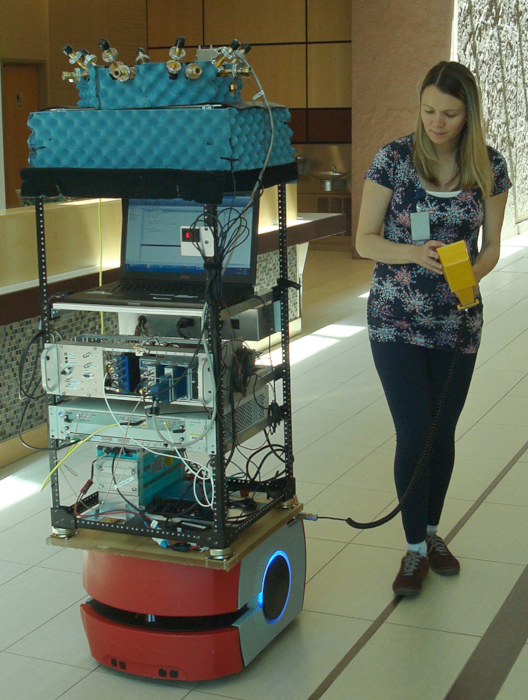
To develop the new method, the NIST team collected experimental data in a hallway and lobby of a NIST research building, using a special robot equipped with a custom channel probe and other equipment. A channel probe collects data that captures the reflections, diffractions, and scattering of the signal that occur between a transmitter and a receiver. Many of these measurements can be used to create a statistical representation of the radio channel to support reliable system design and standardization.
The results of the NIST study confirm that narrow beams can significantly reduce signal interference and latency, and that optimized beam orientation reduces power loss during transmissions. For example, the time interval during which signal reflections arrive (a metric called RMS propagation delay) was dramatically reduced from 15 nanoseconds (ns) to approximately 1.4 ns as the antenna beamwidth was narrowed from omnidirectional (360 degrees) to a narrow 3-degree beamwidth, called a pencil beam.
Future research will include scaling the method to different environments and analyzing other wireless channel characteristics.