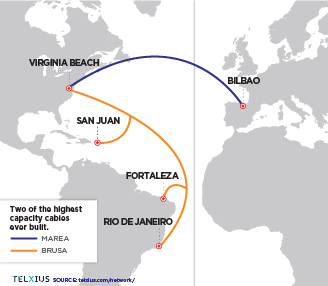
Equinix's global IBX data centers can extend the backhaul capacity of a submarine cable system directly to a high-density data center. This new architecture significantly simplifies network design and provides businesses with easy access to a dense and comprehensive ecosystem of networks, clouds, and IT service providers. Leveraging the capabilities of Equinix Cloud Exchange Fabric™ (ECX Fabric™), the company's interconnection service, Equinix customers will have direct access to MAREA and BRUSA cable systems through a simple cross-connect from any IBX data center.
“At Equinix, we want to help submarine cable operators offer the best service to businesses. For this reason, we are collaborating on new cable projects by developing best-in-class docking station architectures—centers that will connect systems like MAREA directly to our Equinix International Business Exchange (IBX®) data center. This way, any company that relies on a submarine cable tethered to one of our data centers gains instant, low-latency access to the Equinix Platform ecosystems,” stated Ignacio Velilla, Director of Equinix Itconic in Spain.
“This new cable landing station design effectively connects the data center and different types of submarine communications, opening the door to faster bandwidth growth for our customers. This state-of-the-art architecture leverages the capacity of BRUSA and MAREA, two of the highest-capacity cables ever built, and has been developed to meet the needs of businesses in terms of both capacity and efficiency,” says Rafael Arranz, Director of Operations at Telxius Cable Business
Key Highlights
• Equinix is collaborating with leading network and cloud service providers to develop key innovations in the design of new submarine cables that leverage the full capacity of interconnection and next-generation data centers. MAREA and BRUSA will offer connectivity technologies that will enable the development of high-value cloud services for businesses, including solutions for content distribution to markets in Southern Europe and Latin America. This new submarine cable landing station architecture has been developed to meet the speed, efficiency, and open systems design needs of major cloud service providers.
• MAREA, deployed by Telxius in collaboration with Facebook and Microsoft, is the highest-capacity submarine cable system ever built in the Atlantic: eight fiber pairs spanning 6,400 kilometers between Virginia Beach and Sopelana (near Bilbao). Telxius is the company responsible for managing the MAREA construction process and is providing colocation, security, and IP services for this cable. To successfully complete the project, Telxius has partnered with Equinix to develop and deploy the cable landing station architecture at the Equinix DC2 IBX (Washington, D.C.).
Telxius is also building BRUSA, a new submarine cable over 10,100 kilometers long connecting the Brazilian cities of Rio de Janeiro and Fortaleza with San Juan (Puerto Rico) and Virginia Beach (United States). BRUSA, which will be available by mid-2018, will consist of eight fiber pairs supporting ultra-fast transmission capacity and increasing end-to-end connectivity and broadband service availability. In this way, BRUSA will offer one of the lowest latency communication routes between two of the region's largest economies, the United States and Brazil.
Telxius has points of presence (POPs) in more than 20 Equinix IBX data centers worldwide, including the DC2 and DC6 centers in Washington, D.C.; MI1 and MI2 in Miami; SP1, SP2, SP3 and SP4 in Sao Paulo; and RJ1 and RJ2 in Rio de Janeiro, infrastructures where the MAREA and BRUSA cable systems terminate.