The OM5 – WBMMF fiber is characterized by a minimum effective bandwidth at 850 nm of 4700 MHz*km and a minimum effective bandwidth at 953 nm of 2470 MHz*km, a maximum chromatic dispersion at 840 nm of 103 (Ips/nm*km) and a maximum chromatic dispersion at 953 nm of 61.7 (Ips/nm*km), and a maximum attenuation (according to 568.3-D at 953 nm) of 2.3 dB/Km.
The Cofitel Group announces that the TIA (Telecommunications Industry Association) subcommittee on optical fibers and cables TR-42.12 approved the ANSI/TIA 492AAE standard last October, which sets the specifications for WBMMF multimode fiber.
This type of multimode fiber for broadband multiplexing will now be called OM5, and the corresponding European IEC standard is expected to be published in the first half of 2017.
Given the importance of this type of fiber in data center (DC) installations and similar facilities, the Cofitel Group is already working to adapt to the new standard, ensure compatibility with existing fibers such as OM3 and OM4, and thus meet customer needs.
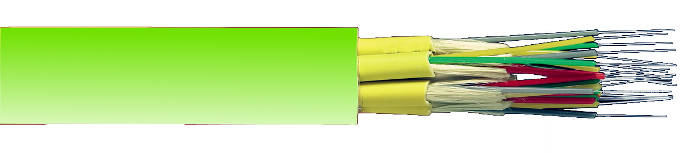
Among other things, the standard recommends the use of lime green jackets for cables made with OM5 fiber, instead of the aqua color used for OM3 and OM4.
Advantages of OM5 Fiber:
WBMMF technology is designed to multiplex up to four wavelengths over a single 50/125 MHz multimode fiber, thus replacing current WDM (Wave Division Multiplexing) methods that use OM3 and OM4 fibers with 12-fiber MPO connectors at each end.
By using the newly defined OM5 fiber, with connectivity compatible with 50/125 MHz multimode types, a system consisting of a pair of these fibers equipped with LC connectors can quadruple the transmission capacity of multimode fibers and support up to 100 Gbps per fiber, for distances of up to 100 meters.
The advantages are therefore evident in structured cabling applications, such as servers, connections between cabinets, and data centers, where traffic is more important than distance, as it eliminates the need for single-mode equipment.