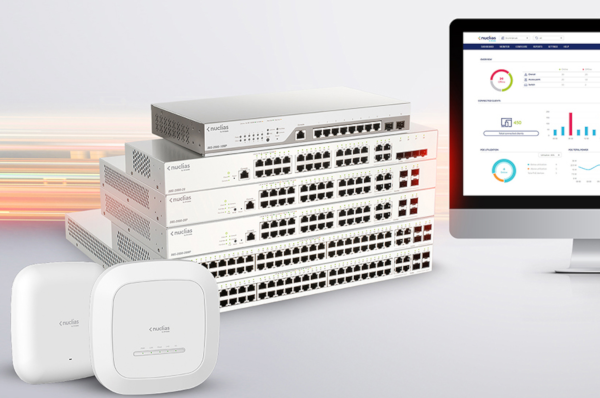
Key features of D-Link Nuclias:
- Intuitive web or app interface for unified cloud management of computer networks in environments with multiple switches and Wi-Fi access points.
- Multi-site architecture for managing multiple companies or different networks from the same cloud account.
- Zero Touch Provisioning: access points and switches are added plug-and-play to the Nuclias platform account for centralized cloud management.
- Remote firmware updates and configuration uploads.
- Traffic data analysis to optimize network management.
- Intelligent event and change log tracking with alert creation
for incident notifications.
- Unified access point management with radio frequency optimization.
- Secure access via 802.1x authentication, RADIUS server, and a Captive Portal
with branding customization for guest internet access.
- Creation of user accounts with different levels of network administration privileges.
- Intuitive VLAN configuration for advanced segmentation.
- Social Login to provide Wi-Fi network access via Facebook or Google.
The first Nuclias-compatible solution is the D-Link DBA-1210P Cloud Managed Access Point. This is a next-generation WiFi antenna with AC Wave 2, dual-band 2.4/5GHz, and a speed of 1300 Mbps. It supports Multi-User MIMO for simultaneous data transmission to multiple devices instead of the sequential standard, making it ideal for high-density user environments. Its PoE (Power over Ethernet) compatibility, allowing it to receive power through the same LAN data cable, increases its installation flexibility.
Antonio Navarro, Country Manager of D-Link Iberia, comments: “D-Link Nuclias has represented a huge R&D challenge for the company, but it's the answer we wanted to give to the growing needs of many of our customers, who are IT network integration and management companies. Thanks to this new cloud-based network management platform, they will be able to deploy and manage multiple infrastructures of switches and access points with enormous agility in responding to potential incidents, greater efficiency in daily monitoring tasks, and considerable savings in installation costs or on-site technician deployments.”