
 There isn't just one field of study for nanotechnologies: we can find references in biology, physics, and chemistry. As for applications, they are found in the energy sector—fuel cells and photovoltaic solar technology—, in environmental engineering—filtration systems for water treatment—, in ICT—new memory and processor architectures—, as well as in the medical sector—implants and prostheses—, textiles, and so on. The word nanotechnology is like an umbrella term encompassing a wide variety of studies on materials and manufacturing techniques, all sharing one thing in common: they work with structures with dimensions below 100 nanometers.
Nanotechnologies exploit the special properties of nanometric structures. At this scale, many materials behave completely differently than they do at the macrometric scale; for example, some opaque substances become transparent (copper), inert materials become good catalysts (platinum), stable materials become flammable (aluminum), some solids become liquids at room temperature (gold), and certain insulators act as conductors (silicon). Another very important aspect of the nanoscale is that the smaller the nanoparticle, the greater its relative surface area compared to its volume.
The nanoscale's conquest of industry has already begun. Just as in ICT, basic physics research is being accompanied by the development and launch of the first products. While the use of nanostructures in chip manufacturing and hard drive development is already commonplace, there are other important branches of industry, such as chemistry, pharmaceuticals, the automotive industry, and optics, where future competitiveness cannot be separated from the comprehensive exploration of the nanocosm.


 Observing Nature:
In Asia, the lotus plant is considered a sacred symbol of purity. Liquids form beads on its surface that slide off, and dust never accumulates on its leaves (Figure 1). The “secret” behind this phenomenon: Nanoparticles! Water is repelled by microscopic papillae. In nanotechnology, this concept can be translated into self-cleaning ceramic surfaces. Materials coated with nanoparticles possess special properties; when applied, for example, to the surface of glass, it becomes scratch-resistant, giving it excellent characteristics for optical applications. Such lenses can be cleaned even with a metal scouring pad without leaving a mark. At the same time, the coating particles are so small that light passes through perfectly, without diffraction or refraction problems.
 Practical Application:
In nanosealing, different types of particles are applied. Some form a solid bond with the surface, while others impart the desired characteristics. These particles are intelligently arranged during application: the bonding components adhere to the surface to be coated, while the non-stick components remain above this layer (Figure 2). This self-organizing process produces an ultrathin, mirror-like layer that, when adhered to the surface to be protected, provides extreme durability. This type of coating is used by Rittal on the condenser surface of its control cabinet cooling units.
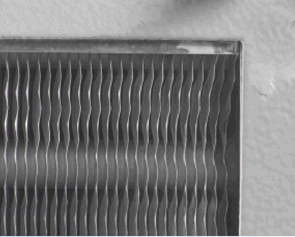
Applications: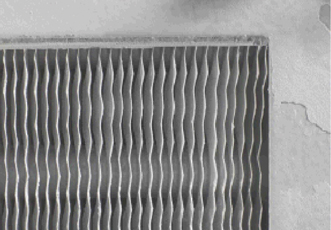 The condenser of air conditioning units—the part of the circuit where the heat exchange takes place between the unit's heat intake and its release to the outside—is coated with a nanometric layer of special paint. The ceramic nanoparticle compound covers the condenser fins with a dust-repellent surface. At the same time, the surface pores are permanently sealed, preventing contamination from adhering and preserving the surface properties (Figure 3). The nanoprotected surfaces are also highly resistant to abrasion.
The main advantage of this lies in the reduction of air conditioning equipment maintenance costs. Since cleaning is not required as frequently, preventive maintenance can be spaced out, and the equipment's performance increases because the heat exchange surface remains clean for longer.
Another practical application, completely different from the previous one, is the preparation of metal surfaces for subsequent painting. In the case of electrical enclosures, major manufacturers use a three-layer painting system: the first layer is an iron phosphate coating (called phosphating) that prepares the steel sheet to receive the next primer layer, typically applied by immersion in a liquid bath, and finally, a powder coating, all with intermediate and final oven drying.
Replacing the iron phosphate application with a 20-30 nanometer-thick layer of non-heavy metal nanoparticles not only improves corrosion protection but also significantly increases the usable surface area and, therefore, the adhesion of the subsequent primer layer (Figure 4). Rittal has named this technology NanoTech, which, in addition to the mechanical benefits already mentioned, offers significant environmental advantages by not using or producing solvents, heavy metals, or phosphates during its application. Energy consumption is also reduced because it is applied cold, eliminating the need to heat the bath as required with phosphating.
 NanoTech has been tested and perfectly adapted to metal surfaces of steel, zinc, or aluminum and is already being used routinely in some plants in the painting processes. By the end of 2006, all metal enclosures manufactured by Rittal will have this pretreatment.
Other uses of nanotechnology that Rittal can apply include, for example, anti-graffiti protection of painted surfaces, which can be cleaned with ordinary products without leaving a trace; antimicrobial coating of stainless steel boxes used in the food industry; and anti-corrosion treatment of any other metal structure.