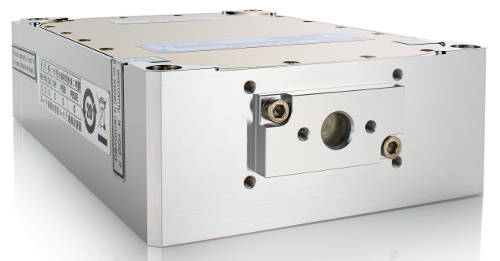
The Flare NX is a series of pulsed solid-state diode-pumped (DPSS) lasers with a choice of outputs at 1030 nm, 515 nm, and 343 nm. These lasers combine high pulse power (>500 µJ at 1030 nm, >300 µJ at 515 nm, >100 µJ at 343 nm), excellent beam quality (M² <1.2), and short pulse amplitude (~1 ns). Other lasers offer a maximum of two of these characteristics. The short pulse amplitude of the Flare NX provides higher temporal resolution in some applications (e.g., higher mass resolution in MALDI-TOF). The high pulse energy leads to an improved signal-to-noise ratio, requiring fewer pulses per measurement. Furthermore, the higher beam quality results in greater spatial resolution in microscopy-type applications.
MALDI-TOF is a type of mass spectrometry widely used, for example, in biology to study large molecules such as proteins and viruses. Traditionally, MALDI-TOF was performed at low repetition rates (up to 100 Hz) using nitrogen lasers. The latest MALDI-TOF instrumentation supports speeds up to 2 kHz for faster data acquisition, far exceeding the capabilities of nitrogen lasers. The new Flare NX laser meets this speed requirement while offering superior spatial and mass resolution. The easy integration of the Flare NX also reduces the cost of MALDI-TOF measurements; with a lifetime of more than 2 gigapulses, it provides a much lower cost per pulse than a nitrogen laser.
Another application of the Flare NX is laser microdissection: the dissection of specific tissue sections and individual cells under visual control using a microscope. This application will benefit from the Flare NX's high pulse frequencies, pulse energies, and excellent beam quality, resulting in faster processing speeds and improved dissection quality.