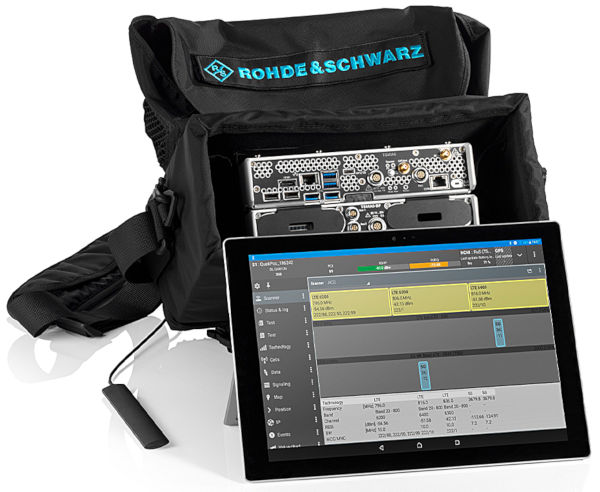
The 5G STS includes the R&S TSMA6 receiver, the R&S TSME30DC step-down converter, the QualiPoc Android smartphone for network fault location, and the R&S Cable Rider ZPH analyzer.
At the heart of this solution is the standalone R&S TSMA6 receiver, which uses automatic channel detection (ACD) to display all LTE and 5G signals, identify the channel frequency, and decode PCI/SSB information to provide efficient signal quality analysis.
The QualiPoc Android smartphone allows on-site service engineers to detect the presence of a 5G operator and verify key parameters: upload and download speeds, as well as latency. QualiPoc Android can perform cell and beam quality measurements, and verify the presence and quality of another LTE anchor cell, which is essential in non-standalone (NSA) mode for 5G base stations.
The optional R&S Cable Rider ZPH combines spectrum analysis with cable and antenna testing functions. It can measure the occupied bandwidth of a 5G carrier. The "Time Gating" function isolates the uplink signal, which is important for detecting interference in TDD networks. The "Zero Spam" function allows viewing the single-sideband (SSB) signal in the time domain and determining the number of beams present. The R&S Cable Rider ZPH can also measure optical power and performs conducted RF measurements of SWR and distance to fault on-site within the cell.
With the Rohde & Schwarz 5G STS solution, field service engineers benefit from automated channel detection (ACD) to automatically configure the receiver with the correct measurement settings instead of entering them manually. This solution is also considerably faster and more sensitive than a traditional spectrum analyzer. It can run both 5G and LTE tests in parallel, as well as all the tests required for the effective verification of 5G base stations and fault location.