The rapid pace of high-volume component manufacturing demands testing more devices in less time to minimize testing costs. Engineers are constantly striving to reduce test durations by automating test systems. The challenge of scaling up component testing volume is becoming increasingly complex as devices tend to incorporate a growing number of ports and functionalities. Examples include RF front-end modules (FEMs) that enable multiband operation in smartphones, multi-input multi-output (MIMO) antennas, and passive interconnect products for high-speed digital applications, such as RF cable and connector assemblies.
To accommodate multiport devices, vector network analyzers (VNAs) have evolved from two-port to four-port and now to multiport. A device requiring more than four ports for network analysis is considered multiport. As the measurement parameters for multiport devices increase, high-volume manufacturers are seeking test solutions capable of multiport measurements to improve measurement productivity and reduce testing costs.
Technological Advancements in Multiport Testing Solutions:
Multiport testing solutions have evolved from simple switching test equipment to complete, truly multiport solutions that enable faster and more accurate multiport measurements. Four multiport testing solutions will be described here. The choice of solution will depend on performance needs, productivity requirements, and budget.
Single-Switch Test Equipment. 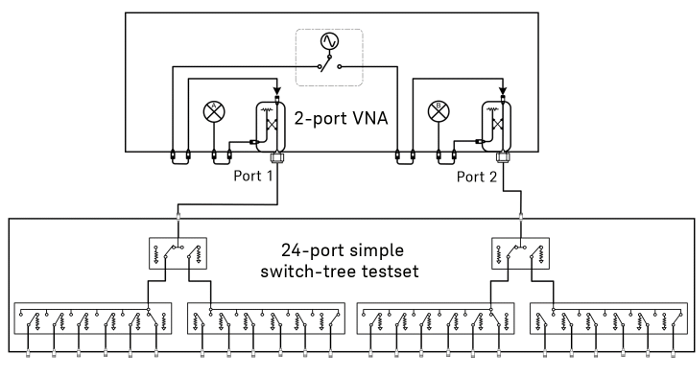 A single-switch test set, or single-switch tree, uses two-port measurements for each path from the common port. A two-port VNA with one common port and one switching port can perform all the necessary measurements. The single-switch test set contains only RF switches arranged in an array to provide the required measurement paths. Figure 1 shows a two-port single-switch test set, each port containing one 1x2 switch connected to two 1x6 switches, resulting in 24 ports. Although 24 ports are available on the test set, only 12 paths can be measured from any of the 12 input ports because measurements cannot be taken between ports on port 1 of the test set, nor between ports on the port 2 side. Therefore, this test set supports 144 paths, even though a 24-port device has 276 paths.
Measurement performance is determined by the type of switch used: solid-state or electromechanical. Each type of switch offers advantages for different testing needs. Solid-state switches offer high switching speeds and longer lifespans for high-volume, fast-track testing applications. Electromechanical switches are used in applications where devices require more than 1 W of power, which is typically the limit of solid-state switches.
 Full Crossbar Switching Test Equipment:
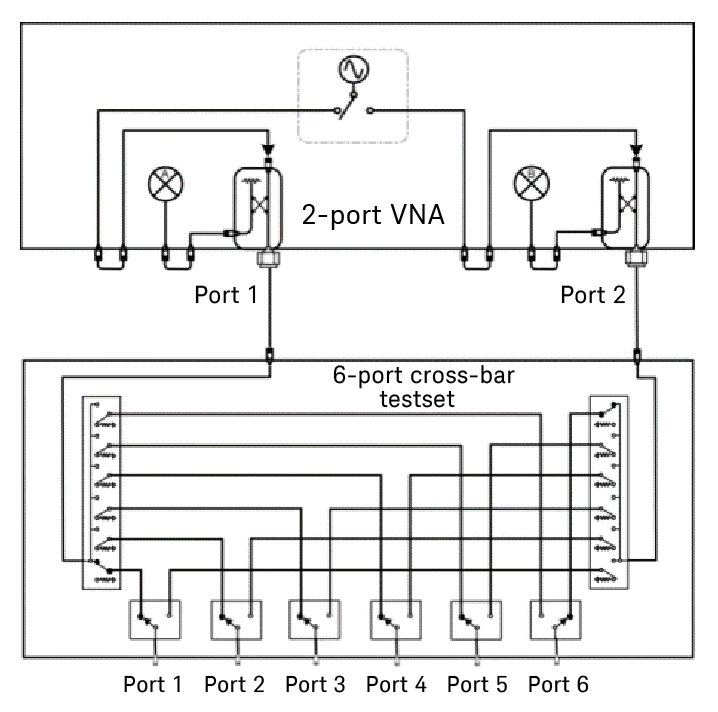
A full crossbar switching test rig provides measurements from one port to every other port. The full crossbar switching test rig shown in Figure 2 uses groups of 1xN switch trees connected with 1x2 switches at each port, allowing measurements to be taken on any path. Unused ports must be terminated, which can be handled internally by the 1xN switch or by the 1x2 switch with a load. Measurement performance is also determined by the switches, as well as by the load/mismatch of each path.
The full crossbar configuration, which combines a VNA with a switching matrix, offers a low-cost testing option. However, the response of each path is affected by the load applied to every other port. A full NxN port calibration must be performed to correct imperfect matching at each port. This calibration is difficult to perform in this type of switching matrix, since the exact value of the load termination on any port changes depending on the switching configuration of the other ports.
Combining a VNA with switches is a low-cost solution for expanding the number of VNA ports. However, the signal loss in the switches after the directional coupler associated with the VNA's test ports reduces system performance in terms of dynamic range, trace noise, and temperature stability compared to a standalone VNA. This degradation is particularly significant for higher-frequency applications, above 10 GHz.
 Extension Test Equipment
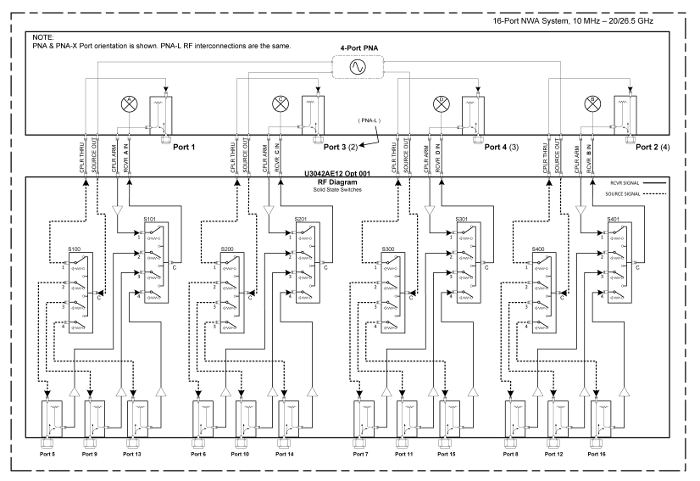
: Extension test equipment is a design for performing full NxN calibrated measurements, enhanced by the addition of directional couplers and switches. The extension test equipment expands the VNA's source switching matrix to more outputs and the internal receivers to more ports using a source switch and a receive switch, respectively. Additionally, a test port coupler is required on each port, as shown in Figure 3.
The stability and performance of measurements are improved compared to the test rig configurations described earlier because all switching occurs before the test port coupler, and vector error correction eliminates systematic error sources upstream of the test port couplers. Since any number of switching paths can exist upstream of the test couplers, additional test rigs can be added, allowing any number of test ports to be created by stacking extension test rigs. However, the dynamic range remains limited due to switching loss.
 True Multiport Solutions
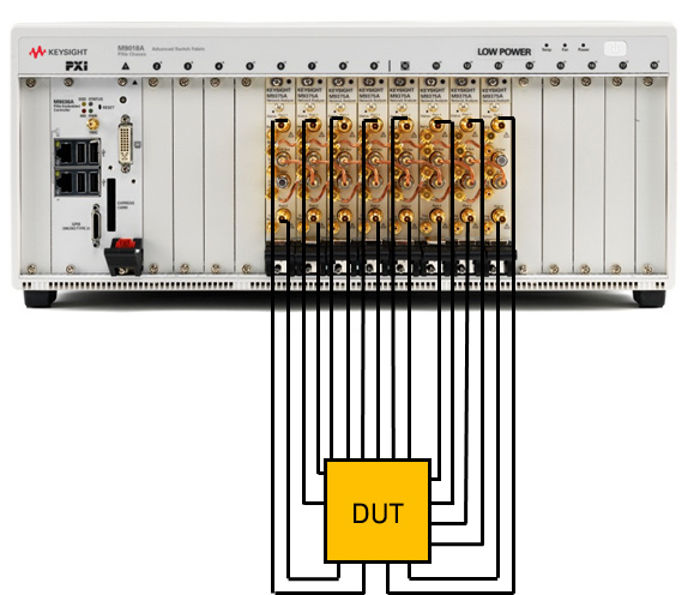
: True multiport solutions do not require external switching or additional couplers to perform multiport measurements. An example of such a solution is the Keysight M937xA 2-Port PXIe VNA (Figure 4), a true multiport solution in a PXI chassis. Up to 16 modules can be configured in a single PXI chassis, enabling fully correct measurements up to 26.5 GHz for 32-port device under test (DUT) arrays. Each PXI VNA module has its own independent power supply, and each test port has its own independent reference and test receivers. These receivers allow for the simultaneous capture of S-parameter data for all measurement paths. Measurements are highly accurate and stable because there is no signal attenuation between the DUT and the receivers.
Figure 5 shows the number of measurement sweeps required for the complete characterization of a multiport DUT. Because a true multiport PXI VNA captures data with multiple receivers, one for each test port, measurements can be accelerated with a significantly lower number of sweeps compared to a switch-based solution. True multiport solutions offer a clear advantage by optimizing test duration and productivity.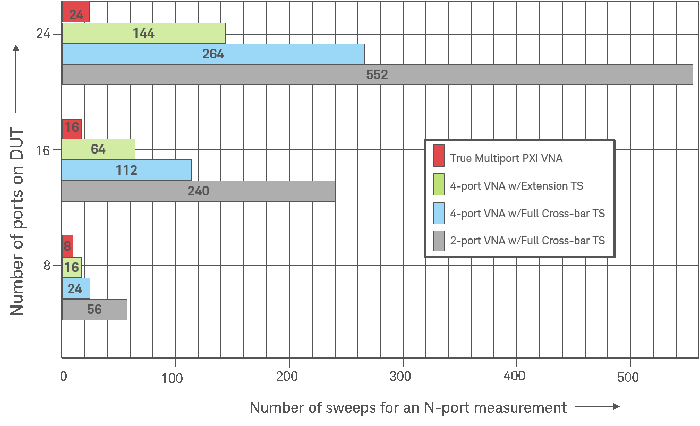
Considerations regarding multisite testing
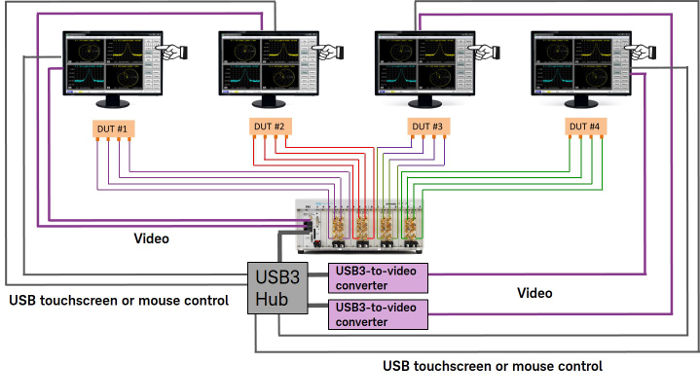
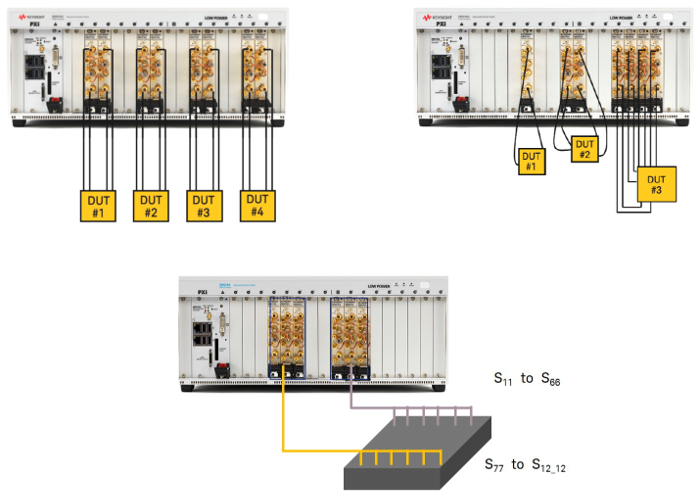
Multi-site test solutions enable parallel measurements to increase productivity. Multi-site test systems can be built using multiple VNAs in various configurations (Figure 6) to measure multiple paths of a single device or multiple devices simultaneously. A multi-site test solution uses a single PC controller with individual software instances for each VNA. Each instrument on the VNA is independently configured and controlled so that it operates concurrently with other VNAs in the test system. Multi-site configurations are particularly useful in manufacturing environments where testing is performed by more than one operator. For example, a 4-port VNA configured for tuning low-cost, multi-site filters can be used simultaneously by four test operators (Figure 7).
Other factors, such as PC controller capabilities, VNA IF bandwidth (IFBW), and system communications, can also impact the overall productivity of multi-site measurements. The number of PC cores should match the number of VNAs in the system to avoid significantly affecting test speed. Lower VNA IFBWs, such as 1 kHz, will not affect system productivity, but IFBWs of 100 kHz and above can slow down the overall test system's productivity. Choosing a fast communications connection also ensures that communication between the VNAs and the CPU does not reduce the speed of the multi-site test system. Fast communication between the PC and VNAs, such as that provided by a PXI multi-site VNA configuration, benefits from the high-speed PXI chassis connection.
Summary:
When selecting a VNA test solution for multiport devices, switching loss, system calibration, and other factors that impact test productivity and accuracy must be considered. Advances in test and measurement technologies have enabled multiport and multisite test solutions to better address these challenges by increasing the number of measurements, the number of devices, and the measurement speed, while maintaining high accuracy and stability. The automated PXI-based VNA test system is an ideal high-performance multiport solution that allows high-volume component manufacturers to achieve the high test productivity they seek in less time.
For more information on multiport and multisite test optimization techniques, visit
http://literature.cdn.keysight.com/litweb/pdf/5992-0681EN.pdf?id=2611867
Author: Takuya Hirato, Keysight Technologies