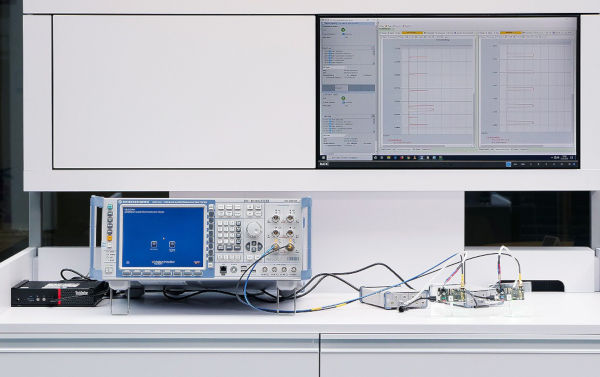
Reducing power consumption in NB-IoT devices is crucial for extending their lifespan. 3GPP version 15 introduces the wake-up signal, a special paging signal sent from an NB-IoT base station to specific NB-IoT devices, instructing them to activate the primary receiver in preparation for data reception. The primary receiver only needs to be activated when instructed. An NB-IoT device with the wake-up signal function remains in standby mode until instructed to decode the PDCCH (physical downlink control channel) for data reception.
Only Rohde & Schwarz radio testers have implemented the numerous new features of 3GPP versions 14 and 15. The R&S CMW500 and R&S CMW290 now offer the wake-up signal function, along with other version 15 features, in their latest firmware updates.
Matthias Weiss, Managing Director of CommSolid, states: “Low power consumption is a key factor for NB-IoT applications. Early testing of the new features introduced by 3GPP allows our customers to leverage this advantage throughout their product design cycles.”
Anton Messmer, Vice President of Mobile Communications T&M Systems at Rohde & Schwarz, adds: “Rohde & Schwarz is committed to providing T&M systems for the NB-IoT features that device manufacturers plan to include in commercially viable products. We greatly appreciate the cooperation with early adopters, as it gives us the opportunity to verify whether our implementations are efficient and suitable for the features defined by 3GPP.”
Rohde & Schwarz CMP180: High-precision portable radio communication tester
The Rohde & Schwarz CMP180 radio communications tester is designed to provide advanced, portable signal analysis in critical communications environments. This device combines laboratory accuracy with ease of use in the field, making it an invaluable tool...