
With the rapid proliferation of wireless networks, there is a growing demand to support more users. Previously, people only connected their phones to the network. Today, it is common for people to connect multiple devices, such as phones, laptops, and tablets. Furthermore, the rise of wirelessly connected IoT devices further amplifies the demand for wireless network connectivity.

Although it's difficult to determine the exact figure, it's estimated that over 90% of commercial wireless access points (WAPs) are powered by Power over Ethernet (PoE). PoE is a unique technology introduced by PowerDsine and later acquired by Microchip Technology in 1998. This technology allows power to be transmitted over an Ethernet cable that already carries data. Consequently, a WAP only needs one cable to supply both power and data.
Advances in wireless networks are placing new demands on switches and other power-supplying devices. To better understand these demands, we must first examine current market trends.
Trends in wireless access points
A significant number of networks currently use Wi-Fi® 5 (802.11ac), which was introduced in 2013. This standard offered faster data transfer speeds, greater capacity, and improved performance compared to its predecessor, Wi-Fi 4 (802.11n). Wi-Fi 5 supports a maximum data rate of 3.5 Gbps.
Wi-Fi 6 (802.11ax) was introduced in 2019, bringing new improvements in speed, capacity, and performance. Unlike Wi-Fi 5, which operates primarily on the 5 GHz band, Wi-Fi 6 supports both the 2.4 GHz and 5 GHz bands.
In 2020, Wi-Fi 6E, also known as Wi-Fi 6 Extended, was introduced, extending operation to the 6 GHz band. This addition provided extra spectrum, reducing congestion and improving overall network performance. Both Wi-Fi 6 and Wi-Fi 6E support maximum data speeds of up to 9.6 Gbps.
Wi-Fi 7 (802.11be) was announced in January 2024. Designed to meet the growing demand for high-speed internet and the increasing number of connected devices, Wi-Fi 7 supports data speeds of up to 30 Gbps. Each generation of Wi-Fi standards has progressively supported more users, higher speeds, and faster data rates.
Significant progress has also been made in energy efficiency during this period. In 2014, shortly after the introduction of Wi-Fi 5, the U.S. Department of Energy (DOE) ratified its Tier IV efficiency standards. The DOE has since advanced to Tier VI and has defined, though not yet implemented, Tier VII standards. Furthermore, all major countries have implemented their own energy efficiency programs.
Another aspect of energy efficiency is distribution. To optimize power distribution, many wireless access point (WAP) manufacturers are incorporating features such as PoE power forwarding into their designs. This allows excess power from the receiving WAP to be forwarded to subsequent WAPs, making power distribution more efficient.
In summary, trends in WAPs indicate advancements in power, efficiency, user capacity, data management, and speed.
Powering Wireless Access Points
The proliferation of wireless networks will require a significant increase in WAPs of all types. These WAPs will need to connect to the network and be powered efficiently. Power over Ethernet (PoE) has become the preferred method for powering these devices due to its simplicity and efficiency. PoE requires only one cable, simplifying installation. Classified as Class 2 power by the National Electrical Code (NEC), PoE is considered safe and does not require a certified electrician for installation, nor does it need conduit or shielding. Ethernet standards allow for cable lengths of up to 100 meters, providing flexibility in device placement without requiring proximity to a power source.
However, currently, only about 20% of networks provide PoE power. Therefore, when installing PoE on an existing network, additional power will need to be integrated. In 1999, PowerDsine recognized that it would take several years to design and manufacture new Power Supply Equipment (PSE) integrated circuits (ICs) to add power to Ethernet cables within switches, routers, and gateways. To address this, they introduced a device called a midspan, also known as an injector.
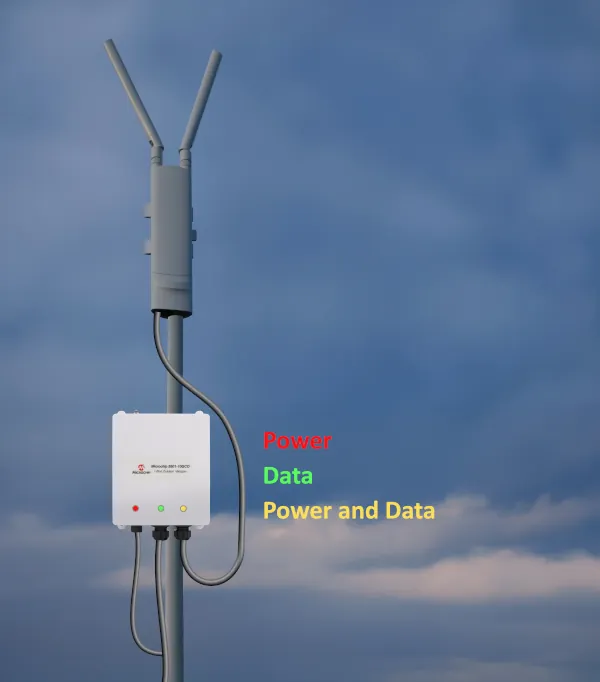
Midspan feeding an outdoor wireless access point
The midspan connects to an Ethernet cable from a switch that does not supply power. The output is a second Ethernet cable that carries both power and data. Adding a midspan before the WAP is the fastest and most cost-effective way to add power to a network. For installations requiring multiple WAPs, multiport midspans can be rack-mounted above the existing switch to add power to the network.
Even when installing new switches, there's no guarantee they will provide power. Many switches on the market today are PoE-compatible. However, even PoE-compatible switches have a limited power budget, meaning they may not deliver maximum power to all ports. Therefore, for new non-PoE switches and PoE switches with insufficient power budgets, the PoE midspan remains a crucial component for powering wireless networks.
Selecting the right device
Before selecting a device, it's crucial to determine whether the WAP will connect to an existing wired network or create a new one. If connecting to an existing network, check if it supports PoE. If not, midspans are the most cost-effective solution for adding power to the network.
If you are creating a new network, consider whether to build it using PoE switches. Some prefer to isolate the switch from the power source, as switches are typically replaced more frequently due to technological upgrades compared to PoE midspans. This preference may lead to selecting a non-PoE switch and introducing power through a midspan.
When midspans are required, several factors must be considered to select the appropriate device:
• Power
• Ports
• Environment
• Data speed
Most WAP manufacturers adhere to IEEE PoE standards when designing their midspans. The IEEE has defined three standards with predefined power levels known as classes:
• IEEE 802.3af: 3 Classes - 4W, 7W, and 15.4W
• IEEE 802.3at: 4 Classes – all of the above plus 30W
• IEEE 802.3bt: 8 Classes – all of the above plus 45W, 60W, 75W, and 90W
The WAP manufacturer will specify the power requirements and the IEEE standard it follows.
The number of ports needed depends on the number of devices to be connected. Many WAP manufacturers offer a single-port midspan as a power option for their devices. The manufacturer may offer a package that includes a single-port midspan with each WAP.
System integrators installing multiple WAPs at a single location often prefer a multiport midspan solution. This simplifies installation by mounting the midspan on top of the switch in the rack. Multiport midspans can also offer additional features, such as scheduling.
It is also important to consider the installation environment of the WAP and midspans.
For outdoor WAP deployments, select a device designed to operate in such conditions. Placing indoor or industrial units in a NEMA (National Electrical Manufacturers Association) enclosure typically results in high failure rates. Outdoor midspans and switches should be designed for outdoor environments, ideally with an Ingress Protection (IP) rating of at least 66, although 67 is preferable to ensure protection against the elements. They should also have a suitable temperature range for extreme weather conditions and surge protection to withstand lightning storms.
In addition, the midspan must support current data rates of up to 10 Gbps. While most current midspans support data rates up to 1 Gbps, options are available that offer 2.5 Gbps, 5 Gbps, and even up to 10 Gbps. These higher data rates are required for Wi-Fi 6 and later versions.
Finally, a growing number of manufacturers and consumers are prioritizing sustainability. Consumers are demanding greater attention to environmental impact and energy efficiency. To ensure compliance with current and evolving global standards, it is essential that midspans meet these requirements.
The road ahead
The advantages of emerging Wi-Fi standards will continue to include increased user capacity, improved data handling, and higher speeds. The recently ratified Wi-Fi 7 standard supports data rates of up to 30 Gbps. As new devices are designed to incorporate this standard, we can anticipate that the midspans powering these devices will also support these data rates. Although the Wi-Fi 8 specifications are not yet finalized, discussions suggest it could support data rates of up to 46 Gbps.
PoE: an environmentally friendly, sustainable, and energy-efficient power source
Energy efficiency standards are also expected to advance. Attention remains focused on DoE Level VI, in effect since 2016, and the recently defined Level VII, which emphasizes no-load conditions. This specifies the amount of energy that can be consumed when the unit is not supplying power. This is especially important for PoE midspans, as they do not supply power when a WAP does not need it, remaining in a standby or "no-load" state, ready to provide power when required. It is crucial to ensure that all power devices are designed to meet or exceed current and emerging standards, not only from the DoE but also globally.
Author: Alan Jay Zwiren, senior marketing manager, Microchip Technology's networking and connectivity solutions – https://www.microchip.com