 Generation Y is fundamentally changing how traffic flows on the information superhighway. The era of the analog modem was primarily download-oriented: users typically downloaded information and made little use of uploading.
Since then, the Internet has been filled with terabytes of data uploaded by teenagers who know the multimedia environment very well and by twenty-somethings with unlimited creativity and access to high-quality, low-cost digital production equipment.

The massive amount of consumer-generated content and the demand for reliable broadband services presents service providers with an unprecedented opportunity to generate profits: higher-quality internet access services that require greater capacity for faster upload bandwidth. Service providers that can deliver faster upload bandwidth will be able to meet Generation Y's desire for a quality internet experience and develop a loyal customer base.
Definition of Generation Y:
Generation Y represents the last generation of the 20th century. In the U.S. alone, Generation Y totals approximately 76 million individuals. Dubbed the Net Generation by Don Tapscott in his book "Growing Up Digital," this group is the first generation to grow up immersed in a digital world dominated by the internet.
Generation Y is defined by technology. Its members have always had personal computers with modern operating systems and graphical user interfaces based on mice, cable television, CDs, and remote controls. They expect advanced computer graphics in video games, animated films, and TV programs. And they know the internet only as a consumer tool for communication, entertainment, and shopping.
They are the first generation to grow up with digital cameras, camera phones, DVDs, TiVo and other types of digital video recorders, high-definition television (HDTV), iPods, and MP3 players. As a result, this group constitutes the largest consumer of next-generation personalized communication products and services.
Approximately 84 percent of American teenagers (ages 12 to 17) report owning at least one personal multimedia device, such as a desktop or laptop computer, a mobile phone, or a PDA, according to the 2005 Pew Internet & American Life Project report, "Teens and Technology." At least half of these teenagers own two or more such devices.
Internet use also plays a major role among teenagers, according to the Pew report. About 87 percent of teenagers use the Internet, compared to only 66 percent of adults. In fact, more than half of teenagers go online daily.
With their access to computers and the internet, Generation Y is fueling an online cultural revolution. Email is no longer in vogue; instant messaging has become their primary means of communication. The Pew Report on “Teens and Technology” revealed that nearly 45 percent of instant messaging (IM) messages used by teenagers involve sending photos or documents, while another 31 percent send music or video files. Blogs and video blogs have replaced personal diaries as a way to chronicle their lives, thus increasing the popularity of YouTube and similar websites. And instead of meeting up with friends at the mall, they gather on social networking sites like MySpace, Facebook, and Friendster.
Generation Y is putting the upload capacity of typical broadband connections to the test, with so much content moving from desktops and laptops to blogs, websites like YouTube, and to other people via instant messaging or email. To ensure users are satisfied with their broadband experience and can access the internet the way they prefer, service providers must deliver more symmetrical bandwidth.
Upload bandwidth drives revenue growth.
By deploying a broadband network capable of delivering higher upload bandwidth, service providers have a valuable opportunity to build loyalty among the largest internet users, such as Millennials. They can also improve their revenue by offering higher-quality services that require greater upload bandwidth.
Inexpensive and easy-to-use webcams are driving many of these potentially profitable services. These cameras can be used for home security monitoring. Users set up USB cameras at home and connect them to websites that allow them to view activities at home when they are not there. For example, from work they can check if their children arrive home on time from school or make sure there are no intruders if the alarm is triggered.
Another application is real-time video communication with family members. Webcams are allowing grandparents to see their grandchildren's first steps or hear their first words. Multimedia messaging services popular among Generation Y are now providing more support for video, including video mail and instant video chat setup.
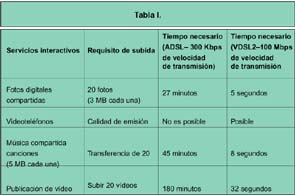
The common denominator for the successful delivery of these types of interactive broadband services is increasing upload bandwidth. The current average upload speed is around 300 Kbps. To upload 20 videos of 20 MB each, users need about 3 hours. However, by increasing the upload speed to 100 Mbps, the same video upload takes only 32 seconds. When upload bandwidth is increased, the consumer experience similarly improves for uploading digital photos, sharing music files, and using videophones (see Table I).
 To succeed in delivering the higher-quality services that require greater upstream bandwidth, service providers need to deploy a robust, bidirectional bandwidth solution that is cost-effective and supports the growing broadband needs of Generation Y over the next few years.
One option is the deployment of fiber to the home (FTTH). While FTTH provides high upload and download bandwidth, its deployment is also very expensive. It requires building a new network to each customer's home and involves digging long trenches and accessing each home for installation. For example, Verizon's cost to connect a home to cable is approximately $1,700. NTT, another major fiber provider, states that its connection cost per home is $1,100. Several independent studies indicate that the payback period for deploying fiber-to-the-home services can be up to 15 years. For many service providers, the cost of FTTH is impossible to justify financially, despite the potential opportunity it may represent.
The Advantage of VDSL2:
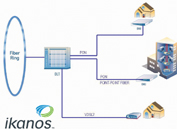
A more cost-effective option for delivering higher upload bandwidth to homes is the technology known as very-high-data-rate digital subscriber line (VDSL2). VDSL2 allows service providers to maximize their investments in existing copper infrastructure. In fact, VDSL2 deployment is estimated to be five times cheaper than fiber.
VDSL2 can deliver up to 100 Mbps of symmetrical bandwidth. It is widely used in Korea and Japan to support a large number of new and innovative consumer services.
Generation Y will continue to push the limits of current broadband networks as they demand higher upload bandwidths to support the loading of large amounts of data. To succeed, service providers must ensure their broadband networks can meet this challenge quickly and cost-effectively. By deploying a VDSL2 solution that enables symmetrical bandwidth of up to 100 Mbps, service providers are establishing a strong relationship with bandwidth-hungry consumers, while simultaneously creating the infrastructure to take this high-tech generation to the next level.
Author:
Dr. Manouchehr Rafie, Director of Strategic Products and Technologies,
Access Products Group, Ikanos Communications, Inc.