 Balanced twisted-pair cabling, whether unshielded twisted pair (UTP) or shielded twisted pair (ScTP), is more than capable of supporting the next generation of Ethernet. The terms shielded twisted pair or shielded twisted pair generally define a cable structure recognized by the TIA that incorporates an overall metallic shield over a core of 4 pairs, also called F/UTP cable in international standards.
Before analyzing the 10 Gigabit/second data transmission capacity over balanced twisted-pair cabling, let's recall that in 1995 copper skeptics predicted that Category 5 and 100 Mbps represented the limit of this material's capacity and that the future would be dominated by fiber. However, 15 years have passed, and copper continues to hold a strong position, supporting data speeds 100 times higher than originally imagined. We have seen it evolve from Category 5 to Category 5e, to Category 6, and now to Category 6A. In addition, multimode optical fiber has also evolved from OM1 62.5/125 mm fiber to OM2 50/125 mm, to the laser-optimized OM3 50/125 mm and to OM4 fiber.
By examining the technology and channel requirements of different Ethernet generations, we can estimate what is needed to support 40 Gbps over copper.
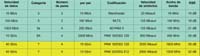
Table 1 shows the data rate, encoding technology, symbol rate, channel bandwidth, and signal-to-noise ratio (SNR) for each Ethernet generation. It also shows, highlighted in yellow, two possible scenarios for a 40 Gbps Ethernet implementation.
The first scenario uses the same 10GBASE-T Ethernet encoding scheme, namely PAM 16/DSQ 128 encoding. The minimum bandwidth required to support this data rate is 1600 MHz with an RSR of 26 dB. The second scenario uses PAM 32/DSQ 512 encoding, which reduces the bandwidth requirement to 1200 MHz, although the RSR requirement increases by 6 dB.
Table 2 shows key performance parameters for a balanced twisted-pair channel up to 1600 MHz. The most significant parameter here is the channel insertion loss. This table was developed using the insertion loss equations for a Category 6A channel extrapolated to a frequency of 1600 MHz.
 The insertion loss for a 100-meter channel at 1600 MHz is 94.9 dB, which is undoubtedly a very weak signal, close to the minimum noise threshold for measurement at these high frequencies. If we reduce the channel distance to 50 meters, the insertion loss is comparable to the result obtained for a 100-meter channel at 400 MHz.
Table 2 shows the total noise figure calculated after taking into account certain improvements to the cabling characteristics and internal noise suppression, including 60 dB of echo suppression, 40 dB of near-extended crosstalk (NEXT) suppression, and 20 dB of far-extended crosstalk (FEXT) suppression. The net result is a positive signal-to-noise ratio extending up to 1600 MHz for a 50-meter channel.
The Shannon capacity for the 50-meter channel shown in Table 2 ranges from 50 Gbps to 56 Gbps for different scenarios. From this, we can deduce that Enhanced Category 6A copper cabling can support data rates of 40 Gbps for channel distances up to 50 meters. This isn't the end of the road yet. What's needed are higher-performance cabling solutions specified up to a frequency of 1600 MHz, a challenge that cable suppliers are well-positioned to meet.
Since data rates of 40 Gbps would primarily be targeted in switch-server connections within a data center, the 50-meter distance is not a limitation for most data center topologies.