 The measures taken to reduce costs must be considered holistically. It is no longer enough to simply reduce component costs; installation and infrastructure must also be taken into account when calculating costs. Nor should the space required by the new solutions be overlooked.
New technologies in the manufacture of connectors and cables, as well as the increasing integration of functions in semiconductors, allow data and power to be combined in a single medium.
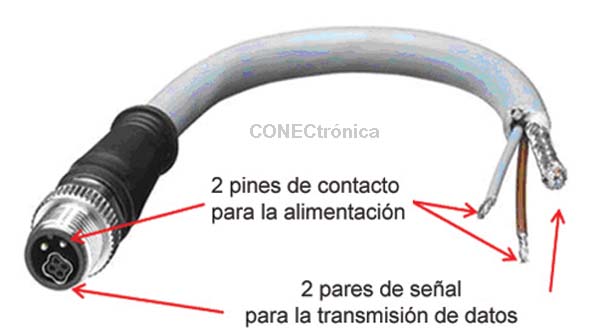
 In light of the above, the first step in integration is to combine separate data and power lines into a single cable and, consequently, a single connector. This hybrid technology results in smaller cables and simplifies installation compared to conventional technologies. Molex's M12 CHT connection system includes a cable compliant with the Cat 5e standard and can carry data and power up to 4 x 6 amps. These solutions are already being used for copper cables. Another option anticipated for the near future is the combination of power and fiber optic cables.
 The conversion of proprietary fieldbuses to Ethernet-based communications represents another technological advancement. Technologies such as PoE (Power over Ethernet) for low power and EoP (Ethernet over Power) for high power will, sooner or later, contribute to further reducing installation costs and will enable simultaneous transmission over a single cable. But for now, these technologies are not yet ready for use in industrial applications; however, their increasing use in the consumer market will lead to technically mature solutions suitable for industrial systems in the near future.
Likewise, the number of networks implementing wireless Ethernet protocols is growing in order to incorporate new devices, primarily to save on installation costs, but also to offer greater flexibility and mobile communications. This is only possible if an additional power source is not required. If such a source is necessary and, at the same time, high transmission speed is required, the new trend is to replace the multiple separate signal and power cables with a hybrid solution.
A hybrid solution combines the different wires for signal and power and connects them with a hybrid connector. Building on its extensive experience with hybrid technology, Molex has already implemented hybrid solutions in a wide variety of systems.
In Ethernet applications, where traditional RJ45 connectors have been used for many years, progress has been made, reaching the Cat 5e and Cat 6a standards, and now even incorporating PoE technology. Today, a standard Ethernet network can transmit data at speeds of up to 10 Gbps and power up to 30 W per port. PoE technology has been operating effectively for many years in office applications such as network routers, telephones, and webcams.
 PoE components with up to 16 ports for data transmission are already being used in the network. Initially, pluggable modules were used in industry to replace cabling and create a more flexible, faster, and more secure solution. As the use of industrial networks (such as Profibus and Profinet) expands, so does the use of distribution boxes with trunk lines and extensions.
RJ45 connection systems, previously used only in indoor office environments, have been adapted for industrial settings by adding a round or rectangular housing. Hybrid solutions have also been developed, which can be integrated into power cabling. However, these solutions are expensive, and the M12 system, which is considerably more robust and reliable and features a much more compact design, is increasingly being used instead.
The Molex M12 series, with its Circular Hybrid Technology (CHT), integrates two pairs of shielded signal contacts and two or four additional power contacts into a standard M12 form factor. This allows for the transmission of signals at a frequency of 100 MHz and currents of up to 10 A with two power contacts, and up to 6 A with four power contacts, over a single Cat 5e cable.
This enables surveillance cameras, encoders, and sensors for automation components to operate with a single cable, even in harsh environments. Further improvements have been achieved by incorporating the M12 hybrid system into IP67-rated industrial distribution boxes.
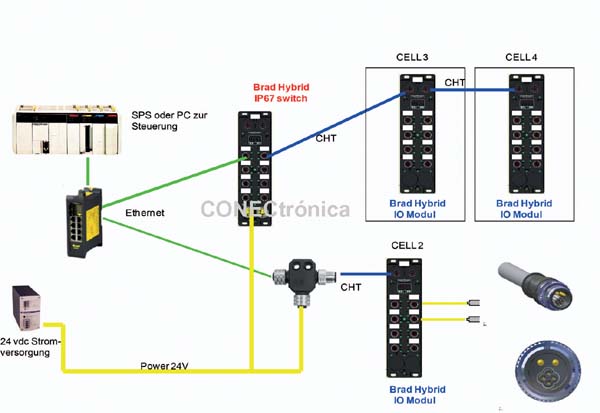 Apart from industrial applications, M12 hybrid connection systems are increasingly used in the automotive, commercial vehicle, shipbuilding, mining and offshore sectors.
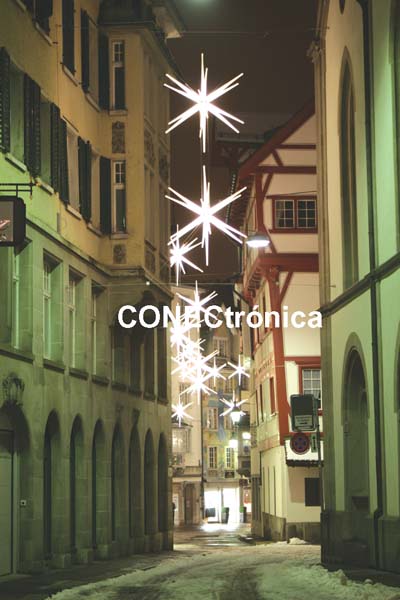
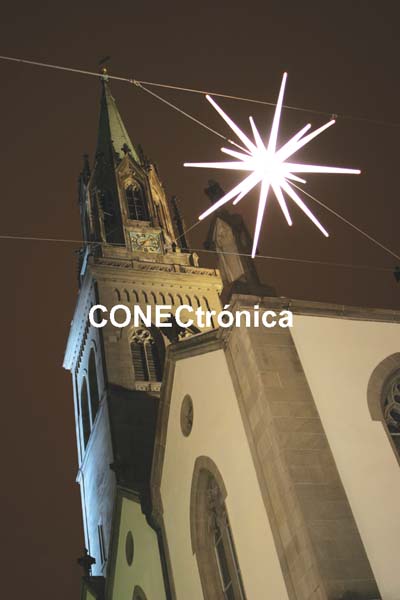
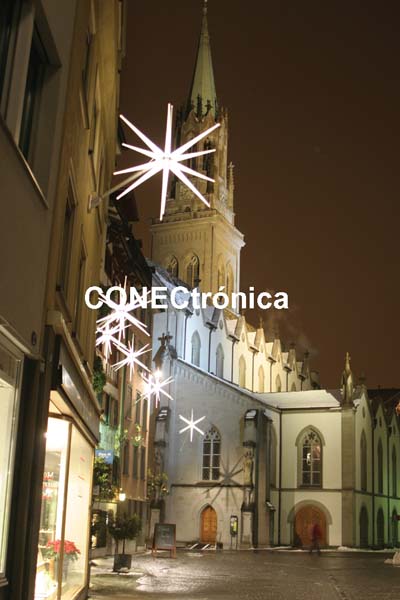
A more recent example of hybrid technology comes from the lighting industry. Last year, a European city installed new Christmas lights, placing particular emphasis on economic and sustainability aspects, in addition to considering urban design and landscaping.
The lighting project utilized numerous stars, each containing 14 LEDs and emitting 14 beams of light. The 9,800 star beams were individually controlled from a centralized unit and emitted a warm white light. Signals were transmitted via the DMX/ACN intranet protocol from the centralized unit to the distribution substation, where they were converted into EtherCAT signals and then transmitted to the stars through additional distribution boxes. The complete lighting system comprises approximately 1,000 EtherCAT nodes. For example, video signals can be transmitted and then displayed on the star beams as monochrome video images.
To decorate the streets of the city's old town with these stars, hanging cables are needed, and to avoid having to install two different cables for data and power transmission, the M12 hybrid connection system was implemented using the Molex CHT 4+2 connector.
The hybrid connection system not only offers aesthetic advantages (i.e., less cabling in the streets) but also provides significant cost and time savings, requiring only half the amount of cable compared to conventional systems. The wall-mounted distribution boxes include hybrid devices that are screwed into the corresponding hybrid cable connectors. This allows for quick installation and removal of the lights, as well as a compact and watertight connection, ensuring reliable operation for many years.
These different methods demonstrate that the convergence of data and energy is already underway. Molex offers the technologies and expertise needed for a wide range of solutions.
Author:
Authors: Gerd Klaiber, Integrated Products Manager;
Andreas Vogt, Integrated Products Direct Engineering,
Molex Connectivity GmbH, Bretten, Germany