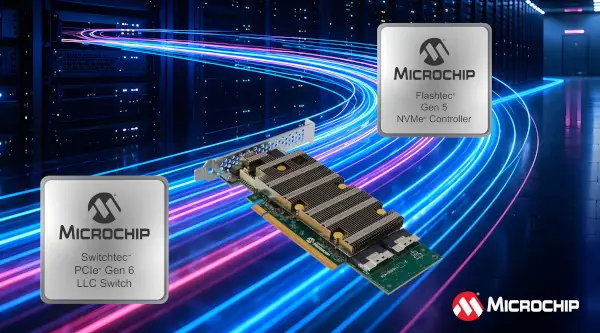
These solutions are geared towards enterprise storage systems, high-performance computing platforms, artificial intelligence infrastructures, and certain edge computing equipment.
The new features address various functions within the data center architecture: device interconnection, SSD control, and management of redundant storage configurations.
Switchtec PCIe 6.0 with up to 64 lanes and 32 ports.
The new Switchtec PCIe 6.0 LLC is designed to bring sixth-generation PCIe connectivity to systems with space and power constraints. The device supports up to 64 PCIe Gen 6 lanes and 32 ports, with x2, x4, x8, and x16 link configuration options. This flexibility allows for distributing available lanes among different devices and adapting the interconnect topology to the requirements of each platform.
The switch also incorporates a Direct Memory Access (DMA) engine designed to facilitate data transfers between connected devices and reduce certain operations that would otherwise require CPU intervention.
Multicast, Partitioning, and Security in the Switchtec Switch:
The switch retains features found in other Microchip Switchtec PCIe Gen 6 devices, such as PCIe Multicast and partitioning mechanisms. PCIe Multicast allows for the distribution of certain data transfers to multiple destinations within a compatible architecture, while partitioning facilitates the organization of interconnect resources. In terms of security, the device incorporates a hardware-based root of trust and secure boot mechanisms. These features are designed to verify components of the boot process and provide a foundation of trust for certain device operations.
Microchip describes the new switch as a smaller, lower-power alternative to other, higher-capacity models in its product line.
Flashtec NVMe 5016 Adds CNSA 2.0 Support.
Microchip has also announced an update to the Flashtec PCIe Gen 5 NVMe 5016 SSD controller, designed for enterprise storage drives. One of the main new features is the announced support for CNSA 2.0 (Commercial National Security Algorithm Suite 2.0). This suite establishes cryptographic requirements related to the transition to algorithms designed to address certain threats associated with quantum computing. The update is aimed at SSD manufacturers who need to incorporate security mechanisms in accordance with new data protection requirements.
Dual-Port and High Availability in NVMe Storage:
The Flashtec NVMe 5016 controller features a dual-port architecture, designed for storage configurations that utilize redundant access paths. This feature allows for the design of systems where an SSD can be accessed via more than one data path. The architecture can also be used to distribute specific workloads, depending on the storage system configuration.
Microchip also mentions virtualization, Quality of Service (QoS) management, and programmability features. These capabilities are geared towards controlling storage behavior and its integration across different platforms.
SmartRAID 4300 Expands Data Protection Options.
The third area of update concerns the Adaptec SmartRAID 4300 family of storage accelerators. Microchip has incorporated new features for managing and protecting NVMe storage configurations. These include support for self-encrypting drives (SEDs) with both local and remote key management mechanisms.
The family also includes RAID 6 and RAID 60 options, which allow for configuring storage systems with parity redundancy.
RAID 6 uses double parity to tolerate the failure of up to two drives within the same RAID 6 array. RAID 60 combines multiple RAID 6 arrays using data striping, so fault tolerance depends on how those arrays are organized. These configurations provide protection against certain drive failures, but they do not replace backups or protect against all data loss scenarios on their own.
Dynamic NVMe Configuration and P2P Rebuild:
SmartRAID updates include dynamic NVMe configuration features to perform certain management operations while the system is running. Microchip also incorporates a persistent event log, designed to retain information useful for troubleshooting and incident tracking. Another new feature is P2P (peer-to-peer) rebuild, which allows certain data transfers between devices with less CPU intervention. This feature is geared towards storage rebuild operations after failures or drive replacements.
Compatibility with Linux, Debian, Ubuntu, and Windows 11:
Microchip has expanded software support for the SmartRAID 4300 family to various operating environments. The press release mentions Linux, Debian, Ubuntu, and Microsoft Windows 11. This compatibility allows the accelerators to be integrated into different storage platforms and computing equipment.
Integration via the EStorageCore API:
The SmartRAID family incorporates compatibility with the EStorageCore API, designed to facilitate integration with external management tools. According to Microchip, this interface allows SmartRAID management functions to be incorporated into applications running within the operating system. It also supports management environments based on the Baseboard Management Controller (BMC), which allows certain management tasks to be performed outside the main operating system. This capability is particularly relevant for servers using centralized hardware management platforms.
development and management
tools for configuration, diagnostics, and maintenance. These include ChipLink, designed for configuring, telemetry, diagnostics, and debugging PCIe switches. The company also offers software for device monitoring, firmware configuration and management, as well as development resources for NVMe controllers.
In the storage sector, the offering is rounded out with management tools for Adaptec accelerators.
Applications in data centers and AI infrastructures:
The three product lines cover different needs within computing and storage platforms.
The Switchtec PCIe 6.0 LLC provides connectivity between PCIe devices; the Flashtec NVMe 5016 is designed for SSD control; and the SmartRAID 4300 incorporates storage protection, management, and acceleration features.