Typical applications of laser systems in space include precision range measurements, radar-like “lidar” systems to collect a complete picture of the terrain surface or three-dimensional sampling of planetary atmospheres, and laser-based space communications with high bandwidth and minimal electromagnetic interference.
ESTEC is ESA's largest research center in Europe and is responsible for developing and managing all types of space missions for scientific exploration, satellite navigation and communication, and Earth observation. It has an environmental testing center for spacecraft, supported by engineering laboratories specializing in systems, component, and materials engineering, including an optoelectronics laboratory focused on verifying the performance of active optical instruments, including high-power laser systems and solid-state laser components.
The laboratory includes a Class 10,000 (ISO 7) cleanroom, two fully equipped optoelectronics laboratories designed for the operation of Class 4 laser systems (defined as powerful enough to burn skin, cause permanent eye damage, or ignite flammable materials), workshops, and storage areas. It has the necessary equipment to measure the optical spectrum, beam profile, power and energy, stability, and modulation response in free space as well as in optical fibers.
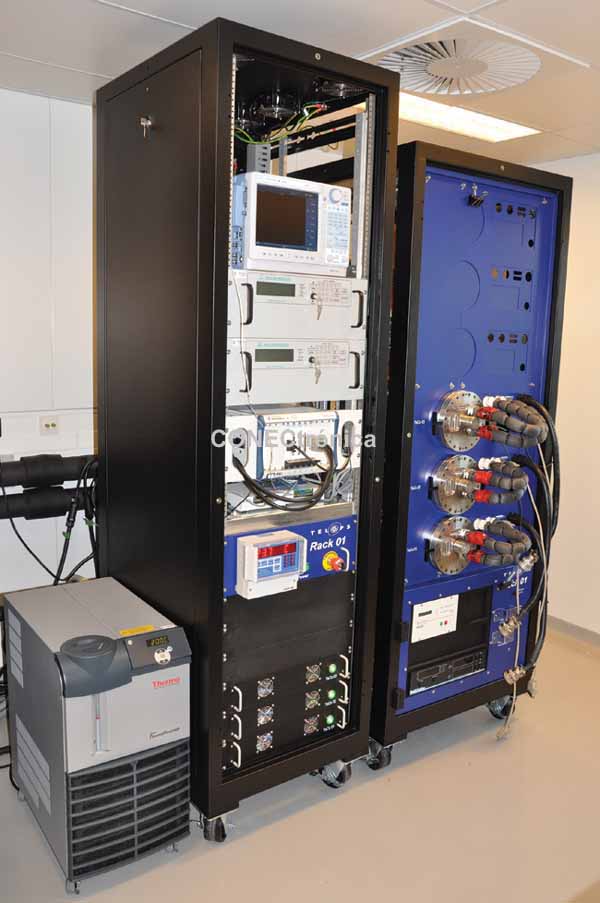
The Yokogawa test equipment—initially a DL6154 oscilloscope, currently being supplemented by a DL850 ScopeCorder—is specifically used to complement the calibration tests developed to investigate laser-induced contamination or to perform endurance tests on the laser diodes used as pumps in solid-state laser sources.
These tests involve recording large amounts of data over extended periods: several weeks or even months in some cases.
The key electrical parameters involved in the tests are voltage and current under well-controlled environmental conditions. Furthermore, for endurance testing, the instruments must be able to automatically detect and store very short, intermittent transient events such as current spikes. Additionally
, the DL6154 is used to monitor the pulse shape of a high-power solid-state laser germ injection used in laser-induced contamination and damage experiments. This instrument has proven capable of successfully detecting intra-pulse modulation at the laser output, which occurs when the germination mechanism is ineffective, thus providing reliable and crucial information on laser behavior.
The evaluation of the measured parameters and environmental conditions must be correlated with the optical performance of the test sample, specifically the output power profile.
The ESTEC team selected Yokogawa equipment based on their prior experience with other Yokogawa products, as well as the application expertise and proactive support provided by Yokogawa engineers. Another key factor was the instruments' ability to observe high-speed physical phenomena and review historical data over extended periods, along with their compatibility with NI LabVIEW software for further analysis.
The ESTEC team is currently expanding the fine-tuning of its Yokogawa test system by adding new voltage, current, and temperature modules to the ScopeCorder DL850.