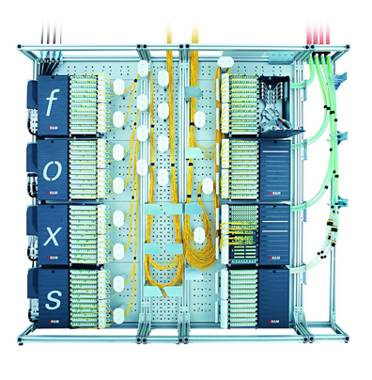
 The Swiss manufacturer has developed a universal concept for patch cord management. Both the patch cord management system and the ODF (Optical Distribution Frame) simplify and expedite individual cable handling. All sizes, types, combinations, and ODF configurations now feature a Universal Patch Cord Management System. The patch cord guide is now even clearer than before, resulting in increased safety and security. Patch cord lengths, from three to five meters, are easily accommodated within the distribution cabinet. The ODF also allows for internal patching with a standard length of four meters.
The fiber entry through the SpliceMODULE has been optimized, now supporting mixed assemblies of different cables and blown tubes. Fibers are easier to feed even as their density continues to increase. Both features—mixed cabling and increased densities—meet user needs. Scaling and feedback to the distributor are achieved faster and with even greater flexibility.
Distribution cabinet planning in just five minutes.
A new feature is the ODF SCM Configurator, based on HTML programming and requiring only internet access. R&M technical consultants carry it with them on their laptops or iPads to the customer's site and input the required parameters. In just five minutes, an entire distribution platform can be easily entered into the system, including the layout, bill of materials, and patch cord management concept. Up to 2,304 splices and connections can be arranged in the R&M ODF, occupying a footprint of less than 0.30 m².
Visio and AutoCAD templates for the Raceway System have also been optimized. These are used to configure and plan cable routing in headquarters and data centers in virtually no time. Similarly, the warehouse for Raceway System components has been expanded in Wetzikon, the manufacturer's headquarters.
More information or quote.
Image file: Source R&M
Simple distribution, fast management: R&M's ODF.
A universal concept for patch cord management and fiber entry optimization for mixed cabling and increasing cable storage densities.