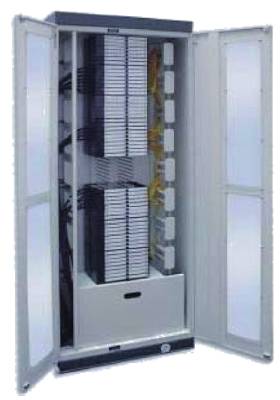
 Access to the interior of the distribution frame is from the front, allowing cables to be inserted from either the top or bottom. This, combined with its flexible configuration, makes the REOP a compact structure capable of managing a large amount of fiber in a minimal space.
There are four different models of distribution units, depending on the height and the type of organizing tray chosen (BMM-8 and BMM-12).
The interior of the REOP model optical distribution units can be divided into four zones:
1) Cable entry/exit zone. The upper part (if the cables enter the distribution unit from the ceiling) or lower part (if they enter from the floor) has space for the entry and/or exit of fiber optic cables, as well as a system for securing the cable jackets to the distribution unit.
2) Fiber optic loose tube routing zone. The left side of the distribution unit is separated from the central zone by a divider plate. The space between the left side of the distribution unit and the divider plate is reserved for routing and directing the fiber optic loose tubes from the cable entry/exit zone to the previously assigned organizing tray. Throughout their entire length, the tubes are protected with a special black sleeve (supplied with the splitter according to the number of trays to be installed). This additional protection prevents the tubes from bending or kinking, and consequently, from damaging the fibers inside.
3) Fiber Optic Connectorization and Splicing Area: The central part of the splitter is reserved for the placement of 3dnet.es BMM-8 and/or BMM-12 fiber optic organizer trays, where the fiber optic connectorization and splicing will be carried out.
4) Jumper Routing Area:
The enclosure, made of 2 mm thick steel sheet, is U-shaped and mounted on a rigid lower frame with
adjustable feet for leveling. The upper section is finished with a second rigid frame with a metal plate containing openings for cable entry/exit.
On the back of the enclosure, in its central section, are installed 8 or 9 (depending on the height of the distribution unit) comb-type support assemblies, each capable of holding 8 BMM-8 and/or BMM-12 trays. The prongs of the comb-type supports allow for the insertion and removal of the trays, with two positions that hold the tray fully closed or fully open.
The distribution unit has two doors on the front that allow access to the interior. These are made of sheet steel with transparent methacrylate windows.
Finally, the 8 or 9 wire guides on the right side and the separator plate located on the left side are made of the same material as the enclosure (sheet steel).
3dnet REOP cabinets have been designed based on 3dnet's BMM model fiber optic splice and connector trays.
They are manufactured from ABS-PC, meeting low smoke emission and zero halogen requirements. These trays are rectangular in shape and feature adapters located on the right side, providing ease of handling and safety by preventing the operator from directly viewing the front faces of the connectors (and consequently the laser light).
Fibers are inserted from the left side of the tray.
Fiber arrangement and splicing are carried out on the organizing unit, which has two compartments, each capable of holding eight heat-shrink splice protectors (16 splices per tray).
The amount of fiber that can be stored in the organizing unit varies depending on the number of turns of different radii applied to the fiber.
The minimum bending radius of the optical fiber is limited to 35 mm anywhere within the organizing unit, ensuring reliable transmission at 1550 nm for single-mode optical fibers. The fiber's path through the tray is determined by its design, simplifying installation and preventing the operator from misorganizing the fiber inside. The organizing unit has a transparent methacrylate protective cover.
Three main models are available, based on capacity.