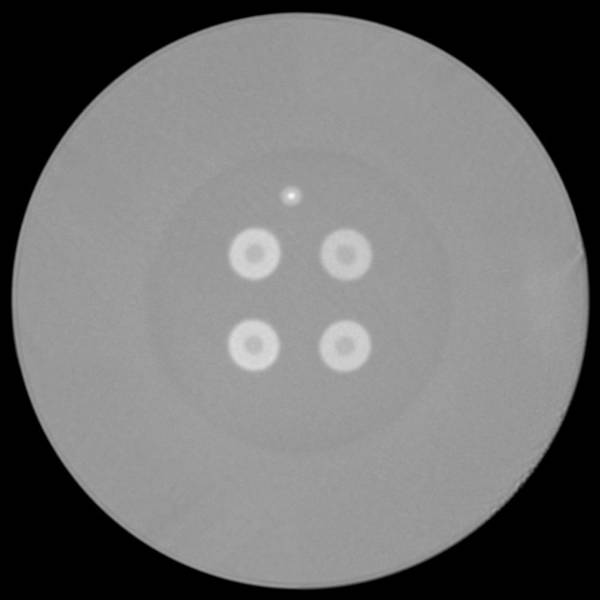
Data network traffic in long-distance transmission systems is growing due to the widespread use of smartphones, data centers, and other technologies; and transmission capacity has been enhanced by the low loss of single -mode optical fiber cables . At the same time, to achieve this dramatic capacity improvement, space-division multiplexing (SDM) has been intensively studied, and multi-core fiber (MCF) is anticipated to be a next-generation optical fiber capable of achieving ultra-high-capacity transmission systems.
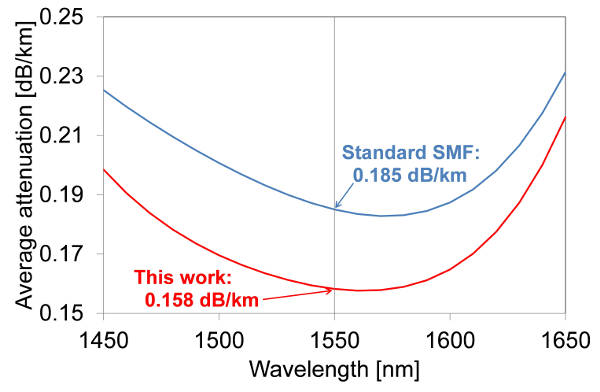
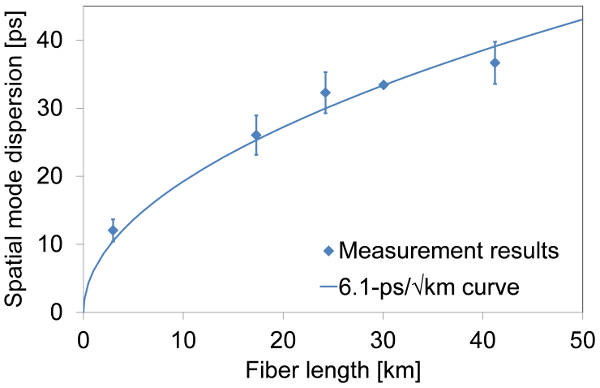 Sumitomo Electric has developed a coupled MCP (CC-MCF)2 of 4 pure silica cores, in the 125-micron cladding standard. The developed fiber has achieved an attenuation1 of 0.158 dB/km at a wavelength of 1550 nm and a spatial mode dispersion (SMD)3 of 6.1 ps/√km4 at wavelengths of 1520 to 1580 nm, which are the lowest ever recorded for optical fibers for space-division multiplexing.
The ultra-low attenuation, combined with the ultra-low loss single-mode fiber (SMF), enables signal transmission with less noise than previous SDM fibers, and is expected to achieve a spatial channel count without any per-channel capacity degradation. The SMD of 6.1 ps/√km is one-fifth that of the lowest SMD of previous MDF fibers, thus reducing the computational complexity of the MIMO (multiple-input-multiple-output) digital signal processing (DSP)for crosstalk compensation. Furthermore, the CC-MCF, developed with the standard 125 µm diameter cladding, can be wired using existing cable designs for standard optical fibers and is expected to have high mechanical reliability equivalent to that of standard optical fiber.
* 1: Attenuation, or transmission loss, is the amount of light degraded by scattering and absorption as it travels through an optical fiber. With lower attenuation, optical signals can be transmitted over longer distances. The lowest loss for commercially available optical fiber is 0.154 dB/km at 1550 nm, achieved in ultra-low-loss single-mode fiber for submarine transmission. The attenuation for standard single-mode fiber is around 0.185 dB/km. The lowest attenuation for SDM fibers previously was 0.168 dB/km (averaged over the core).
* 2: Types of Optical Fibers
Characteristics
Single-mode fiber (SMF): An optical fiber with a thin core.
Standard optical fibers: A standardized optical fiber for different fiber optic communications, including SMF. The standard diameter cladding (glass) is 125 microns.
Multi-core fiber (MCF): An optical fiber with multiple cores. There are "decoupled" and "coupled" types.
Decoupled MCF: An MCF with core-to-core crosstalk low enough to use each core as an isolated spatial channel. To suppress crosstalk, the core-to-core distance must be increased, and the cladding diameter tends to increase.
Coupled MCF / Core-coupled MCF (CC-MCF): An MCF with a short core-to-core distance and high crosstalk. MIMO DSP is necessary for crosstalk compensation, but CC-MCF can pack more.
Multimode fiber (MMF): An optical fiber with a thick core (>10 microns). Multiple optical pathways (modes) exist within the core. Modal crosstalk is difficult to suppress, and therefore MIMO DSP is necessary for crosstalk compensation in SDM transmission
* 3: Spatial mode dispersion (SMD) is the amount of light pulse propagation time induced by optical path differences between multiple optical paths in an optical fiber. A lower SMD is preferable because the DSP computational complexity can be reduced.
* 4: "ps/√km" is the unit of spatial mode dispersion in the coupled MMF, representing that the time propagation (p) of the pulse signal grows proportionally to the square root of the transmission distance (√km). That is, the DME after a 10,000 km transmission is 100 times (not 10,000 times) higher than after a 1 km transmission. Furthermore, the pulse signal propagation (PS, NS) of the MMF grows proportionally to the transmission length (km) because mode coupling is weak. Thus, the SMD unit becomes "ps/km", "NS/km", etc.
* 5: DSP MIMO or Multiple-Input-Multiple-Output digital signal processing is the digital computation that can compensate for crosstalk between MCF and MMF. The fully mixed signals can be separated from the original individual signals.