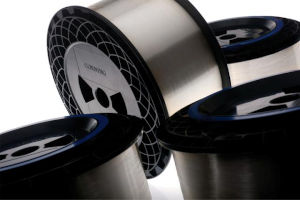
 Corning Incorporated has introduced the Corning SMF-28® Contour optical fiber to help telecom operators address the growing number of connected devices, the construction of 5G networks, and advances in cloud computing.
 Fiber offers:
- Enhanced bending designed to reduce the impact of installation errors and optimize reach in densely wired environments where 5G networks are being deployed. The SMF-28 Contour fiber is an ITU-T G.657.A2 fiber that has 10 times the macrobending strength of G.652.D fibers and seven times the macrobending strength of G.657.A1 fibers. The associated increase in microkinking strength enables the creation of dense, high-fiber-count cables, necessary to meet the demands of future high-capacity networks.
- Exceptional compatibility with legacy networks, while providing superior bend protection, which can result in up to 50% faster installation by minimizing splice loss correction work. Other G.657.A2 fibers also provide bend protection, but with a compromised and smaller mode field diameter. The SMF-28 Contour fiber makes no compromises, providing both G.657.A2 bend protection and a 9.2-micron mode field diameter in the same product.
- Wide spectrum and low-loss transmission across all wavelengths that constitute the communication systems of today and tomorrow. First, the low attenuation of SMF-28 Contour fiber provides 10% greater reach across all networks and up to 20% wider access network coverage. Second, the bend loss protection of SMF-28 Contour fiber allows for doubling the network reach in new, long-wavelength fiber-to-the-home (FTTH) systems. Together, these features enable expanded FTTH subscriber areas and increased revenue potential.
The SMF-28 Contour fiber is available in a standard 242-micron configuration and a smaller 190-micron version. Smaller diameter designs are becoming increasingly important because, while bandwidth demand has increased, the space available for network infrastructure has not. The 190-micron version of the SMF-28 Contour fiber allows for the use of smaller cables with a higher fiber count, maximizing the use of existing infrastructure.