Although most organizations use encryption technology based on databases, data centers, storage arrays, or hard drives to provide comprehensive protection while data is at rest, it is when this data leaves the premises and is transmitted across networks that it is most vulnerable to compromise and interception. Maintaining complete physical security of end-to-end links remains a key challenge for operators, and because cables are easily accessible to hackers, they have become strategic targets. Compromising a fiber network link is not as difficult as it may seem, as hackers can easily acquire software tools to infiltrate a fiber optic network and remain undetected.
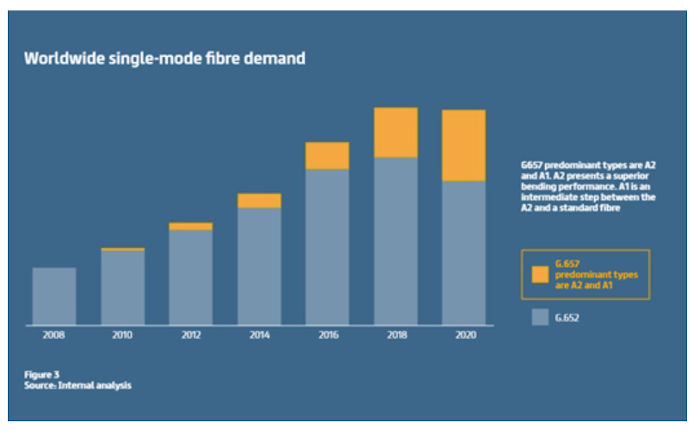
Introducing encryption solutions into the optical systems that transmit and receive data will help secure the network end-to-end. By leveraging optimized glass technology, Prysmian Group's BendBright™XS G.657.A2 fiber secures all transmission paths, from long-distance to access. Offering 100 times greater bending resistance than G.652.D fibers when bent using a hacker-tracking tool, BendBright™XS G.657.A2 fiber is being deployed in networks worldwide, seamlessly providing added bend immunity and intrinsic traffic security.
ITU-T G.652.D single-mode fibers are inherently sensitive to bending effects. When bent, hackers can exploit this weakness to intercept transmitted signals. This is achieved by hackers who steal sensitive customer data from fiber optic cables, particularly at splices and splice cassettes, where fibers are individually pulled for splicing or structuring.
Prysmian's solution helps facilitate the demanding cable designs required to increase density and reduce space in both rural and urban environments. It fully complies with the strictest recommendations of the G.652.D standard, and is backward compatible and future-proof.
Flat 2-fiber indoor drop fiber optic cable.
GetConnect presents a flat, 2-fiber indoor drop cable.
This cable is one of the most comprehensive on the market. It offers numerous advantages: