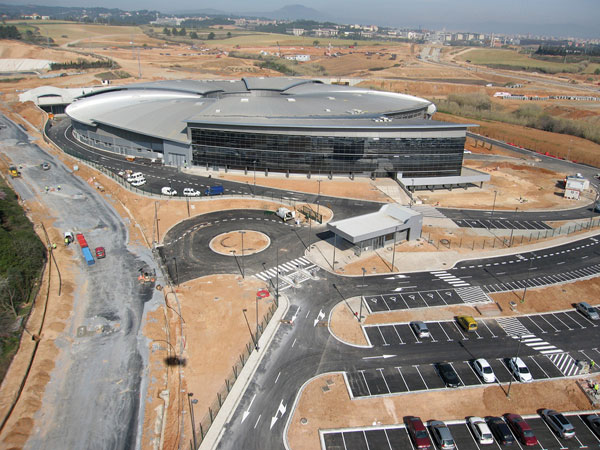
This project represents the largest and most significant investment in scientific research made to date in Spain. R&M's cabling solutions were selected for the first phase of installation, providing optimal voice and data infrastructure to the laboratories, offices, and administrative departments. The collaboration was so successful that R&M's fiber and copper solutions were chosen for the next phase of installation—the accelerator synchronization network, as well as the data and storage networks—when the tender was issued.
When the complex is fully operational in the coming years, it is expected that around 1,000 scientists per year will visit and conduct experiments using the synchrotron. Cells, the consortium responsible for the construction and operation of the Alba Synchrotron, recognized from the outset that a high-performance, error-free voice and data network guaranteeing secure and reliable communications was crucial
for the success of such an ambitious project, both in its initial phase and in the long term.
The voice and data network installation in Cells' offices, beamlines, and adjacent facilities, built and equipped by the engineering firm Soclesa-Elecnor, was carried out using R&M copper cabling solutions, selected for their component quality, bandwidth, cost, and future expansion capabilities. The project was supplied by Atlas Comunicación, a certified R&M distributor.
To ensure adequate speed for high-resolution image transmission, the network was designed using 10 Gigabit Ethernet copper cabling, a pre-terminated fiber optic system, and MPO modules for the backbones. Around 1,700 connection points were installed with the Real10 system, using 130 km of Cat. 7 900 MHz S/FTP cable, thus achieving an EA class system.
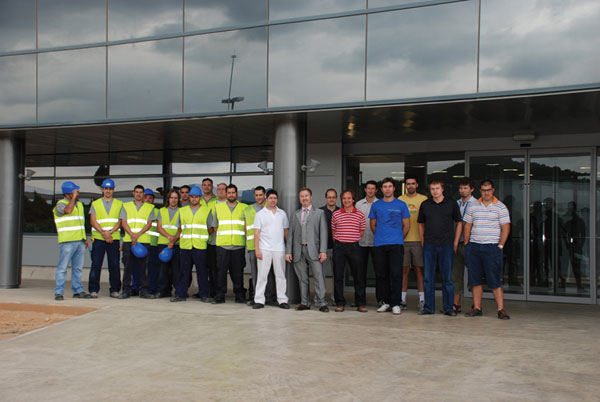 Furthermore, the added value and security offered by R&M's color-coding system for the correct identification of connectors, both for patch panels and user outlets, along with the quality of the connections, was a decisive factor for Cells in discarding the other options.
With the first phase complete and Cells satisfied with the quality and reliability of the cabling products used, the consortium prepared the contract for the second phase—the IT network that will control the synchronization of the storage ring within the Synchrotron and the data network storage equipment. Once ready for tender, R&M's Madrid office worked closely with systems integrator Ambar Telecomunicaciones on a design proposal that was ultimately selected by Cells in March of this year.
“The specific installation requirements led us to collaborate with manufacturers whose products best met the client's needs, not only in terms of switches and routers, but also for passive cabling,” said Santiago Cea, Project Manager at Ambar. “For the copper cabling, R&M selected the latest generation shielded Cat 6A solution with Category 7 1200 MHz cable because it guarantees optimal performance and protection against electromagnetic interference.”
It was in the quality and results of the fiber optic cabling that R&M truly excelled. The solution chosen as the most efficient in terms of quality, implementation, and ease of installation was R&M’s Varioline pre-terminated fiber optic system. Above all other features, the key point for Cells was, in particular, the ring synchronization network, which must ensure the accelerator’s synchronization, including the injection of electrons into the ring using magnets and the synchronization of diagnostic tools to control and stabilize its orbit. Therefore, the organization established a maximum permissible signal delay in the fiber optic cabling of 10 nanoseconds for 35 m runs and 14.8 nanoseconds for 200 m runs. R&M provided the consortium with two samples of Varioline Fiber Optic cable for its own analysis. The results showed a signal delay of no more than 0.5 nanoseconds and 1.1 nanoseconds respectively—around ten times less than the maximum allowed in both cases.
Subsequently, Cells checked and verified the performance of approximately 200 pre-terminated fiber optic cable runs, 35 and 200 meters long, supplied by R&M through the certified distributor Atlas Comunicación. In a letter sent to the R&M Spain team, Oscar Matilla from the Electronics and Control division said: “The results have been excellent, as you can see in the attached report. Congratulations on the work done!”
Work on the second phase has already begun and is expected to be completed by the end of 2009. Cells' long-term goal is to increase the number of operational beamlines from the current 7 to a maximum of 32. The network will require expansion, so R&M and Ambar will work closely together to ensure the necessary support. The future of the alliance between the two integrators (Ambar and Elecnor) and R&M Spain, which already collaborate on other projects, is very promising.
Author:
Miguel Ángel Sevilla Nebril (Enterprise Sales Manager Spain / Portugal) R&M