
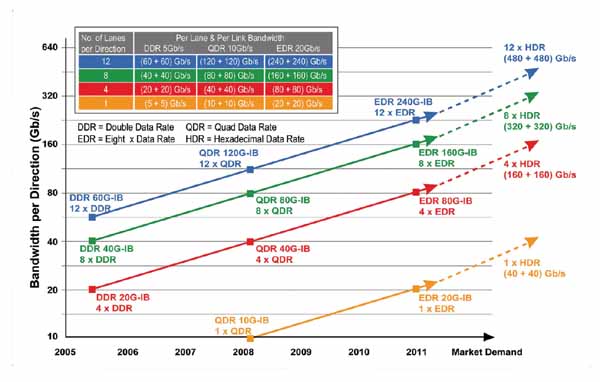
In light of this anticipated growth, leading companies, industry organizations, and trade associations have been actively working to ensure that specifications and products are ready to meet these projected capacity needs. Several industry specifications have been developed to ensure uniformity, compatibility, and network functionality for hardware, signal, and software communications. These industry standards include those for data center interconnect technologies such as InfiniBand, Fibre Channel, Ethernet, Serial Attach SCSI (SAS), and Serial ATA (SATA). Meanwhile, organizations such as the InfiniBand Trade Association and various IEEE 802.3 subcommittees are finalizing specifications that address the industry's demand for systems capable of supporting 40 Gbps and 100 Gbps bandwidths and I/O connections. To further reinforce these trends, a roadmap has been published that points to link bandwidths well above 100 Gb/s in the 100 Gb/s bandwidth range. See Figure 2.
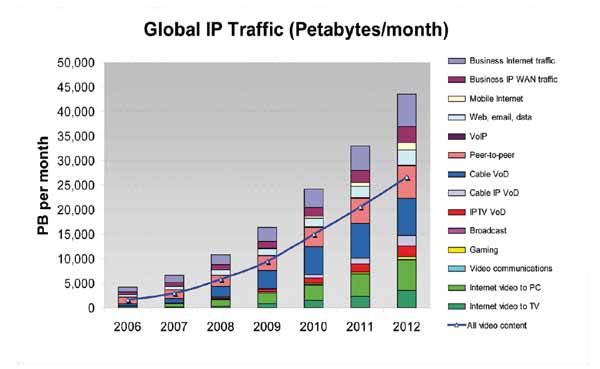 Meeting these bandwidth needs is not always easy, as service providers must balance customer demands for timely, reliable, and cost-effective service delivery with energy and equipment costs, equipment utilization, and the overall efficiency and productivity of data centers. Clearly, these challenges will continue to affect virtually all data centers and communication equipment platforms, whether switches, routers, servers, or storage systems.
The growth and proliferation of 10Gb/s server connections over the next five to six years will be followed by a similar growth cycle in 40Gb/s connections, beginning around 2015. To connect these servers to the network, industry analysts expect Ethernet switches to experience a CAGR of 143% from 2008 to 2012, and that demand for high-performance servers with 10G ports will have a CAGR of 31% over the same period.
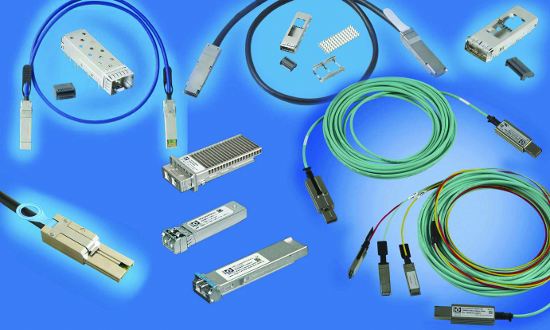
To support the growth of this sector, new and evolving I/O interface and cable connection specifications such as SFP+, QSFP+, CXP, mini-SAS HD, and CFP will provide the high-speed external and internal cable connections needed to manage this significant growth.
Where does this product evolution and technological advancement leave suppliers of current copper-based I/O connectivity solutions? The short answer is that producing cable assemblies for these systems is not as straightforward as it once was. There are several challenges that any viable cable assembly supplier must address to ensure they are providing their customers with a compatible, high-quality interconnect link.
Systems and Equipment Design:
Systems and equipment designers face several challenges in trying to adapt to increasing bandwidth demands. Technologies such as multi-core processors, virtualization, consolidation, increasing host bus speeds, and memory performance have helped increase the available capacity a designer can integrate into a system design, but these technologies strain bandwidth capacity, power consumption, and power and temperature management. Migrating to higher speeds while maintaining adequate signal integrity increasingly makes it difficult to continue using common and cost-effective printed circuit board materials such as FR-4 and cables with commonly used insulation, as well as the manufacturing processes.
 Let's take a Google search as an example of the power management challenge. With current chip capabilities and technologies, it's estimated that a Google search requires 3 watts of power to complete the query. But for proper cooling and heat dissipation, an additional 3 watts are needed. This power requirement is leading designers to use "green" techniques such as port power management functionality, which automatically puts the port into a "standby" mode when not in use. This aims to reduce power consumption through more efficient power management. This is just one example of the many, and sometimes conflicting, considerations that system designers and users must weigh when designing next-generation equipment.
Signal integrity at higher speeds and power consumption are not the only issues designers and users must consider. Other factors, such as proper system heat management and dissipation, sufficient airflow, cable routing and EMC/EMI protection, port density, and the installation, removal, and connection of cable assemblies, must also be carefully considered.
Equipment manufacturers and users are looking for flexible and adaptable interconnect systems that are easy to install and maintain, and that provide potential performance capacity compatible with future system upgrades. While the minimum requirement is to maintain the current system's port density, there is a preference for increasing the I/O port bandwidth density at the edge of a line card to provide greater capacity. The goal is the ability to freely design or configure any available system port with fiber or copper cabling, depending on the specific installation environment, with minimal problems and costs.
All these needs have contributed to the necessity of a closer working relationship between system designers and suppliers of high-speed I/O systems. In the past, these two disciplines did not collaborate extensively, but with the advent of higher signal speeds, the need for increased collaboration between system designers and I/O system designers became evident in order to achieve the objectives outlined above. This also requires both parties to better appreciate and understand the specific functional and design capabilities that each can contribute to the overall system design without adding excessive manufacturing costs and expenses.
This new dynamic is best illustrated by the collaboration among industry standards bodies, committees, and subcommittees, as well as among ad hoc industry groups, such as the Small Form Factor (SFF) committee, where a great deal of discussion and collaboration takes place. This interaction has become a necessity for equipment suppliers, who ultimately provide their customers with what they request. The I/O system supplier must provide the equipment designer with as much flexibility and functionality as possible.
I/O System Solutions:
The good news is that the I/O systems that have been developed address many of the requirements. Copper-based and fiber-optic-based XFP and SFP I/O systems have been on the market for some time. They have been key in bringing I/O port bandwidths to 5 to 6+ Gb/s per channel capacity level. These systems are also more compact, minimizing the required longitudinal board contact line. The SFP system significantly reduced the contact line and module design required by previous systems such as GBIC and XENPAK.
One need that the SFP system failed to address was the 10 Gb/s channel capacity, which is currently in demand. This led to the development of the SFP+ system, capable of properly supporting a 10 Gb/s channel capacity. Although SFP and SFP+ systems share the same board space, connectors, and drives, only SFP+ systems can support a 10 Gb/s channel bandwidth.
Progress in I/O product development continues with recent developments of industry-standard interfaces such as QSFP+, mini-SAS/SATA, mini-SAS HD, CXP, and CFP.
The QSFP+ system was created to meet the need for an I/O system capable of supporting a total bandwidth of 40 Gb/s per port. Similarly, the CXP system is being developed to support systems requiring a total bandwidth of 100 to 120 Gb/s per port. Both systems are being developed, offered, and aligned with various interconnect technologies, such as InfiniBand and Ethernet, and are being adopted in several industry specifications. Both also offer units and connectors compatible with a passive copper cable solution, typically used for relatively short cables (5 to 7 meters or longer, depending on acceptance criteria); an active-equalized copper cable solution for longer lengths (up to 15 meters or more, depending on acceptance criteria); a plug-in optical transceiver module with an optical I/O connector on the back of the module; or an active optical cable (AOC) assembly with the fiber optic termination inside the cable's rear housing. The architectural approach provides the system installer and user with the flexibility to define and change port configurations and capabilities as needed.
The CFP system, announced in early 2009 as an MSA (Multi-source agreement), takes a similar approach to the CXP interface in that it can support a bandwidth of 100 Gb/s. The CFP system, as currently configured, always has the transceiver housed within the module and uses a standard two-piece connector interface between the module and the equipment port. The module's I/O side allows for multiple port configuration options (SFP+, QSFP+, CXP, or combinations of simplex or multi-fiber optical interfaces), which can be customized according to the customer's desired data distribution and I/O interface. In contrast to the more compact CXP module, the larger CFP transceiver module is optimized for longer-range single-mode fiber applications.
The demand for bandwidth and signal transmission speeds is driven by social networking applications and intensive video usage, which are expected to see a significant increase in the future. A considerably higher level of collaboration is needed among equipment designers, raw cable suppliers, component suppliers, and high-speed I/O system suppliers to adequately meet these market demands. This collaboration will be reflected in products that offer greater flexibility and port density in port configurations. Given the added functionality and higher signal speeds, manufacturing these cable assemblies is now a much greater challenge.
Quality considerations for raw wires, printed circuit board design, and wire management, stripping, termination, and strain relief must be properly managed and controlled as these systems and components evolve.
References
Cisco Visual Connectivity Index: Forecast and Methodology, 2007-2012, June 16, 2008 Cisco Press Release.
Infiniband Trade Association Roadmap, 2005-2011+.
Author: Jim David, Global Product Manager for High-Speed Cable Groups and Connectors, FCI
More information or a quote


