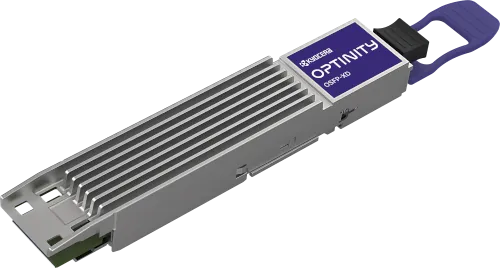
Kyocera has been developing onboard optoelectronic modules compatible with PCIe® 5.0, which convert electrical signals from CPUs, GPUs, and other components into optical signals. With this new development, by advancing to the PCIe® 6.0 standard, the company has achieved a new level of high-speed, high-capacity communication. Furthermore, the pluggable configuration of the new module improves design flexibility, system configuration versatility, and ease of deployment.
Kyocera will continue developing onboard modules to offer optoelectronic interfaces tailored to specific applications and configurations.
This product was developed in collaboration with AuthenX, Inc., in which Kyocera has invested through its corporate venture capital fund, Kyocera Venture Innovation Fund I (KVIF-I).
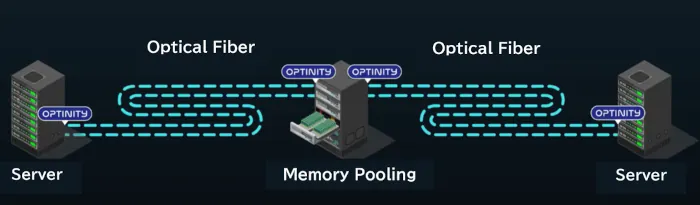
Conceptual image of the optical interconnection in a data center
Development Context:
In recent years, with the advancement of generative AI and other technologies, the volume of data managed in data centers has grown rapidly. Consequently, PCIe® interfaces connecting high-performance devices such as GPUs and AI accelerators must support higher speeds and capacities.
Traditional PCIe® connections using electrical wiring present challenges such as increased signal loss and power consumption as transmission distance increases. Furthermore, they require the use of retimers to ensure communication stability, which increases latency and power consumption. This limits flexibility in equipment layout within racks and makes optimizing cooling and maintenance more difficult.
To address these issues, PCIe® connections using optical signals are gaining prominence, as they enable stable, low-loss transmissions even over long distances, improving system design flexibility and contributing to the overall energy efficiency of the data center.
In this context, in addition to onboard modules, Kyocera has developed a new plug-in module compatible with PCIe® 6.0.
New Product Features
1. Higher Capacity and Lower Power Consumption with Optical PCIe® 6.0
Using the OSFP-XD form factor, Kyocera achieves high-capacity communication with PCIe® 6.0 x16 (64 GT/s per lane). Optical transmission eliminates the need for retimers in electrical cabling, significantly reducing power consumption between PCIe® devices. This contributes to overall data center energy savings, reducing environmental impact and operating costs.
2. High Versatility Thanks to the Plug-in Design
The plug-in design enhances system flexibility, allowing integration into existing infrastructures and facilitating future expansion.
3. Greater Flexibility Through Long-Distance Connections
Fiber optic transmission extends the distance between PCIe® devices to several hundred meters, compared to the less than 10-meter limit of electrical cabling. This allows for more flexible equipment placement, optimizes cooling, and significantly improves maintenance.
Future Development:
In addition to onboard and OSFP-XD modules, Kyocera plans to develop solutions using other formats, such as Optical CDFP, progressively expanding its product portfolio. This will contribute to the development of large-scale computing in the future.