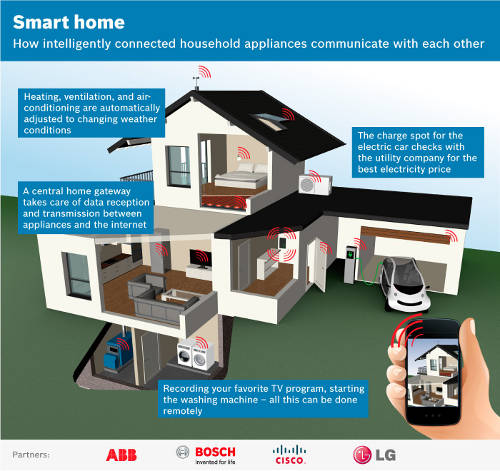
 Under the agreement, the participating companies aim to develop an open architecture that facilitates data exchange. The software platform will enable different devices and services to communicate with each other. Additional application software will also be provided. This will allow electronic devices and appliances from different brands within a home to be integrated into the platform and become part of home security, healthcare, and entertainment systems. Currently, without a common platform, this is not feasible. Therefore, devices—from light switches and blind motors to household appliances, multimedia systems, smartphones, tablets, and PCs—which until now have not communicated with each other or via the internet, will now be able to do so in a standardized way. By networking the various devices in the home, this common platform will represent a further step towards the implementation of the so-called 'Internet of Things' for homes, in which all physical objects will be networked.
This software platform will be available to all manufacturers, software developers, and service providers. The new platform will bring together a wide variety of services, for example, in the areas of energy management, security and comfort technologies, and consumer electronics. This will allow for the creation of new business models, such as the development of software to program the various apps for these areas. Consumers will no longer have to choose between different technologies to automatically control their electronic devices at home.
Security, comfort, efficiency:
A Smart Home will be able to detect, for example, with the help of sensors and software, that the upstairs windows are open and link this information to online weather forecasts. To protect against an approaching storm, the system could automatically close the windows and lower the blinds. Another clear example would be during vacation periods, when the system could activate the lighting controls in the rooms to deter burglars. Furthermore, if a motion sensor is triggered, the Smart Home will be able to alert the security service and transmit a video to the residents' smartphones.
Many devices, one language.
These applications are already possible, but each requires its own technical solution, and the various solutions are not always compatible. Therefore, ABB, Bosch, Cisco, and LG intend to develop a common language that will allow devices to communicate with each other. Following the standards this consortium aims to establish, devices will connect via the Home Gateway to the internet and a shared software platform, enabling the services of different providers to interact. Anyone who buys a refrigerator, washing machine, heating system, or any other type of appliance in the future with the provider's compatibility certificate can be confident that the appliance will connect and integrate seamlessly into their smart home system.
Once
the aforementioned standards are available, compatible devices will communicate with each other via networks such as Wi-Fi and ZigBee, or via wired connections like KNX. The various devices will be controlled through a central control unit in the home, which can be from any manufacturer. What's truly important is that it has software installed that meets the standard. Independent developers will be able to program new apps that manage, via the internet, for example, the central control unit, the heating and cooling systems, and the electrical installations throughout the entire home. The software platform will have a sophisticated security architecture to ensure that only authorized individuals have access to the functions of their Smart Home.
What is a Smart Home?
The Smart Home concept defines homes whose devices are interconnected, offering new functions and services. They can generally be controlled remotely via the internet. Other terms for this technology include Smart House, Smart Living, or eHome. In simpler terms, we could call it a smart home connected to a network. Connecting Smart Homes to a local network helps, among other things, with a topic as important for the future as the efficient use of energy. If, for example, energy prices are available online, homes can react automatically and meet their needs at the lowest possible cost, without requiring any intervention from residents. The washing machine would activate when electricity is cheaper. Another key aspect of Smart Homes is their security, for example, through remote control and diagnostic systems. Smart Homes will even make possible what's known as "Ambient Assisted Living" for homes adapted for the elderly.
Cambium Networks and EZVIZ collaborate on wireless video surveillance
Cambium Networks and EZVIZ have formalized a strategic agreement aimed at boosting advanced wireless video surveillance services in the residential and micro SME market, offering new business opportunities to Wireless Internet Services Providers (WISPs).