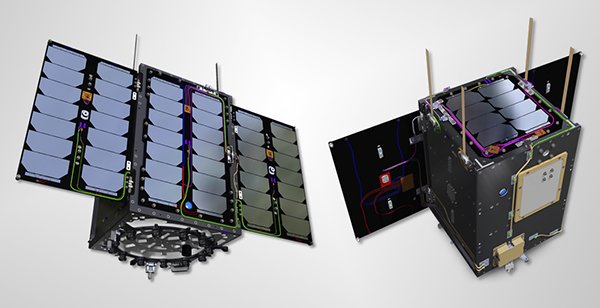
This first university satellite was conceived by a group of researchers from the Ignacio Da Riva University Institute of Microgravity (IDR/UPM) as a scientific and technological demonstration satellite in orbit for industry, but the primary aspect of this project was its educational nature. Therefore, the first objective was the satellite itself: to test the capacity of the Polytechnic University of Madrid (UPM) to design, develop, build, test, integrate, and operate a spacecraft with modest capabilities, but one that retained all the complexity of a complete space system.
Successfully launching the satellite into orbit was a major achievement, but our greatest success has been the practical training gained by the large group of students, professors, and other technical staff involved in the project. Some of these students went on to join the faculty at UPM and other Spanish universities, while others became highly successful professionals in industry.
Another important consequence was the establishment of strong relationships with industry, which have continued, on the one hand, supporting subsequent UPM satellite missions, and on the other hand, promoting the adaptation of facilities for space environment testing in the UPM area, which are so necessary for the development of small missions.
In addition to the inherent technical difficulties of any space project, there was the challenge of organizing the team needed for a project of this complexity, especially within the framework of a university. Not to mention the complexity of securing the necessary funding. This task fell to José Meseguer, founder and first director of the IDR/UPM, among many others.
UPMSat-1 became the pioneering satellite of the UPM program, which entailed addressing and resolving a large number of bureaucratic issues associated with its development. To cite a couple of examples, it was necessary to promote the creation of the Spanish satellite registry REOELEU, by the Ministry of Foreign Affairs and the Ministry of Industry, and also to negotiate with the Arianespace launch organization, supported by the Spanish Ministry of Defense, the inclusion of our satellite in the launch of the Helios military satellite.
The continuation of satellite development activities by that group of professors involved in UPMSat-1 was reduced due to a lack of funding at the time, although they focused on the development of space instrumentation for scientific missions such as MINISAT 01 (1997); APIS and TEBAS for the International Space Station, ISS (2003); Sunrise-1, 2 and 3 (2009, 2013); Rosetta (2004-2016), ExoMars (2016, 2020); Solar Orbiter (2014-2020), Mars 2020 Rover Mission (2020)..
When it finally became possible to begin developing UPMSat-2, led by professors Gustavo Alonso and Elena Roibás, one of the main difficulties was finding a launch opportunity. Initially, it was going to be launched with a Ukrainian launcher, until this became impossible in 2014 due to the conflict between Ukraine and Russia. The opportunity arose later thanks to an agreement reached with the European Space Agency (ESA) for an experimental flight.
UPMSat-2 followed a similar concept to its predecessor, but adapted to a different technological and scientific demonstration mission. It was launched on September 3, 2020, culminating a launch campaign marked by the COVID-19 pandemic. In addition to the immense effort required to develop the satellite, a series of challenges arose during that launch campaign that could have been the plot of an action-thriller. This satellite has been operational ever since, providing us with highly relevant information about the mission's experiments, and has far exceeded our expectations by well over the two-year lifespan of its design.
The IDR/UPM is currently developing the third model in the UPMSat series, the UPMSat-3. This microsatellite is smaller than its predecessors, weighing 22 kg and measuring 250x250x366 mm³, but is technologically much more advanced. It is scheduled to be launched into space aboard the new Spectrum launcher, from the German company ISAR Aerospace, during the first half of 2026.
UPMSat-3's primary scientific mission will be to image the cosmic microwave background. Simultaneously, it will serve as a low-cost technology demonstration platform, carrying various experiments and innovations from Spanish companies and research centers that will test their functionality in orbit. Furthermore, UPMSat-3 aims to continue IDR's line of work, which focuses on the development and testing of control algorithms and attitude determination systems for satellites.
The UPMSat-1 (1991-1995), UPMSat-2 (2013-2019), UPMSat-3 (2023-2025), and UPMSat-4 (currently in preparation) series of university satellites has been developed in collaboration with various schools and research groups at the UPM: ETSIAE, ETSISI, ETSIT, ETSIINF, and the IPTC's STRAST group, as well as companies and institutions in the space sector (AIRBUS, INTA, OCCAM, OESIA-TECNOBIT, SATNOGS, EA-AMSAT, DLR, ESA, ISAR, etc.). Logistical and financial support has also been provided by the various Ministries of Science, Industry, Research, and Defense, along with the CDTI, the UPM, the Community of Madrid, and companies such as MISUMI, GMV, and DHV
The various rectors of the UPM have also committed to the specific UPMSat project that coincided with their term of office: Rafael Portaencasa and Saturnino de la Plaza (for UPMSat-1), Carlos Conde and Guillermo Cisneros (for UPMSat-2), and Óscar García Suárez (for UPMSat-3).
We are proud of the work our entire team has done, where everyone has contributed with great collaboration and enthusiasm, overcoming many obstacles and complex situations (within the context of various economic crises). But that's how you learn to solve problems in engineering.
Regarding the educational objective, we are very pleased and excited by how well the participation of our students from the Master's Degree in Space Systems (MUSE) at the UPM has worked over the years. Their involvement in these projects (including realistic practical exercises and working sessions with a concurrent design facility, CDF) has provided them with an experience that is difficult to obtain otherwise, as it has allowed them to see a space system in all its aspects, combined with specialization in their own field.
I want to take this opportunity to remember and pay tribute (together with my colleagues from the IDR) to Professor Ignacio Da Riva (who died in 1991), founder and leader of the group that started these activities at the ETSIAE, and to Professor José Meseguer Ruiz (who died in 2015), the first director of the IDR, who was the soul of the group for many years and promoter of the development of this satellite program and whom those of us who worked with him greatly admired for his wisdom and great humanity.
Author: Angel Sanz Andrés
The UPM-Sat1 Satellite "Countdown to a milestone"
Link to the UPMat-3 website: https://sat.idr.upm.es/
* Ángel Sanz Andrés, professor at the Polytechnic University of Madrid, was the technical director of the UPMSat-1 satellite program. He also directed the “Ignacio Da Riva” University Institute of Microgravity from 2015 to 2024.