Valet parking is a service in which a professional parks drivers' cars in large parking lots and commercial facilities, primarily in Europe and the United States. AVP enables this parking to be done automatically, without a driver in the vehicle. Version 1.0 of the AVP technical report was published by the 5GAA in June 2022, and it proposed a wireless communication scheme (type 2) linking the parking infrastructure to users' smartphones.
The AVP is being developed as an autonomous driving use case that can be deployed in the short term. Type-1 AVP autonomous driving vehicles require expensive, high-performance computing and sensing facilities, while Type-2 AVP cooperative communication vehicles do not require such facilities.
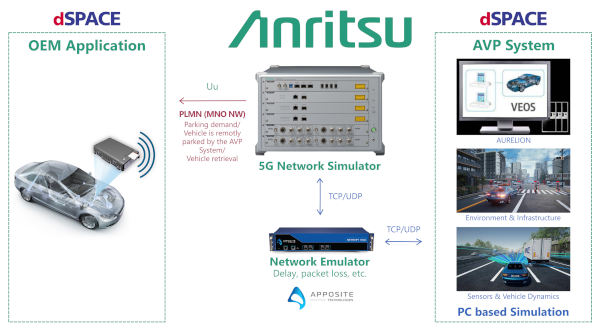
Since Type 2 AVP requires reliable end-to-end communications, a test system must evaluate quality of service management and the effects of IP layer deficiencies. The wireless connectivity environment also needs to be assessed. The test solution has created a digital twin environment that incorporates both virtual and real devices. This allows the necessary system testing and certification to begin before the physical devices are available, thus improving the reliability of Type 2 AVP.
The dSPACE software-based tool integrates and simulates environment/infrastructure/sensor/vehicle information on a single PC. In this demonstration, the AVP system is installed on this PC.
Vehicle motion control (VMC) commands generated by the AVP system are transmitted to the OEM application, which displays the vehicle control status, via 5G communication using Anritsu's 5G base station simulator.
The VMC commands pass through the Apposite network emulator on their way to the OEM application. The emulator introduces IP data delay and data packet loss, making vehicle control unstable due to its impact on the OEM application. AVP developers design control systems and networks to maintain stable vehicle control.