


The Bologna Customer Experience Center: A hub of innovation
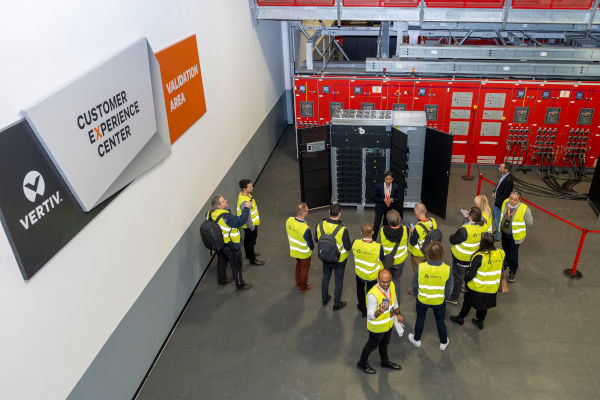
Located in the heart of Emilia-Romagna's thriving technology ecosystem, Vertiv's Bologna CEC offers a state-of-the-art environment for the design, testing, and validation of mission-critical infrastructure. The center is equipped to simulate and analyze real-world conditions, ensuring that infrastructure solutions meet the stringent demands of HPC and other industrial applications.
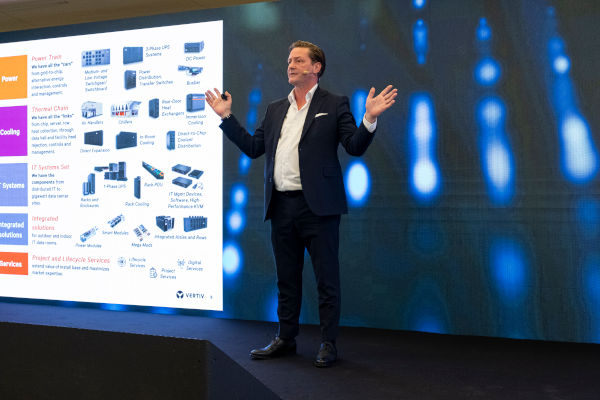 According to Karsten Winther, president of Vertiv for Europe, the Middle East, and Africa (EMEA), "the Customer Experience Center in Bologna is a benchmark R&D center for power management." "At Vertiv, we believe we can cover the entire cooling spectrum, from the area closest to the chip to exhausting heat from the racks.".
Regarding the current technological trend of AI, Karsten Winther stated that the company is working to lead the way in power and cooling for the new density brought about by AI, the importance of industry collaboration for AI integration (highlighting NVIDIA's leadership and joint collaboration), the impact of AI on cybersecurity and its regulation.
Invited by Vertiv to its annual press conference in Bologna, Carlo Ruiz, Vice President of Enterprise Solutions and Operations for EMEA at Nvidia, explained that enabling advances in AI depends on creating an "AI factory" that functions as a unified computing unit. In other words, the AI unit is no longer the microchip, but the data center. He stated that Nvidia Blackwell devices "will increase in performance by a factor of 1000 in eight years." He also mentioned their involvement in the JEDI supercomputer in Germany, the most efficient at 72.73 GFlops/Watt.
“If we spread technology across a data center, we lose the ability to use it as a single computing resource,” he said. “This was already anticipated in our technology roadmap, which is why we partnered with Vertiv to create more efficient systems.”.
AI continues to transform the data center landscape, and this is reflected in the trends for 2025 identified by Vertiv, which predicts increased innovation and integration within the sector to support high-density computing. Furthermore, they anticipate greater regulatory scrutiny of AI and a stronger emphasis on sustainability and cybersecurity.
Key features of the Bologna CEC include:
Comprehensive testing facilities: The center offers integrated testing of uninterruptible power supply (UPS) systems, thermal management systems and other critical systems under simulated real-world conditions.
Customer collaboration: The facilities emphasize transparency and collaboration, allowing customers to witness and validate the performance of their systems during the testing phase. This hands-on approach ensures tailored solutions that meet the specific requirements of each project.
Sustainability focus: With an increasing emphasis on environmental responsibility, the Bologna CEC incorporates energy-efficient testing methodologies and supports sustainable design principles, aligning with the growing need for greener data centers.
Many of the company's latest releases are on display at the center and can be tested and evaluated by end customers.
These include:
- The new Vertiv™ EnergyCore high-density lithium-ion battery cabinets, which are compatible with most current and previous Vertiv™ three-phase uninterruptible power supply (UPS) systems, including the recently launched Vertiv™ Trinergy™ range.
Vertiv EnergyCore cabinets are optimized for five minutes of runtime to full discharge at 263 kWb per compact 600 mm (24”) wide cabinet, and operate across a wide temperature range, making them ideal for high-density environments.
The modular design of Vertiv™ Trinergy™ allows each UPS core to be paired with a dedicated Vertiv™ EnergyCore battery cabinet in a distributed architecture, ensuring uninterrupted service for critical applications. Due to the density of the Vertiv EnergyCore design, only two lithium-ion battery cabinets are required to support each 500 kW Trinergy™ core, compared to the three cabinets required by most vendors.
The Vertiv™ Trinergy™ UPS, an uninterruptible power supply (UPS) system designed to manage the fluctuating load demands of data centers, and Vertiv™ PowerNexus, an integrated solution that provides tight coupling of the UPS and system switchgear to save space, are both available worldwide. The Vertiv Trinergy UPS is available globally in 1500, 2000, and 2500 kVA capacities.
Vertiv estimates that the Vertiv Trinergy exceeds the expected availability of the Tier IV data center power chain, with a projected 99.9999998 percent uptime compared to 99.9994 percent—a difference of 30 seconds of downtime over ten years for the Vertiv Trinergy, compared to eight hours over ten years as expected for the Tier IV data center power chain. The system increases resilience with extended reserve time configurations and its innovative self-isolating core design, featuring a modular architecture with physically segregated 500 kW cores. Each core includes the components of an online UPS: inverter, rectifier, booster/charger, and dedicated, segregated controls, allowing each core to operate independently and provide uninterrupted, reliable power even during maintenance.
Leonardo Supercomputer: Europe's computing power
Leonardo, developed by the Italian inter-university consortium CINECA and housed at the Bologna Technopole, is one of the world's most powerful supercomputers. This exascale-class machine is designed to handle advanced workloads in artificial intelligence (AI), scientific research, and industrial simulations. With a peak performance exceeding 10 exaFLOPS, Leonardo is a testament to the evolution of high-performance computing (HPC).
The supercomputer's infrastructure demands are immense:
Power requirements: Leonardo's computing power requires a robust and highly reliable power supply system to prevent outages and ensure optimal performance.
Cooling needs: HPC systems generate a lot of heat, so they require advanced thermal management solutions to maintain efficiency and prevent component degradation.
Scalability: As workloads increase, the infrastructure must scale without compromising performance or sustainability.
Vertiv's role in supporting Leonardo:
The collaboration between Vertiv and CINECA exemplifies the integration of infrastructure expertise with HPC innovation. Vertiv solutions deployed for Leonardo include:
- Customized power systems: Vertiv's UPS solutions are designed to deliver clean, uninterrupted power to Leonardo, protecting it from fluctuations and outages that could disrupt calculations.
- Advanced cooling solutions: Using state-of-the-art thermal management technologies, Vertiv ensures that Leonardo operates within its optimal temperature range. Techniques such as liquid cooling are essential for effectively managing the supercomputer's heat output.
- Scalable infrastructure: Vertiv's modular approach allows Leonardo's infrastructure to evolve alongside computational demands, ensuring long-term operability and profitability.

Synergies between the CEC and HPC Development:
The Customer Experience Center in Bologna is fundamental to ensuring that infrastructure systems meet the rigorous demands of HPC environments like those at Leonardo. By facilitating real-world testing, the center bridges the gap between theoretical design and operational reality. This synergy ensures that HPC systems can reach their full potential without compromising reliability or efficiency.
Conclusion:
Vertiv's Customer Experience Center in Bologna exemplifies the cutting-edge innovation needed to support the next generation of supercomputing. Through its partnership with CINECA and its role in the Leonardo project, Vertiv has demonstrated its ability to meet the demands of HPC environments. The Bologna CEC not only supports the immediate needs of projects like Leonardo but also sets a benchmark for future collaborations in the rapidly evolving landscape of computing technology.
For industries seeking to push the boundaries of what is computationally possible, facilities like Vertiv's Bologna CEC are not just an asset, they are a necessity.
Author: Carlos Martínez, Editor, Conectronica / Convertronic








