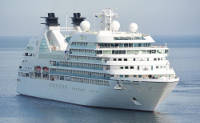
 Eurona, through its recently incorporated subsidiary Quantis, has entered the maritime sector by securing contracts worth 1.1 million euros to provide satellite internet to passenger ferries, merchant ships, yachts, fishing vessels and even boats that carry out maritime rescue work in the Mediterranean, as reported to the Alternative Stock Market (MAB).
 Through these contracts, Eurona already offers satellite internet on all types of vessels, including the passenger ferries of Balèaria and Naviera Armas, the two main passenger transport groups between the Balearic and Canary Islands and the mainland, respectively, and also abroad, as both companies have extended their routes through Africa and the Caribbean.
In addition, the technology operator will also provide satellite connectivity at an average speed of 10 Mbps to fishing vessels, yachts, and megayachts, as well as smaller recreational craft. Eurona has leveraged Quantis's terrestrial capacity in Europe and Africa to enable ships to access the satellite signal while sailing in these waters.
For the time being, the ships already connected will be joined in the coming months by new passenger vessels in the Mediterranean and the Atlantic, as well as fishing vessels in the North Sea, the Grand Banks, and the Pacific coasts of Latin America.
Eurona anticipates strong growth in this sector in the coming years, driven by an exponential increase in satellite technology on board vessels and a corresponding rise in bandwidth consumption. Currently, only 3% to 4% of vessels have satellite connectivity; and those that do only use it for basic operations, such as sending navigation data or communicating by voice to shore. While the technological revolution has led users to need to be connected at all times and in all locations, this also applies when they are working, traveling, or sailing.
So much so that, according to the technology consultancy Northern Sky Research (NSR), in the next ten years some 95,000 vessels out of a total of 350,000 worldwide will begin using satellite connections to access Internet, data, voice and television, which will generate revenues of more than 2 billion euros during that period.
Targeting the Maritime Sector:
The satellite business unit currently represents 17% of the group's revenue, of which 4% corresponds to the maritime sector. Eurona's Horizon 2022 Business Plan forecasts a doubling of current satellite revenue to €62.6 million within five years, with 3.5% coming from the maritime line within this business area. Under this new plan, the group expects to increase its revenue tenfold, reaching €239 million, and its EBITDA sevenfold, to €34 million.
According to Aquilino Antuña, Head of Eurona's Satellite division and CEO of Quantis, “The internet revolution in transportation is unstoppable. It is essential to offer mobile broadband connectivity; navigation is no longer conceivable without being able to send a WhatsApp message or update social media from the ship, and Eurona will be there to ensure those messages always reach their destination.”