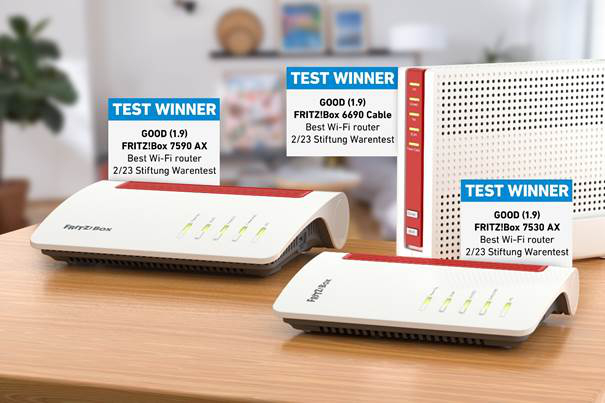
The FRITZ!Box 7590 AX, 7530 AX and 6690 wired routers lead in several categories
In its router comparison test, Stiftung Warentest tested eight devices from different manufacturers: seven for DSL connections and one for wired connections. The three FRITZ!Box models included in the analysis—the FRITZ!Box 7590 AX , the 7530 AX , and the wired 6690 —received a "good" quality rating with a score of 1.9. The organization awarded these three devices a "very good" rating in the categories of usability, security, and telephony, making them the only products in the comparison to achieve these distinctions.
Furthermore, Stiftung Warentest experts noted that all three routers also provide "very good security features." Finally, in terms of energy efficiency, the FRITZ!Box 7530 AX proved to offer by far the lowest energy consumption of all the devices tested in this edition, at just 6 watts in operation.
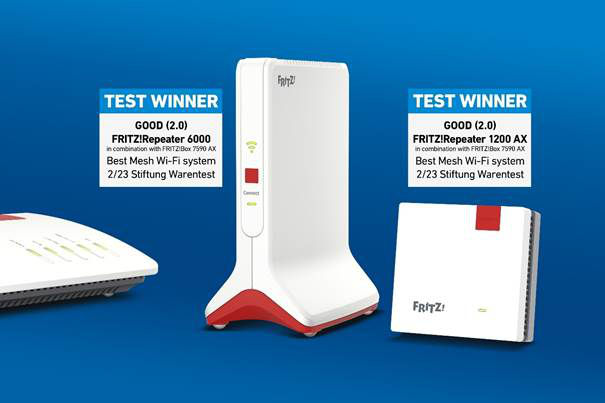 Top score for the FRITZ!Repeater 6000 and FRITZ!Repeater 1200 AX repeaters
Stiftung Warentest also tested ten Wi-Fi Mesh systems, a technology that extends the range of wireless networks by combining routers, Wi-Fi repeaters, and powerline adapters. The FRITZ!Repeater 6000 and the FRITZ!Repeater 1200 AX each received a "good" quality rating and a score of 2.0, the highest possible score in the tests.
The technicians at Stiftung Warentest noted that "in the test, these two AVM repeater solutions proved to be the best." They also highlighted that, unlike other systems, the FRITZ!Repeaters offer an automatic update function that increases security, a particularly critical aspect of Wi-Fi networks. Finally, the FRITZ!Repeater 1200 AX received a special mention for its "particularly economical" price in the comprehensive analysis conducted by Stiftung Warentest.
Founded in 1964, Stiftung Warentest is a German consumer organization dedicated to the impartial research and comparison of products and services. It is known for its comprehensive and detailed quality tests, as well as its participation in leading international consumer advocacy networks such as ICRT, BEUC, and ANEC.