They have also developed the technology to modulate it. With these developments, they succeeded in achieving wireless transmission speeds of 56 Gigabits per second (Gbps), the fastest in the world.
In recent years, to cope with the surge in data traffic resulting from the widespread use of smartphones and other devices, networks linking base stations have been built using fiber optics. One problem with this approach, however, is the difficulty of expanding service in areas where laying a fiber optic cable network is challenging, such as urban areas or regions surrounded by rivers or mountains. To address this issue, the Tokyo Institute of Technology and Fujitsu Laboratories have developed high-speed wireless transceiver technologies that utilize the millimeter-wave band (30 to 300 GHz), where few wireless applications are currently being developed, and which are capable of achieving high-capacity communications.
This technology makes it possible to have high-capacity wireless communication equipment that can be installed outdoors, in applications that fiber optic networks could not serve.
The details of this technology were revealed at the IEEE International Solid-State Circuits Conference 2016 (ISSCC 2016), the largest conference related to semiconductor technology.
High-capacity wireless transmissions require the use of wide frequency ranges. This makes the millimeter-wave band a suitable option. However, because the millimeter-wave band uses such high frequencies, designing CMOS integrated circuits for this purpose has been challenging, as the circuits need to be designed to operate near its limits. It has also been difficult to develop low-loss transceiver circuits that modulate and demodulate broadband signals within and outside the millimeter-wave band, along with low-loss interface circuits that connect the circuit board to the antenna.
About this technology
The newly developed CMOS wireless transceiver chip and the included wireless module (Figure 1) are comprised of two key technologies.
 1. Low loss, high bandwidth transceiver circuit
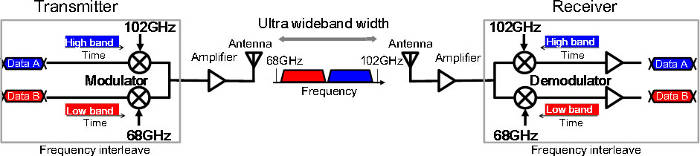
The Tokyo Institute of Technology has developed a technology for wideband, low-loss transceiver circuits in which data signals are split into two, each converted to a different frequency range, and then recombined (Figure 2). Each signal is modulated in a 10 GHz wide band, with the low band occupying the 72–82 GHz range and the high band occupying the 89–99 GHz range. This technology enables the modulation of an ultra-wideband 20 GHz signal with low noise and a similar input-to-output power ratio range up to 10 GHz, resulting in high-quality signal transmissions.
The Tokyo Institute of Technology has also developed an amplifier for sending and receiving radio waves as millimeter-wave signals. The ultra-wideband amplifier for 72 to 100 GHz was designed with circuitry that stabilizes the amplification ratio by feeding the output signal amplitude back to the input for signal components whose amplification ratio decreases with frequency.
 2. Modulation technology
The millimeter-wave band signal converted by the semiconductor chip is carried along the circuit board's signal path and delivered to the antenna. Because the antenna is made of a waveguide (a metal cylinder), an ultra-wideband, low-loss connection between the printed circuit board and the waveguide is required. Fujitsu Laboratories and the Tokyo Institute of Technology developed an interface between the circuit board and the waveguide that uses a specially designed pattern of interconnects on the printed circuit board to adjust the impedance for the ultra-wideband range, thus reducing loss in the desired frequency range.
In this development project, the Tokyo Institute of Technology was primarily responsible for reducing circuit-transceiver losses and developing broadband technologies, while Fujitsu Laboratories mainly managed the modularization technologies.
Results:
Indoor data transfer tests were conducted with two modules facing each other, separated by a distance of 10 cm. These tests achieved data transfer rates of 56 Gbps, the fastest wireless transmission speed in the world, with a maximum loss of 10% between the waveguide and the circuit board.
By combining the technologies developed in this project with high-output amplifier technology, used to amplify the signal and increase the transmission area, and circuit-based baseband technology, used to process ultra-wideband signals, it is possible to increase the capacity of wireless equipment for outdoor installation. In this way, even in locations where new fiber optic lines are difficult to install, such as urban areas and places surrounded by mountains or rivers, a high-capacity wireless base station network can be deployed, thus contributing to a comfortable communications environment in those locations.
Future plans
Fujitsu Laboratories aims to have a commercial implementation of wireless trunk lines for cellular base stations around 2020.