The index tracks the projected adoption of high-speed fixed and mobile broadband services in 191 countries worldwide from 2013 to 2020.
"In Europe, LTE, fiber, and DOCSIS technologies are being progressively deployed, and broadband connectivity is approaching the levels of developed Asian countries," said Upin Dattani, senior financial analyst at Ovum.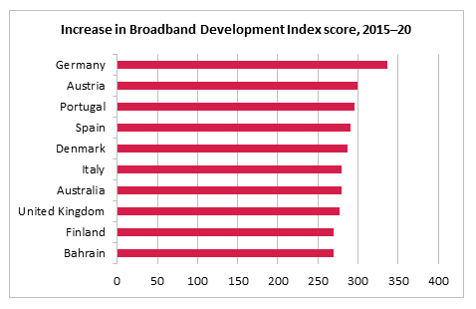 Elsewhere, between 2015 and 2020, India, Nigeria, and Indonesia will significantly improve their positions in the Ovum Broadband Development Index. In emerging markets, mobile is often the primary means of internet access. However, in practice, countries that score highly for fixed broadband development often do the same for mobile broadband.
The table shows the 10 countries that exhibited the greatest improvement in broadband connectivity between 2015 and 2020, as measured by the Ovum Broadband Development Index.
The Ovum Broadband Development Index combines fixed and mobile broadband penetration, resulting in a maximum score of 1,000. However, significantly greater weight is given to fast broadband technologies in calculating this score, meaning the index highlights economies with the most advanced data communication networks.
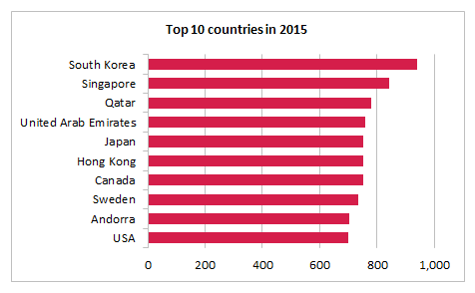 The leading region for broadband connectivity is currently Asia, as shown in the table below. South Korea, Singapore, Qatar, the United Arab Emirates, and Japan occupied the top five positions in the Broadband Development Index in 2015.
"The global demand for faster internet connectivity, both on fixed and mobile networks, is driving the progressive deployment of 4G and fiber technologies," Dattani concluded.
* Ovum Broadband Development Index.
In the Ovum Broadband Development Index, countries are awarded points based on how well people connect to basic fixed and mobile data networks, with a maximum score of 1,000. The highest scores are awarded for connecting people to fiber, VDSL, and DOCSIS 3.0 in the fixed index and for LTE networks in the mobile index. Lower points are awarded for slower fixed and mobile broadband connections. As such, the index should be used as a tool to understand the typical rate of broadband and high-speed broadband adoption over time in different countries and regions around the world. The entries for the Index are taken from Ovum's interactive online databases, the World Cellular Information Service and the World Broadband Information Service, and from Ovum Research.
Ovule defines mobile broadband connections as active mobile connections that use 3G and 4G technologies, such as LTE, W-CDMA (including HSPA) and CDMA 1xEV-DO.