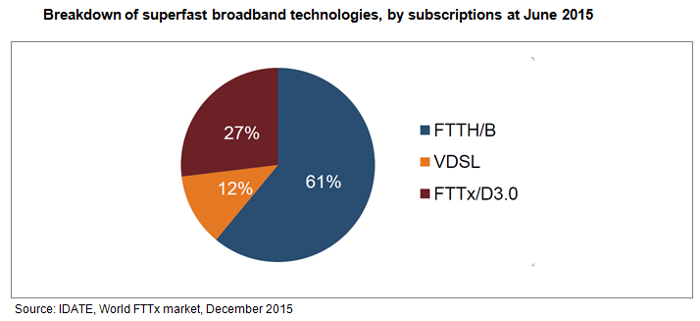
 FTTH/B remains the leading ultrafast broadband solution, well ahead of FTTx/D3.0, followed by VDSL
. FTTH/B accounted for 61% of FTTx subscriptions in mid-2015. Growth in FTTH/B subscriptions will continue through 2019, but at a slower pace than in 2014, a truly successful year in China.
FTTx/D3.0 accounted for 27% of FTTx subscriptions in June 2015. After two years of significant growth, the share of FTTx/D3.0 in ultrafast broadband is stable
. VDSL, meanwhile, has lagged behind, accounting for 12% of subscriptions in mid-2015 compared to 13% in June 2014.
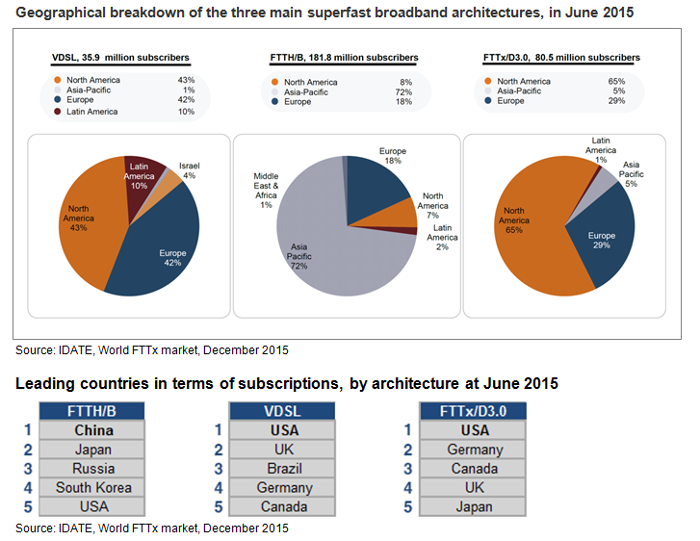 The regional breakdown is very heterogeneous
. • There are no major changes in APAC's geographic dominance in the FTTH/B market.
• FTTH/B is also the main technology used in the MENA region. This was also the case in LATAM, but it is now encountering stronger competition from VDSL technologies in the region (Brazilian market).
• FTTx/D3.0 is still dominant in North America and is generally growing faster than other technologies.
• There is considerable room for VDSL in Europe, where traditional operators still want to optimize their copper networks.
(1) For the definition of super-fast platforms we consider three main architectures: FTTH/B, VDSL and FTTx/D3.0 deployed by cable operators.
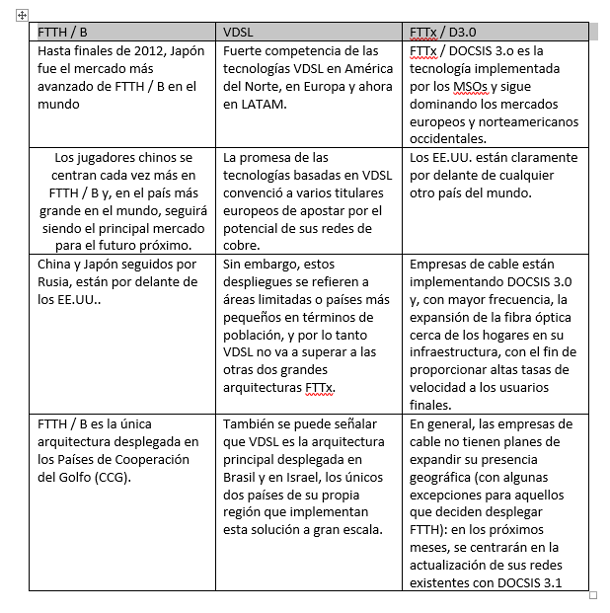
The growth rate of FTTH/B subscriptions is expected to continue increasing at an average annual rate of 10% until 2019.
Growth in the total number of FTTH/B subscribers will gradually decrease from 37% in 2014 to 6% in 2019; this is linked to the progressive maturation of the markets.
In 2019, FTTH/B subscriptions will represent 32% of the total broadband market worldwide (compared to 22% at the end of 2014).
FTTH/B is already being deployed in major regions of the world, at varying levels. FTTH/B represents a significant opportunity for countries where broadband is not yet widespread (Latin America, Africa, and some countries in Asia and the Pacific).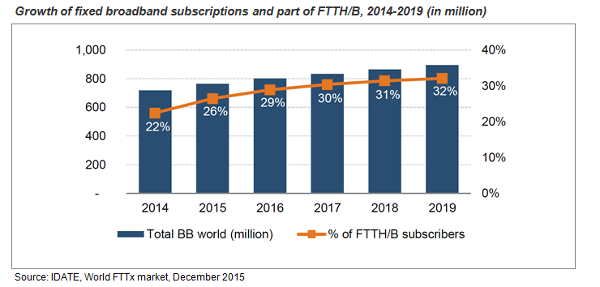 The global FTTH/B utilization rate will gradually increase from 32% at the end of 2015 to 34% by the end of 2019.
While regional disparities persist, the ranking of leading regions will change:
• Eastern Europe will see its utilization rate grow from 30% to 41% between the end of 2015 and the end of 2019, significantly higher than Western Europe's growth from 26% to 40% during the same period.
• In North America, the utilization rate will increase from 41% to 46% by the end of 2019.
• In Asia Pacific, the adoption rate will grow thanks to the dynamism of China and new markets such as Indonesia, Kazakhstan, and Vietnam.
• In Latin America, the adoption rate will remain stable, similar to early-stage FTTH/B, with players focusing more on expanding coverage.