However, while wireless technologies are improving in terms of performance, they also face a different challenge than fixed-line networks: delivering mobile data and voice services. As wireless and fixed-line technologies converge and the dividing lines become less clear, the common denominator will be fiber optics. Whether considering fiber-to-the-x (FTTx), WiMAX, or LTE, future fiber access networks are included as an essential part of the network infrastructure.
The growth of IP traffic puts pressure on mobile networks.
Traffic over the global internet protocol (IP) has skyrocketed as consumers and businesses adopt high-bandwidth services such as video streaming, gaming, and cloud-based software. This increase in data traffic is made possible by the deployment of faster broadband networks, both fixed and mobile.
Mobile data usage is projected to grow three times faster than fixed-line IP traffic. According to Cisco's Visual Networking Index, global mobile data traffic will increase 18-fold between 2011 and 2016. Demand for video content is expected to be a major driver of this growth. The increasing number and sophistication of mobile devices, such as smartphones, tablets, and dongles, is also fueling mobile data growth. In fact, laptops with dongles generate 450 times more data traffic than phones alone.
Operator networks are already being pushed to their mobile data limits. One way operators can reduce the pressure on network capacity is by encouraging their customers to offload mobile data traffic to fixed-line access networks via Wi-Fi or femtocells. Since a large proportion of mobile data traffic is consumed at the subscriber's home or workplace, this approach is compelling for operators. The use of complementary network technologies for mobile data delivery has created a new market segment. Approximately one-third of mobile data traffic was offloaded in 2011, according to Cisco.
The growing demand for data capacity in mobile networks raises interesting questions: can or should fiber optic and wireless technologies coexist, or are they ultimately competitive technologies?
Wireless technologies are explained.
Communication through the air essentially serves one of two purposes. Fixed wireless access provides an extension or replacement for fixed-line telephone access networks, while mobile networks are designed to meet the communication needs of people on the move. Different technologies have been developed around these different user scenarios.
Local Area Networks (LANs) provide connectivity to a local group of computers and other electronic devices. Wireless LANs have been developed to provide service in locations where installing LAN cabling is difficult or expensive. The technology has been standardized by the IEEE Standards Association under IEEE 802.11, but is more commonly known by its trade name, Wi-Fi.
Mobile or cellular networks provide connectivity over a wide area and allow users to move seamlessly between different locations on the same network, or even between different networks (roaming).
Originally designed to carry voice services, mobile technology was later adapted to support data transfer, and the latest generation of mobile network standards, known as Long Term Evolution (LTE), has been designed from the ground up to support data transmission.
Mobile network technology can also be configured to provide fixed wireless access. Operating from a fixed location results in a clearer signal and mitigates limitations related to battery life and size, improving overall network performance.
Let's take a closer look at these technologies.
Wi-
Fi is one of the most popular wireless communication technologies in use today, mainly because it is easy to install, easy to use, and inexpensive.
The technology allows electronic devices, such as computers and printers, to exchange data across a local network using radio waves instead of cables. Wireless connectivity performs the same function as an Ethernet cable running from a computer to a router or switch. The router then enables computers connected to the LAN to communicate with the wide area network (WAN).
Many devices now come with built-in Wi-Fi, for example, personal computers, smartphones, tablets, video game consoles or connected televisions, allowing them to connect to a network resource, such as the Internet, through a wireless access point or “hotspot”.
Wi-Fi has become very popular in the home, allowing connectivity anywhere without the need for cables. The mobile use of Wi-Fi technology in urban cafes and other public spaces is also expanding rapidly. Some cities and urban centers provide extensive Wi-Fi coverage.
A wireless access point can transmit or receive data over distances ranging from several meters (if, for example, there are thick walls in the way) to many kilometers, provided there are no obstacles and the signal is strong enough. In practice, because Wi-Fi primarily uses unlicensed spectrum, signal strength is usually limited to prevent interference between different users. However, special point-to-point configurations can achieve ranges of several kilometers.
The maximum range and capacity of a Wi-Fi system are determined by the version of the IEEE 802.11 standard it uses, as well as the specific options implemented by the hardware manufacturer. IEEE 802.11-1997 was the original wireless networking standard, but 802.11b was the first to be widely adopted, followed by 802.11g and 802.11n.
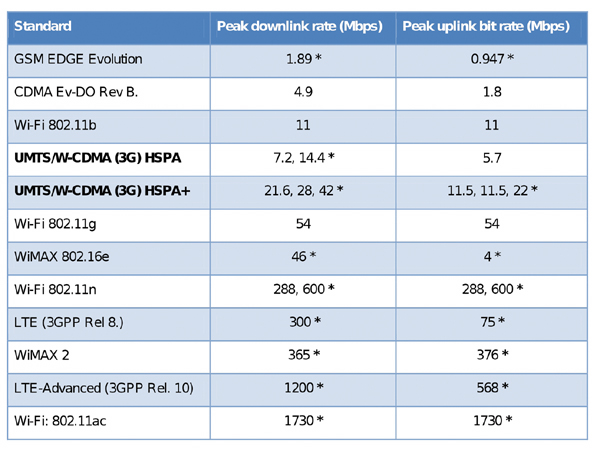
Released in 1999, 802.11b used the original 2.4 GHz frequency band with a range of 30 meters and maximum speeds of 11 Mbps, which was comparable to broadband speeds at the time.
To keep up with the increase in broadband speeds, a new version, 802.11g, was released in 2003. This increased the data rate to 54 Mbps, using a more efficient encoding scheme, while maintaining the 2.4 GHz frequency.
With the 802.11n amendment in 2009, things got more complicated. This added the ability to operate on wider frequency channels, in both the 2.4 GHz and 5 GHz bands, and the use of multiple antennas. Multiple-input multiple-output (MIMO) technology allows multiple users to connect to a single Wi-Fi access point by assigning each user a single antenna. 802.11n has a maximum data rate of 150 Mbps per antenna (using a 40 MHz channel), supporting up to four antennas.
Currently, the IEEE is finalizing work on 802.11ac, which promises speeds of up to 867 Mbps per antenna (using a 160 MHz channel) and increases the number of supported antennas to eight, for a total theoretical maximum capacity of 6.93 Gbps. The first products to appear on the market before the standard's finalization offer a configuration that supports up to 1.3 Gbps.
WiMAX
(an acronym for Worldwide Interoperability for Microwave Access) is an IP-based wireless technology that offers wireless MANs as an alternative to DSL and cable networks. It is based on the IEEE 802.16 family of standards, also called WirelessMAN.
Alongside IEEE standardization efforts, the WiMAX Forum promotes adoption by establishing a brand for the technology and fostering interoperability through a certification program.
WiMAX provides performance similar to 802.11/Wi-Fi networks, but with the coverage and quality of service of cellular networks. It can provide wireless broadband access up to 50 kilometers for fixed connections and approximately one-third of that distance for mobile users.
The issue of interference with other networks is reduced through a technical approach. WiMAX operates on both licensed and unlicensed frequencies; licensed frequencies provide a regulated environment suitable for wireless operators.
Like Wi-Fi, WiMAX standards have evolved through several technological generations. While WiMAX's initial focus was on providing wireless access to a fixed location, there was a subsequent industry push to also provide WiMAX mobile services. Hence, the resulting standard, approved in 2005 and described in the 802.16e standard, is known as Release 1.
Mobile WiMAX Release 2.0, approved in 2011 and described in 802.16m, is also known as WirelessMAN-Advanced. It offers faster download and upload speeds than the previous generation of technology, with peak download speeds of up to 365 Mbps for mobile users and over 1 Gbps for fixed connections (achieved by combining more spectrum bands).
As with Wi-Fi, the actual speed supported by WiMAX equipment will depend on various technical options, such as the number of antennas and the amount of available spectrum.
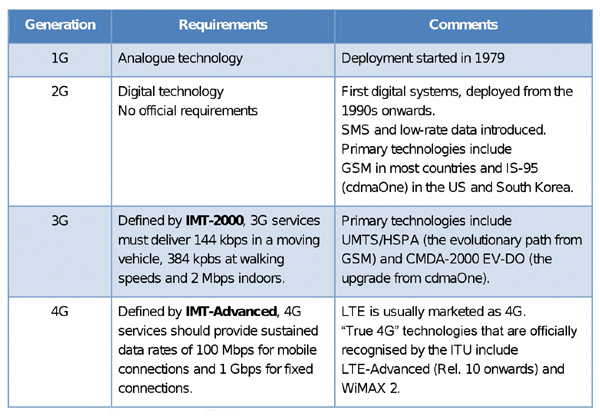
WiMAX 2 has also been officially approved as a “true 4G” mobile technology by the International Telecommunication Union (ITU). The ITU, in its International Mobile Telecommunication Union-Advanced (IMT-Advanced) specification, has outlined what it believes represents a true generational shift in mobile technology compared to the previous third generation (3G). The requirements include the ability to provide sustained data speeds of 100 Mbps for mobile connections and 1 Gbps for fixed connections.
Thus, while it originated from the same stability as Wi-Fi, WiMAX currently more closely resembles LTE in terms of its capabilities. WiMAX and LTE are often said to be competitive, but they also appear to be converging. In future versions, the WiMAX standard is expected to provide a framework that can support multiple air interfaces, including both 802.16 and the time-division duplex (TDD) version of the LTE standard.
Mobile Communication:
A mobile or cellular network, as the name suggests, is a radio network made up of a number of radio cells, each served by at least one fixed-location transceiver known as a base station. These cells cover different geographical areas to provide radio coverage over a much larger area than the surface area of any single cell. Portable transceivers (mobile phones or other devices) can be used in any cell and move between more than one cell during transmission.
Mobile networks use licensed spectrum. Mobile network operators must acquire spectrum "outright," granting them exclusive rights to transmit in a particular spectrum band, usually through an auction, and often at a considerable cost.
When a mobile device is switched on, it registers with the mobile network using unique identifiers so that it can be alerted to incoming calls. The device constantly "listens" for the strongest signal received from surrounding base stations and switches between locations to maintain the signal as the user moves around the network, thus keeping the call connected.
The technology used in the radio interface has changed considerably over the years. The first generation (1G) of mobile systems, based on analog technology, only carried voice calls.
When second-generation (2G) systems arrived, they replaced analog networks with digital ones. The largest deployment of 2G technology is the Global System for Mobile Communications (GSM). It is a circuit-switching technology; ideal for voice transmission, but with limitations for data transmission.
In 2000, the introduction of General Packet Radio Service (GPRS) added packet functionality and began delivering internet access to mobile phones at speeds of up to 56 kbps. Further improvements to GSM networks were made with the introduction of Enhanced Data Rates for GSM Evolution (EDGE), which increased peak data speeds to a maximum of 236.8 kbps.
In 1998, the 3rd Generation Partnership Project (3GPP), a collaborative effort between standards development organizations and industry, was formed to drive the future development of GSM-based mobile technologies. The result was the Universal Mobile Telecommunications System (UMTS) third-generation (3G) family of standards, which uses the GSM core network but features a new air interface standard based on Wideband Code Division Multiple Access (W-CDMA).
When UMTS was launched, it not only provided faster and more reliable data speeds of up to 384 kbps, but it was based on an improved platform that allowed for simultaneous voice and data use. Evolutionary improvements to UMTS have resulted in even higher data rates, with speeds of up to 14.4 Mbps initially supported by High Speed Packet Access (HSPA). Theoretical maximum data rates increased to 42 Mbps when HSPA Evolved (HSPA+) was deployed across the network.
Alongside the development of GSM technologies, mobile operators in other parts of the world have pursued different approaches. In North America and South Korea, some operators chose IS-95 or cdmaOne, which evolved into CDMA-2000 and then CDMA Evolution-Data Optimized (EV-DO). Time Division Synchronous Code Division Multiple Access (TD-SCDMA) is a radio interface developed for UMTS mobile telecommunications networks in China.
The Long Term Evolution (LTE) family of standards created by 3GPP is intended to provide a common upgrade path for the various standards worldwide, and this convergence of technologies is said to have inspired the name. LTE is a revolutionary upgrade that requires a new radio interface along with improvements to the core network.
LTE (Release 8 and 9) has a theoretical bit rate capacity of up to 300 Mbps downlink and 75 Mbps uplink on a 20 MHz channel when using high-end equipment (4x4 MIMO antennas). However, LTE mobile phones on the market today typically support a maximum data rate of 100 Mbps downlink and 50 Mbps uplink.
LTE Advanced (Release 10 and 11) brings the mobile network standards development process to its current state. LTE Advanced meets the ITU's most demanding requirements for "Real 4G" as defined by IMT-Advanced—providing sustained data speeds of 100 Mbps for mobile connections and 1 Gbps for fixed connections. It's worth noting, however, that this would require up to five operators to allocate 20 MHz of spectrum, which is impractical for most operators, as they lack sufficient spectrum.
Real-world wireless speeds
As we saw in the previous section, wireless technologies are continually improving and today are theoretically capable of achieving speeds that rival and sometimes even surpass those achievable on fixed access networks, including fiber to the home (FTTH).
However, theoretical wireless network speeds are never achieved in practice. There are several reasons for this:
Technical Implementation: The highest data rates can only be achieved when using the highest specification equipment, both in the user's device and in the access point or base station connected to the network. Wireless equipment will always fall back to the lowest common denominator; both the equipment on the network and the user's device must be capable of supporting the speed. Furthermore, for MIMO approaches to be viable, the antenna must be located at least half a wavelength away. At 2 GHz, half a wavelength corresponds to 7.5 cm. At least in small terminals, such a distance to the antenna is difficult to achieve.
Protocol Overhead: The maximum theoretical speed includes a significant overhead from network protocol data that wireless connections must pass for security and reliability reasons. The useful data exchanged will always occur at lower data rates. Wi-Fi overhead, in particular, can consume a significant portion of transmissions, especially in situations with multiple overlapping networks, such as an apartment building.
(Continued in the next edition)
Author:
Contributors: Stephen Hough - Sterlite Technologies Ltd, José Salgado - PT Inovação Jim Crowfoot -
Senko Advanced Components, Didi Ivancovsky - Broadcom Wolfgang Fischer -
Cisco Pauline Rigby - freelance editor.