This decision expanded the competitive zone to 696 municipalities (70% of the population), compared to 66 municipalities in the third review of February 2016 (35% of the population). The remaining 7,453 municipalities are part of the non-competitive zone.
According to the CNMC, the competitive zone is characterized by high competition in infrastructure based on next-generation networks (NGA). In each of the 696 municipalities, Telefónica's market share in the fixed broadband retail market is less than 50%, and there are at least three NGA networks with a minimum coverage of 20%. Here, Telefónica is obligated to provide wholesale access services to the civil works infrastructure (ducts, conduits, and poles) and unbundled access to the copper pair.
In the 7,453 municipalities of the non-competitive zone, the CNMC establishes, in addition to the above services, wholesale access obligations to Telefónica's fiber network.
Other important figures for the year:
31 disputes between operators resolved. In line with previous years, the main disputes between the different economic agents are related to access to physical infrastructure, number portability, and disconnections due to non-payment. In addition, three intervention procedures in wholesale relations between electronic communications operators have been resolved.
11 sanctioning procedures concluded, with fines totaling €1,482,620 (in nine of them).
In addition, 11 other sanctioning procedures were initiated, including one against Telefónica for non-compliance with its obligations regarding access to civil works infrastructure.
Review of NEBA capacity pricing and review of MARCo offer prices:
3 procedures that both Telefónica and third-party operators who have improperly occupied its infrastructure subject to the MARCo reference offer must follow, with the aim of regularizing or dismantling network deployments carried out irregularly.
Communication on the resolution of access conflicts to physical infrastructure suitable for hosting high-speed electronic communications networks.
6 reports on approved draft regulations (IPN), including:
–IPN/CNMC/006/21 concerning the granting, by auction, of concessions in the 700 MHz band
–IPN/CNMC/029/21, on the 5G Cybersecurity APL, which establishes obligations for various agents in the 5G ecosystem: operators, equipment and service providers, equipment and device manufacturers or
–IPN/CNMC/032/21, which addressed the draft Royal Decree regulating emergency communications using the single emergency number 112.
315 new agents (companies or individuals) registered in the Register of Operators. The number of active operators as of December 31, 2021, amounted to 3,467.
 Audiovisual
The CNMC also monitors compliance with the obligations of audiovisual communication service providers, ensuring that the rights of minors and people with disabilities are respected, that content inciting hatred and violence is not broadcast, that transparency requirements and self-regulation codes are met, and that regulations on commercial communications are respected.
Along with the supervisory work carried out ex officio, during 2021 the CNMC has received and analyzed 236 complaints and reports received through the web form.
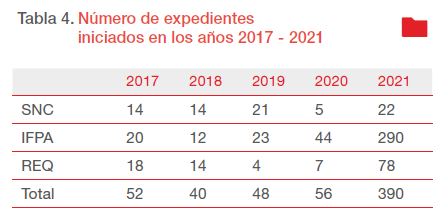
Taking into account the opening of prior information periods (IFPA); the processing of files to require providers to comply with audiovisual regulations (REQ); and the initiation of sanctioning proceedings (SNC); the evolution of recent years highlights the intense activity carried out by the CNMC during 2021 in audiovisual supervision.
Other key figures:
Twelve sanctioning proceedings were initiated. Of these, eight resulted in fines imposed on the offending service providers, totaling €557,000.
Thirty-four formal requests were issued to various service providers to ensure compliance with regulations regarding
36 European works funding projects, corresponding to both 2019 and 2020. All these resolutions are the result of monitoring compliance with this obligation, which involves exhaustive verification of the providers' documented income and eligible expenses, and the proper accounting of the funding provided for eligible projects.
Three inquiries were also received concerning the "must carry" and "must offer" obligations, European works funding, and the nature of title cards and overlays.
Source: CNMC