

The top five annual growth rates in terms of approved households are led by Belgium (+307%), Ireland (+70.4%), Switzerland (+69.1%), the UK (+50.8%), and Germany (+33.5%). FTTH and FTTB network coveragein September 2019 was nearly 50%. By September 2019, EU39 had achieved 49.9% FTTH/FTTB network coverage, while EU283 had reached 39.4%, compared to 46.4% and 36.4% respectively in 2018.
This shows a clear upward trend from the figures of September 2015, when coverage was 39.8% in the EU39 and 27.2% in the EU28. The number of FTTH and FTTB subscribers in Europe increased by 15.0% in the EU39 since September 2018, reaching 70.4 million FTTH/B subscribers in September 2019. Russia still plays a significant role in this increase; however, it is interesting to note that the EU28alone experienced a 20.9% increase. This year,the country with the most new subscribers is located in Western Europe. France added 1,923,000 new FTTH/B subscriptions and Spain came in second with 1,650,820 new FTTH/B subscribers. Other countries also experienced a notable increase in their number of subscribers, such as Greece (+285%), Ireland (+185%), Switzerland (+176%), Belgium (+111%) and Italy (+45.3%). 1 The EU 39 includes Andorra, Austria, Belarus, Belgium, Bulgaria, Croatia, Czech Republic, Denmark, Estonia, Finland, France, Germany, Greece, Hungary, Iceland, Ireland, Israel, Italy, Kazakhstan, Latvia, Lithuania, Luxembourg, Malta, North Macedonia, Netherlands, Norway, Poland, Portugal, Romania, Russia, Serbia, Slovakia, Slovenia, Spain, Sweden, Switzerland, Turkey, Ukraine and the United Kingdom. 2 Coverage = Households passed / Households. 3
The EU 28 includes Austria, Belgium, Bulgaria, Croatia, Cyprus, Czech Republic, Denmark, Estonia, Finland, France, Germany, Greece, Hungary, Ireland, Italy, Latvia, Lithuania, Luxembourg, Malta, Netherlands, Poland, Portugal, Romania, Slovakia, Slovenia, Spain, Sweden, and the United Kingdom. 4
Between September 2018 and September 2019 , the EU39 FTTH/ B5 acceptance rate increased to 40.9% by September 2019, compared to 37.4% in September 2018. For the second year running, the acceptance rate for EU28 exceeded that of EU39, reaching 43.3% (compared to 38.2% in September 2018).
It is interesting to note that fiber technologies have continuously evolved over the past few years, with FTTH architecture now predominating over FTTB (60% vs. 40%). Alternative Internet service providers (AIPs) still constitute the majority of FTTH/B players, contributing around 56% of total fiber expansion. 41% of households are currently served by former established operators. This number will also evolve as some of these operators modify their strategies, deploying more FTTH solutions, migrating from existing copper and cable networks to fiber optics, and even intensifying copper decommissioning. The role of governments and local authorities is also increasing, either directly through agreements with telecom players or through public funding.
“Ubiquitous and reliable digital infrastructure has never played a more crucial role than it does today, connecting families, enabling business activities, and allowing people to work from home. Very high-capacity connectivity is not only mission-critical in times of crisis, but will also be fundamental to economic recovery and the EU’s transition to a green and sustainable economy,” added Erzsébet Fitori, Director General of the FTTH Council Europe. “Competitive investments in very high-capacity networks should therefore remain a high political priority, and we look forward to working with EU institutions, national governments, and NRAs to remove bureaucratic and other barriers to network deployment.”
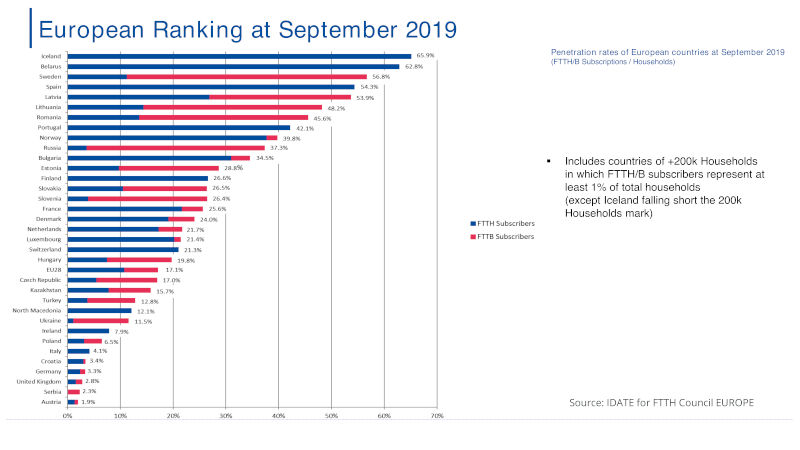
Iceland dethrones Latvia and tops the European FTTH penetration ranking with a penetration rate of 65.9% .Latvia occupies fifth place (53.9%).
Iceland becomes the leader in FTTH/B, defending its ranking, followed by Belarus (62.8%). Sweden (56.8%) regains third place from Spain (54.3%) and assumes the last place on the fiber leaders' podium.
It is worth mentioning that Belgium has significantly intensified its efforts to deploy fiber optics, with a 307% increase in approved FTTH/B homes and a 111% increase in new subscribers. However, in 2020, for the first time in years, no new country managed to enter the European FTTH/B rankings.
Germany, the host country of the FTTH 2020 Conference (postponed until December 1st),
currently accounts for 7% of total broadband connections in the German broadband market. The fixed broadband market remains largely dominated by copper-based technologies (52%) and cable-based services. However, the BMVI (Ministry of Transport and Digital Infrastructure) launched a national program aiming to build a "Gigabit Society" in Germany by 2025.
As of September 2019, Germany had over 4.1 million approved FTTH/B households and nearly 1.35 million FTTH/B subscribers. Although Germany remains relatively low in the European rankings with a penetration rate of 3.3%, the number of fiber optic subscriptions grew by 42% (compared to 18% in September 2018) and the number of approved FTTH/B households by 34% (compared to 15% last year).
"The data in this new edition of Market Panorama confirms the trend that fiber deployments are accelerating in Europe," commented Kees de Waard, President of the FTTH Council Europe. “The implementation of the new European Electronic Communications Code and, in particular, its provision of Very High Capacity Networks will be essential to fulfilling the ambitions of a connected Gigabit Society in Europe, of which FTTH/B networks, which are the only future-proof infrastructure, are the foundation.”
The European FTTH Ranking is available here.
The full Market Panorama presentation delivered on April 23, 2020, is also available here.
The ranking and Market Panorama will be updated next year at the FTTH Conference 2021, while the FTTH/B market forecasts for 2021 and 2026 will be presented at the FTTH Conference 2020 in Berlin, which has been postponed from December 1-3 due to the COVID-19 outbreak.
[1] The EU-39 includes Andorra, Austria, Belarus, Belgium, Bulgaria, Croatia, Czech Republic, Denmark, Estonia, Finland, France, Germany, Greece, Hungary, Iceland, Ireland, Israel, Italy, Kazakhstan, Latvia, Lithuania, Luxembourg, Malta, North Macedonia, Netherlands, Norway, Poland, Portugal, Romania, Russia, Serbia, Slovakia, Slovenia, Spain, Sweden, Switzerland, Turkey, Ukraine, and the United Kingdom.
[2] Coverage = Approved homes / Homes.
[3] The EU-28 includes Austria, Belgium, Bulgaria, Croatia, Cyprus, Czech Republic, Denmark, Estonia, Finland, France, Germany, Greece, Hungary, Ireland, Italy, Latvia, Lithuania, Luxembourg, Malta, Netherlands, Poland, Portugal, Romania, Slovakia, Slovenia, Spain, Sweden, and the United Kingdom.
[4] Between September 2018 and September 2019.
[5] Take-up = Subscriptions / Approved homes.
[6] Penetration rate = FTTH / Subscriptions / Homes








