However, the sky isn't falling. Businesses are adapting to the new conditions as people work from home in most of the US and many European countries. Telecommunications networks and data centers are critical infrastructure facilities that will continue to operate while many other businesses shut down. Data center and network operators are reporting huge spikes in data traffic, while airlines, hotels, and restaurants have very few customers. People are spending more time on video calls, playing video games, watching movies, and shopping online. The pandemic has propelled us into a new, futuristic world that was only imagined during the dot-com bubble. Lockdown isn't fun, but imagine dealing with a pandemic without the internet.
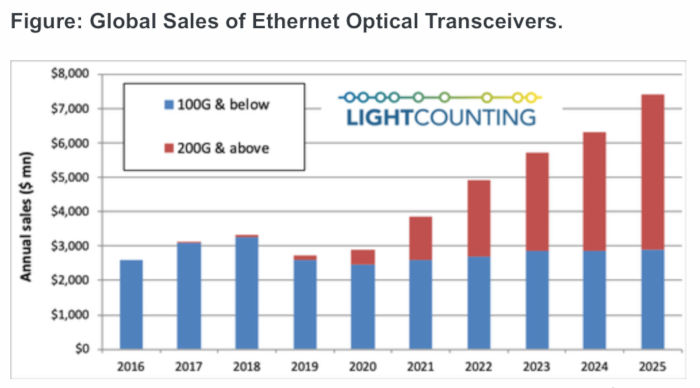
Just before the virus was discovered, demand for optical connectivity was very strong, and sales of optical transceivers set a new record in the fourth quarter of 2019. However, total sales of optical Ethernet in 2019 declined by 17%, as illustrated in the figure below. Weaker-than-expected demand from several large customers and sharp price drops, which began in late 2018, are the main reasons for this decline.
HSEO
Market momentum turned positive in the second quarter of 2019 and accelerated toward the end of the year, but it was too late to prevent the first decline in Ethernet transceiver sales since 2009 and the first double-digit decline in this market segment. Even during the telecom meltdown, Ethernet transceiver sales (primarily for enterprise networks at the time) were a bright spot in the market.
The strong demand for 100 GbE modules in the second half of 2019 led to shortages of some products, which was excellent for stabilizing prices. As the virus shut down Wuhan, the shortages spread to many other product categories, since much of the manufacturing takes place in that city. Factories in Wuhan are now resuming operations, but it will take time for the global supply chain of the optical communications industry to recover from having one of its main manufacturing hubs closed for two months.
The Chinese government is now prioritizing network infrastructure projects, including 5G data centers and cloud services. Demand for optical services from Alibaba, Baidu, ByteDance, Tencent, and many other data center operators in China is very strong, as these companies are catching up on slower optical deployments that occurred throughout most of 2019 and are now facing this more recent disruption. This trend will continue as long as Chinese consumers are willing to pay for cloud services, but a global economic downturn will affect consumer confidence in China and the business of Chinese cloud companies. We saw this in the second half of 2018, when the US-China trade war impacted Chinese consumer confidence, which in turn reduced revenue and spending for local cloud companies.
Business and consumer confidence worldwide has plummeted. They will spend less and therefore earn less, fueling an economic recession. Spending on communications and cloud services is likely on the rise right now, in stark contrast to travel spending, but a global recession is bad for everyone and every industry. Telecom service providers and data center operators are planning to increase their spending in 2020, but this could change as their revenues begin to decline.
Ambitious new data center projects may be put on hold until there is less uncertainty. Adding bandwidth to legacy infrastructure is a safer option now. This will negatively impact sales of next-generation transceivers "200GbE and above".
We expect sales of 2x200GbE and 4x100GbE modules to Google and Amazon to continue growing this year. Facebook's plans to deploy 200GbE by the end of 2020 may shift to 2021, but they shouldn't be significantly delayed. Alibaba and other Chinese cloud companies had no plans to deploy 200GbE or 4x100GbE optical networks in 2020, but they are all likely to do so in 2021.
The lifecycles of legacy products, including 40GbE and 100GbE, will be extended by a year or so, but it will be new versions of 100GbE transceivers, such as DR1 and FR1, that will sustain sales of "100G and lower" products.