These technologies permeate all aspects of socio-economic life, changing the internal organization of businesses and the ways in which citizens and companies interact with the government. They alter work and learning patterns, determine how people interact with the information sphere, and create new leisure time patterns. According to several forecasts, progress in these areas will determine the pace of overall economic development. The ICT sector is characterized by increased labor productivity and profitability in other production and service sectors. Moreover, its contribution to GDP and employment in modern economies is steadily growing. The development of the ICT sector requires capital investment, spending on research and development, scientific and business cooperation in the technology transfer process, a highly skilled and educated workforce, and a digitally competent society that is adequately prepared to use information and communication technologies.
Citizens' interest in the latest technology is, in turn, a result of the availability of telecommunications infrastructure and digital devices, the overall wealth of society, and a wealth of interesting and useful online products and services. Developed countries seeking economic growth can only imitate other technological and organizational economies to a limited extent. Instead, they are compelled to pave the way for the world of new technologies, characterized by high levels of competition, the rapid flow of information, a high rate of innovation diffusion, and the high risk of investing in tried-and-tested solutions.
Examples of countries that have successfully transitioned in recent decades from economies based on low labor costs and production efficiency to knowledge-based economies demonstrate that this type of transformation requires the active participation of entrepreneurs, technological, economic, and organizational state support, the development of telecommunications infrastructure, and facilitated cooperation between science and business.
Poland, as a country in transition to an innovation-based economy, faces the challenge of implementing an effective strategy to foster technological entrepreneurship, promote Polish technological concepts globally, attract high-value-added investments, and enable cooperation between science and business. This article outlines Poland's current position on the global ICT stage and examines its future development prospects, considering the factors that influence the success of countries and their innovative ICT solutions.
Strengths of the Polish economy:
Poland ranks 20th among the world's largest economies, 31st in terms of population, 47th in GDP per capita, and 22nd among global leaders in exports per capita. It boasts a large domestic market and a high level of education and employment. Poland's economy proved resilient during the global economic crisis and the pressure on European and global markets. Strengths of the Polish economy include public safety, increased transparency in political life and administrative decision-making, political stability, and an economy that readily assimilates the latest technologies through foreign investment and increased spending on research and development. This is reflected in increased exports of high-tech goods, higher revenues from the sale of licenses and patents abroad, and a growing number of registered Community designs and trademarks. According to World Bank forecasts, Poland can expect GDP growth of 2.9% in 2012 and 3.2% in 2013. In the 2011-2012 Global Competitiveness Report, Poland was ranked among the 18 countries transitioning from an efficiency-driven economy to an innovation-driven economy.
Poland's growing importance in the global ICT industry is also noteworthy.
Over the past decade, Poland has become a major producer of ICT solutions, partly due to the globalization of the ICT market and the outsourcing of production to Asia, Mexico, Central America, and Eastern Europe. Furthermore, the Polish domestic market is characterized by ever-increasing demand for ICT technologies. Between 1996 and 2008, the Polish ICT export sector grew at an average annual rate of 28%, and Poland has become a specialist in consumer electronics, custom software development, video games, and mobile solutions. The Polish economy is the fifth largest in Europe in terms of employment in the ICT manufacturing sector (5.1% of total European ICT manufacturing employment). Although Poland has not ranked very highly in the information society development ranking (in terms of internet use and the availability of broadband connections for citizens and businesses), the Polish government has made a conscious effort to change this situation by adopting a document, "Strategies for Information Development in Polish Society until 2013." This has led to changes in telecommunications laws that are more favorable to the ICT industry, the simplification of procedures for obtaining funding for computerization, the inclusion of basic computer and internet skills in curricula, and easier investment in telecommunications and information infrastructure. According to the Digital Agenda Scoreboard, spending on the development of telecommunications networks is defined as a percentage of total revenue, which is higher in Poland than the European Union average, and promises to narrow the gap between Poland and the most advanced European countries.
Poles are avid users of social media services, much more willing to interact with others than the European average, and the rate of use of government online services by businesses has exceeded the European average.
The growing importance of the ICT industry to the Polish economy.
In 2010, ICT's share of the manufacturing and services sector was 5.3%, with net sales in the ICT sector reaching PLN 113.5 billion (approximately EUR 30 billion), a 26% increase compared to 2007. Revenue in the ICT manufacturing sector rose by 48%, while revenue in the ICT services sector increased by 17%. Within the ICT services sector, the largest increases were recorded by IT service companies (45%) and wholesale companies (44%). In 2007-2010 the number of ICT sector companies increased by 404, from 995 in 2007 to 1399 in 2010, while the number of IT service providers increased by 307, wholesale companies increased by 63, and manufacturing companies increased by 27.
It is expected that in the coming years, services and software will become the most important part of the Polish ICT market, at the expense of the manufacturing segment. In 2010, the number of employees in the ICT sector reached 162,000, an 8% increase compared to 2007.
Furthermore, ICT exports are playing an increasingly important role in total Polish exports. Net sales for the entire ICT sector increased by almost PLN 9.1 billion (approximately EUR 2.3 billion), or 40%, between 2007 and 2010, with roughly 38% coming from manufacturing and 51% from services. In 2010, ICT manufacturing companies derived 64% of their revenue from exports, while ICT service providers earned 8%. According to the 2012 edition of the Computerworld Top 200, 2011 saw a significant increase in information technology spending by the public sector (spending increased by 17%). Public administration is now the largest ICT spender in Poland due to substantial EU subsidies. Other sectors with significant spending include telecommunications (13%), utilities (44%), transport (53%), health (45%), education (16%), media (16%), and construction (33%). Considering the entire ICT sector (manufacturing and services) in 2010 compared to 2007, spending on research and development more than tripled (to around €140 million), and nearly doubled (to approximately €95 million) compared to 2009.
Compared to other countries in the region, Poland appears to be the most favorable location for R&D centers and the establishment of companies specializing in software development. Nearby BPO service centers and outsourcing services are flourishing in Poland, as are software development centers and specialized services. ICT industry entrepreneurs can benefit from government aid and refinancing, creating new jobs and investing in fixed capital. They can also apply for EU support under five operational programs, the most popular being the Operational Program for Economic Innovations in the ICT Industry. The two most recent editions of the Antal Global Snapshot study revealed that the Polish ICT industry invests the most in embedded applications, e-commerce platforms, mobile applications, and social media tools. Most IT projects are carried out in the healthcare, telecommunications, finance, defense, and automotive sectors. More and more companies are specializing in the production of electronic games, and this segment has registered double-digit growth. The segment of companies that hire IT specialists or design and develop complete teams to carry out specific projects for a specified period is growing rapidly; according to forecasts, this segment of the ICT market will grow at an annual rate of 20% in the coming years.
The challenge of transforming into an innovation-based economy is that Poland currently faces the task of escaping the so-called "middle-income trap," which necessitates a focus on improving the innovation capacity of the Polish economy. This, in turn, requires greater investment in infrastructure development, particularly telecommunications infrastructure; the growth of financial markets, especially venture capital markets; fostering cooperation between science and business; expanding cooperative business clusters; improving citizens' digital literacy; a coherent information society development strategy; investment in R&D, particularly by businesses; stemming brain drain; creating a coherent legal framework without restricting the development of the digital economy; and expanding government online services. Internet availability is also crucial.
According to the Global Competitiveness Index, a growing number of Polish citizens—62%—use the internet at least once a week. In the United States, the figure is 79%, in South Korea 84%, in Sweden 90%, and in Norway 93%. It should be noted that Poland ranks quite high in bandwidth per capita (30th in the world with a rating of 23.5 kb/s, the United States in 26th place with a rating of 29 kb/s). The number of broadband connections relative to the population reached 14.9% in 2010, increasing in recent years at an annual rate of around 3%.
Technology patents.
The rates for new technology patents are somewhat lower. The number of patents granted in 2010 per million inhabitants is highest in Taiwan (356), Japan (353), and the United States (339), followed by Israel (249), South Korea (241), Finland (216), and Switzerland (212). Poland ranked 56th (one patent per million inhabitants).
The manufacturing segment of the ICT sector in Europe.
The European ICT manufacturing sector represents 13% of the total manufacturing sector and, as such, is one of the largest industrial sectors. In recent years, however, the number of ICT manufacturing jobs in the UK and France has declined significantly, while the Czech Republic, Hungary, and more recently, Poland, have experienced employment growth in this segment. The Polish economy is the fifth largest in Europe in terms of employment in the ICT manufacturing sector (5.1% of total European ICT manufacturing employment; Germany 26.8%, France 12.5%, UK 12.3%, Italy 11.3%). Poland, the Czech Republic, and Hungary have been investing primarily in low value-added production. Seventeen percent of employees working in ICT manufacturing within the EU-27 are based in Poland, the Czech Republic, Hungary, Romania, Bulgaria, and Slovakia, but only 4.6% of the value added is created in these countries. In comparison, the Netherlands, Sweden, Finland, and Ireland, with an employment rate of 10% of the total workforce, generate almost 21% of the value added in the ICT manufacturing industry.
ICT services in Europe
are led by the United Kingdom (19.4% of those employed in the ICT services sector generate 24.8% of the value added). Compared to the boom years of 2000-2011, employment in the telecommunications sector declined in all countries except Germany, while growth continued in IT services and software production. Employment in the ICT sector varies considerably across countries. As part of the private sector, excluding the financial sector, computer use is less than 3% in Portugal, Greece, Spain, Lithuania, Latvia, and Cyprus, and more than 6% in Hungary, 7% in Sweden, and 8% in Finland and Ireland.
Computers in businesses:
40% of Polish workers use a computer at least once a week. In Finland and Sweden, this proportion is 70%, in Germany and the UK it is 60%, and the EU-27 average is 55%. In 2011, a high level of computerization was recorded in Poland, particularly in the central province of Mazovia, where more than half of the workers use computers and more than 40% use computers with internet access.
Computers in homes:
In 2010, the proportion of households equipped with a home computer decreased by 5 percentage points compared to the EU average (74%), and the gap has not narrowed compared to the previous year. Iceland remains the leader in this ranking with 93% of households owning a computer, followed by the Netherlands, the Scandinavian countries, and Germany. The lowest percentage of households with computers was recorded in Bulgaria (35%) and Romania (48%). In 2011, 20.3 million Poles were using a computer, of whom 17.5 million were regular users. In 2010, regular computer users represented a percentage of the country's population 10 percentage points lower than the European Union average and 34 percentage points lower than in Iceland, where the rate was 92%. Poland is 23 percentage points lower than Turkey, the country with the lowest rate.
Internet access:
In 2011, 67% of households had internet access at home, 3 percentage points higher than the previous year. The proportion of households with home internet access grew steadily between 2007 and 2011. Households in western Poland have home internet access more frequently than those in the central and eastern parts of the country. The lowest percentage of households with home internet access is found in eastern Poland. It is important to note that the disparity between the eastern and western parts of the country increased in 2011 compared to 2007. In terms of broadband internet access, Poland is in the same group of countries as Spain and Ireland, although it lags behind Sweden, Norway, and Iceland, where over 80% of households have broadband access.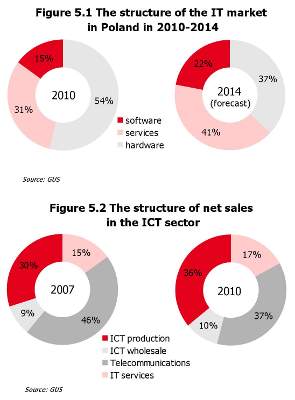 ICT sector revenues:
In 2010, net sales in the ICT sector amounted to €30 billion. Net sales revenue in the ICT sector increased by more than €6 billion (26%) between 2007 and 2011. Despite some declines recorded in 2008 (most notably in ICT) and 2009 (wholesale and telecommunications), the value of net sales at the end of 2010 was higher in each of the indicated groups of entities compared to 2007. The increase in ICT production amounted to almost 3.5 billion Euros (48%), ICT service revenues increased by more than 2.9 billion Euros (17%), of which the majority was in services - almost 1.7 billion Euros (45%), followed by wholesale ICT (around 1 million Euros, i.e. 44%) and telecommunications (by 280 million Euros, i.e. 2%). Positive trends have contributed to the increase in the ICT sector's overall contribution to production and services, from 4.9% in 2007 to 5.3% in 2010.
The share of ICT sector net sales revenue in the manufacturing and services sector net sales reached 5% in 2007, decreased slightly in 2008, rose to the 2007 level in 2009, and exceeded 5% in 2010. ICT output as a percentage of total output has surpassed 4.5%, and ICT services as a percentage of total services output has risen to almost 6%.
Regarding the structure of the ICT sector,
in 2010, service sector entities accounted for 84% of all ICT companies. The majority of these companies (almost 72%) specialized in IT services, 15% in telecommunications services, and 14% were wholesalers. Compared to 2007, the number of wholesale companies increased significantly by approximately 66%, and the number of companies dealing with information technology services increased by 57%. The number of companies in the telecommunications sector was growing more slowly (4%). In absolute terms, between 2007 and 2010, the number of ICT companies increased from 404 to 995 in 2007, and then to 1,399 in 2010. The number of IT service providers grew by 307, wholesalers by 63, and manufacturers by 27. According to the 2012 edition of the Computerworld TOP200 report, the share of IT services in total ICT solution sales increased year after year, at the expense of telecommunications solutions, with the largest increases in the services segment recorded by leading service providers. In 2010, the BPO services market in Poland was valued at $250 million (according to IDC), which is equivalent to the combined value of the Czech, Hungarian, and Slovakian BPO services markets. The value of the Polish IT outsourcing market in 2010 was $500 million, according to IDC.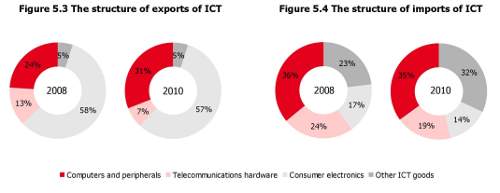 Employment in the ICT sector
has been steadily increasing during the period analyzed. In 2010, it reached 162,000, an 8% increase compared to 2007. Employment in ICT services accounts for more than two-thirds of all ICT sector employees, and their numbers increased by 14% in 2011 compared to 2007, while ICT production declined by 3%. The activities of the ICT sector are characterized by increased productivity and profitability across the entire service and industrial sectors. The number of people working in the ICT sector increased by more than 12,600 (8%). In the ICT production segment, despite a marked increase in 2010, employment was still more than 1,400 (3%) lower than in 2007. The increase in the number of employees working in ICT services resulted from growth in IT services (18.5 per thousand, or 42%) and wholesale trade (3.6 per thousand, or 85%), while telecommunications saw a decrease of 8,100 (16%) compared to 2007.
Within the ICT services sector, the importance of telecommunications, which became evident in 2007, was evident but steadily declined in subsequent years. Between 2007 and 2010, the number of employees in telecommunications services fell by 16%. While in 2007, telecommunications companies employed 35% of their workforce in the ICT sector, and IT companies employed 30%, by 2010 these proportions had fallen to 27% and 39%, respectively. Companies engaged in wholesale trade employed 5% of their workforce in the ICT sector.
ICT Exports:
The role of the ICT industry in exports is growing. Net sales revenue for the entire ICT sector increased by almost €2.4 billion (40%) between 2007 and 2010, of which over €1.9 billion (38%) was in manufacturing and €0.6 billion (approximately 51%) in services.
In ICT services, this increase was primarily due to the growth in IT service exports, which rose by €500 million (around 72%). It is worth noting that ICT manufacturing companies derive 63.5% of their revenue from exports, while service providers derive only 8%. The share of ICT exports in the entire manufacturing and services sector rose from 6.4% to 7.6% during the period. The ICT sector's share of export revenue for both manufacturing and services was 7.7% for production and 7.0% for services. Net revenue from export sales of ICT products, goods, and materials, valued at €8.1 billion, represented 7.6% of the export value of Polish companies. Over a four-year period, the value of ICT exports and imports grew steadily. In 2010, the value of ICT goods exports reached €10 billion, more than double the 2007 figure, and their share of total exports was 8%. The growth rate of imports was slower than that of exports. In 2010, the value of ICT imports increased by 42% compared to 2007, reaching approximately €1 million higher than ICT exports. In 2010, as in 2008, the structure of ICT exports was dominated by consumer electronics (57% of the value of ICT exports). A large share of the value of ICT exports consisted of computers and peripherals, increasing by 7 percentage points compared to 2008. Computers and peripherals represented the largest percentage of the value of ICT imports during the period analyzed. In 2010, the share of imports of telecommunications equipment and general-purpose electronic equipment decreased, while the share of other products—including photographic equipment, smart cards, and integrated circuits—increased.
Salaries of Polish IT professionals.
According to the Salary Survey conducted in spring 2010 by the TEST HR Consulting Group, specialists are among the highest-paid professional groups in Poland. Considering the average salary for programmers in 2010, they earned around €1,200 per month, ranking second only to product managers. In 2009-2010, salaries for IT workers increased, with the lowest-paid positions (IT technicians) rising by approximately €65, while the highest-paid management positions saw an increase of around €290.
In conclusion
, the Polish ICT sector has very good growth prospects due to Poland's large pool of intellectual capital, but its potential remains somewhat hidden. The current weakness of the Polish ICT sector is also its strength – a clear definition of the problems allows for the effective allocation of resources. Positive examples of Polish companies that have found their place in the international knowledge economy, and the very good state of the Polish economy in times of crisis, leave no doubt that Poland manages to build a solid position on the consistent international stage and its role in the growing ICT sector will increase every year.