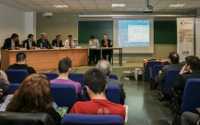
 Investing in broadband networks, and specifically in fiber optics, will help overcome the crisis. That is the main conclusion of the 18th Cable and Broadband Conference in Catalonia, organized by the Center for Cable Studies (CECABLE) and the Autonomous University of Barcelona (UAB), which took place from May 7 to 9 at the UAB School of Engineering in Bellaterra.
“Investment in broadband infrastructure translates into greater productivity and competitiveness, making it the key strategic move to overcome the current economic situation,” states Joan Francesc Fondevila, director of CECABLE. “In FTTH networks, Spain already has some 400,000 connections, reflecting significant progress and a path we must continue to follow,” Fondevila adds. At the opening session, the director of CECABLE emphasized “the understanding, by all stakeholders, that faster and higher-quality infrastructure will translate into more opportunities for everyone, starting with content creators.”.
The expansion of fiber optic networks is Adamo's driving force, and the company has been present in Spain since 2007. The project in Asturias, in partnership with the Asturian government, provided high-speed internet to the mining valleys. The backbone network in Gijón, Madrid, and Barcelona (22@ district), along with the connection to Espanix in 2008, strengthened its infrastructure. In 2010, Adamo built its own FTTH network in Barcelona and Madrid. The Viladecans network was added in 2011. "Our commitment will continue," affirmed Fredrik Gillström, CEO and founder of Adamo.
For Eusebio Cabral of Accenture, the key to making proper use of broadband is its exploitation in smart cities, cities that apply ICTs in order to provide themselves with an infrastructure that allows them to achieve sustainable development, greater efficiency in the use of resources, an increase in the quality of life of their citizens and the promotion of citizen participation.
The key elements of a smart city are ubiquitous connectivity, a local broadband network that serves as the "brain" of the smart city, and the creation of an ecosystem where new and innovative services and applications are developed, always in a participatory manner, as in the Life 2.0 project, which includes Barcelona, among other cities. One of the most visible results is the augmented neighborhood: an increase in the quality and quantity of information about what is happening in the neighborhood, and greater motivation among older people to use online services.
Since 2012, Spain has been among the 22 European countries with fiber optic penetration exceeding 1%, according to a study by the European Fiber Optic Institute. "This has occurred following a 40% increase in customers during the first half of 2012, thanks primarily to the deployment carried out by Telefónica in several cities," according to Vicente Pando of Telefónica.
It is noteworthy that the number of lines in Spain (including both cable and fiber optic) between 20 Mbps and 50 Mbps has increased by 111% in two years, while the number of lines above 50 Mbps has increased by 60%. Together, these total one million lines.
The number of FTTH lines in service has almost doubled in just one year, now representing 2.5% of all fixed broadband lines. User demand is at the root of this growth in broadband demand. However, Spain ranks fourth in the world for illegal downloads (in order: Canada, China, Russia, Spain, and Ukraine), and has become one of the European countries with the highest rates of piracy and content downloading.
In terms of mobile broadband, Spain has climbed to 11th place among OECD countries, above the average. This is further complemented by its leading position in smartphones. Given this reality, Telefónica is adapting its mobile network to the growing use of smartphones, tablets, and 3G modems, expanding 3G coverage and bandwidth, adding more carriers to densely populated areas (cities, events, or coastal regions), and upgrading base station connections to fiber, moving from links in the Mbps range to Gbps. LTE in Europe is being deployed thanks to spectrum refarming and the release of the 800 MHz band. In Spain, this refarming is not expected until 2015.
Since the bands being deployed for LTE in Europe are 800, 1800, and 2600 MHz, Spain is undertaking the necessary developments to begin deployment in these bands. This requires changing the current network architectures (one network for each service) and moving to a robust, single, and scalable architecture for all services and access points, capable of absorbing demand.
According to Narcís Coll of BT Global Services, businesses are among the main beneficiaries of broadband. “Companies are demanding more and more broadband and are increasingly discerning in this regard.”
Xavier Martín of Ilimit believes broadband is essential for the development of cloud projects, whether public or private. “Public administrations need to invest even more heavily in the cloud,” Martín argues. Virtual desktop services are also being developed in the cloud, as advocated by Cloudgroup, eyeOS, and Proceedit. Santi Bassa and David Perálvarez of Endovao emphasized that a startup must operate differently than a traditional company. Emilio Castellote of Panda Security stressed the importance of security, including in the cloud. Ramon Roca of guifi.net believes the future lies in open, free, and neutral telecommunications networks.
According to Xavier Casajoana of VozTelecom, the trend in IT and communications for SMEs is toward the cloud. “Everything will be cloud-based, and we’ll have to get used to it.” Sergio Martínez of Colt Technology Services advocated for integrated solutions.
“Legacy cable networks continue to be a safe bet in the broadband landscape in Catalonia and Spain,” said Joan Francesc Fondevila, director of CECABLE, at the roundtable discussion on traditional cable. Cases like those in Catalonia, where Riba-roja d'Ebre reached break-even in two years with a fiber optic network driven by the public administration, or those in Viladecans (also a public neutral network) or L'Ametlla de Mar (a private network), and other projects in development, “demonstrate the commitment to network modernization in these municipalities and the loyalty of subscribers, who can access quadruple play or quintuple play thanks to companies dedicated to serving local residents and businesses,” according to Fondevila. For Xavier Edo, of Alpha Enginyeria de Telecomunicaciones and Acotec, the efforts of legacy cable networks are commendable, “and technological modernization is increasing.” Representatives from the municipalities of Mequinenza and L'Ametlla de Mar highlighted the possibilities of broadband networks in smaller municipalities.
Xarxa Oberta de Catalunya (XOC), the company awarded the public-private partnership contract by the Government of Catalonia, is building and deploying a high-bandwidth fiber optic network connecting the current and future headquarters of all the institutions that make up the Government of Catalonia, as well as a municipal point of presence. According to Jordi Soler, XOC's manager, the operation, maintenance, and management of this network are carried out through "the provision of self-provisioned connectivity services at the optical transport level and Layer 2 Ethernet." Connectivity services are also offered to provide inter-administrative services to all municipal points of presence, and the network's surplus capacity is used to provide connectivity services on the wholesale market, under the terms determined by the European Commission's Directorate-General for Competition. As of May 2013, XOC had connected 235 Government of Catalonia headquarters and 282 municipalities across 1,560 km of fiber optic cable. of fiber available.
Unit4 emphasized the new CEU-CIO relationship. While CEOs talk about diversification, emerging markets, customer communication, and sustainability, “CIOs can no longer talk about ICT infrastructure, cloud computing, ERP, and CRM,” says Joan Marc Llesuy. In this context, CIOs must perfectly interpret the CEO's new priorities, reorganize their structure and strategy around them, and redefine the role of ICT within the organization to remain relevant. Regarding cloud computing, it depends on three parameters: the number of users authorized to access applications, the Service Level Agreement (SLA) based on multiple service options, and the level of commitment (term of service).
Telecommunications operators are the primary beneficiaries of digital signal measurement tools, according to Robert Pous of Promax, as this results in better signal quality for the customer. The evolution of structured cabling systems reflects the fact that the telecommunications sector is one of the most dynamic today, according to Manuel Pujol of Datwyler Cabling Solutions.
Abacanto emphasized the importance of controlling the MDI (Media Delivery Index), calculated using the Media Distribution Index (Audio, Video and Data), the relationship between the delay factor (milliseconds required to drain the virtual buffer of intermediate memory in a given network node and at a specific time) and the MLR (Media Loss Rate, ratio of video and audio loss or number of packets lost during a certain time interval).
The MLT (Media Loss Total) is the total data loss (Media = Video, Audio, and Data). Field meters, spectrum analyzers, constellation or echo analyzers, merograms, and spectrograms help monitor signal quality.
Argus Test Ibérica presented its ARGUS product line, manufactured in Germany by its parent company, Intec GmbH. This range of measuring instruments for copper wire access networks is used by telecommunications operators and installers worldwide to verify the operation of broadband access lines, primarily DSL, but also covering older technologies such as ISDN and PSTN, and offering additional electrical measurement functions over copper wire.
Argus presented a historical overview of broadband networks over copper wire, describing and showcasing its product catalog tailored to the testing needs of each access technology. From the initial ADSL proposal to the most recent developments in VDSL2, such as vectoring and bonding, which enable speeds exceeding 100 Mbps, and other future proposals (like G.fast) that envision reaching up to 500 Mbps over copper wire, "Argus has been adapting its equipment to new standards, and its equipment is now ready to support the new technologies known as DSL acceleration," according to Gonzalo Sánchez.
In today's highly competitive broadband environment, under immense pressure to offer ever-increasing access speeds, service providers must make significant investments to adapt their access networks to these new demands. In this situation, and although the most widely chosen future option seems to be GPON technology for access via fiber optics, thanks to new and future developments in DSL it is still possible to take advantage of the existing cabling infrastructure and adapt it to the new needs, making it possible to obtain access speeds over copper wire comparable to those offered by GPON technology over fiber optics.
SafeNet emphasized the total cost of ownership (TCO) of security breaches: forensic investigation, user notification, remediation measures, dedicated call center operations, and lost profits (opportunity cost). According to Alfonso Martínez, the rules for preventing data breaches are to encrypt data, define data access policies, control encryption keys, authenticate users, and train employees.
The institutional roundtable on broadband reflected its status as the main strategic focus of Catalan and Spanish public policy. “The idea of having access to ultra-fast broadband with FTTH is beginning to spread among an increasingly aware population, and in Catalonia, it has been a goal that is gradually being achieved thanks to various solutions and initiatives,” stated Fondevila. For Carles Salvadó, from the Catalan government, the efforts of this administration have been enormous in positioning the country's economy, and “there has been a clear commitment despite changes in government.” This commitment was questioned by Jordi Soler, from XOC, who added that only about twenty Catalan municipalities find it profitable. From Feceminte, Román Lantarón emphasized the need to control the quality of installations and combat unauthorized access. Mauro Soto, from Localret, stressed the need for open networks and coordination with municipal initiatives. David Ferré, from COETC (Official College of Telecommunications Technical Engineers of Catalonia), proposed generalizing the deployment of fiber with the microtrenching method, and Àlex Ramoneda, from the Catalan College/Association of Telecommunications Engineers, praised the models of Sweden or Australia.
Anxanet presented the advantages of its virtual fiber optic concept, offering capabilities similar to traditional fiber optics, minimal latency, customized symmetrical bandwidth (virtually unlimited), guaranteed service, moderate costs, shared network access between industrial parks, wide-coverage transmission stations, minimal installation at customer premises, and a high-performance, professional wireless network geared towards businesses. According to David Andreu, “the capillary reach of virtual fiber optics and its immediate deployment promote broadband penetration and stimulate demand.”.
The unstoppable evolution of non-linear television was evident in the presentation by Lluís Borrell of Analysys Mason. However, he noted that “a higher average speed is recommended.” Only countries like Sweden, the Netherlands, and Switzerland seem well-prepared for the challenge. In terms of unique users, video downloads, minutes of television consumed, and online television revenue, the figures are generally on the rise significantly. Along these lines, the HbbTV standard (known in Spain as hybrid DTT) shows promise, according to Xavier Redon of Abertis Telecom. Similarly, Xavier Porras of Banc Sabadell emphasized that content such as online banking can benefit from the new digital ecosystem.
The Catalan broadband event involved the participation and collaboration of institutions such as the Government of Catalonia, Abat Oliba CEU University, UAB, Cercle Fiber, Barcelona Marketing Club, College of Industrial Technical Engineers of Barcelona (CETIB), College of Telecommunications Engineers of Catalonia (CETC), Official College of Telecommunications Technical Engineers of Catalonia (COETTC), Official College of Computer Engineering of Catalonia (COEIC), Telecommunications Market Commission (CMT), Faculty of Communication Sciences of the UAB, Catalan Federation of Telecommunications Installation Companies (Feceminte), Federation of Telecommunications Installers (Fenitel), Barcelona Digital Technology Centre, Talencia, TIC.CAT, Red.es, Localret, AOTEC (National Association of Telecommunications and Internet Service Operators), AEDOC (Spanish Association of Digital Documentation), AETIC (Association of Information and Communication Technology Companies of Spain), and ANEI (National Association of Internet Companies), APD (Association for the Progress of Management), Asimelec (Multisectoral Association of Spanish Electronics and Communications Companies), Catalan Technology Association (ACTec), Association of Computer Technicians (ATI), Astel (Association of Telecommunications Operators and Services Companies), Redtel (Spanish Association of Telecommunications Operators), CTecno, Vallès Technology Park (PTV), CENATIC (National Reference Center for the Application of Information and Communication Technologies ICT), Ilimit, International Association of Technology, Education and Development (IATED), Foundation for the Infotechnological Development of Companies and Society (Fundetec), FOTÓNICA21 Platform or Catalan Technology Society.