Designed as a guide for data center designers and installers, the TIA-942 (2005) standard provides a series of recommendations and guidelines for the installation of their infrastructure.
Approved in 2005 by ANSI-TIA (American National Standards Institute – Telecommunications Industry Association), it classifies these types of centers into several groups, called TIERs, indicating their level of reliability based on their availability.
Designing data centers according to the standard offers key advantages, such as:
• Standard nomenclature.
• Fail-safe operation.
• Increased protection against external threats.
• Long-term reliability, greater expansion capabilities, and scalability.
According to the TIA-942 standard, a data center's support infrastructure will consist of four subsystems:
• Telecommunications: Cabinet and horizontal cabling, redundant access points, entrance room, distribution area, backbone, redundant active and power components, patch panels and patch cords, and documentation.
• Architecture: Site selection, building type, fire protection and NFPA 75 requirements (Fire Protection Systems for Information), vapor barriers, ceilings and floors, office areas, UPS and battery rooms, generator room, access control, CCTV, and NOC (Network Operations Center).
• Electrical System: Number of access points, points of failure, critical loads, UPS redundancy and topology, grounding, EPO (Emergency Power Off) systems, batteries, monitoring, generators, and transfer systems.
• Mechanical system: Air conditioning, positive pressure, piping and drains, CRACs and condensers, HVAC (High Ventilating Air Conditioning) control, fire detection and sprinklers, clean agent extinguishing (NFPA 2001), aspirating detection (ASD), liquid detection.
Furthermore, and following the standard's guidelines, a data center must include several functional areas:
• One or more entrances to the center.
• Main distribution area.
• One or more main distribution areas.
• Horizontal distribution areas
• Distribution equipment area.
• Distribution zone.
• Horizontal and backbone cabling.
 The TIER Concept:
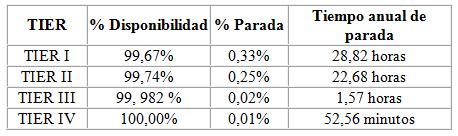
The reliability level of a data center is indicated by one of four reliability levels called TIER, based on its redundancy. A higher TIER number means greater availability, and therefore higher construction and maintenance costs.
TIER I - Level 1 (Basic)
99.671% availability.
Sensitive to planned or unplanned outages.
Single-pass power and air conditioning distribution, no redundant components.
No raised floor requirements.
Independent generator.
Implementation time: 3 months.
Annual downtime: 28.82 hours.
Must be completely shut down for preventative maintenance.
TIER II - Level II (Redundant Components)
Optical Systems: 99.741% availability.
Reduced sensitivity to outages.
Single-pass power and air conditioning distribution with a redundant component.
Includes raised floor, UPS, and generator.
Implementation time: 3 months.
Annual downtime: 28.82 hours.
Implementation time: 3 to 6 months.
Annual downtime: 22.0 hours.
Maintenance of power and other infrastructure components requires a processing shutdown.
TIER III - Level III (Concurrent Maintenance)
High-density solutions. 99.982% availability.
Planned outages without operational interruption, but unplanned outages may cause problems.
Multiple power and cooling access points via a single active routing path. Includes redundant components (N+1).
Implementation time: 15 to 20 months.
Annual downtime: 1.6 hours.
TIER IV - Level IV (Fault Tolerant)
99.995% availability.
Planned outages without interruption of critical data. Ability to withstand an unexpected failure without critical damage.
Multiple power paths and cooling channels. Includes redundant components. Includes two (N+1) redundant components – two UPS units, each with (N+1) redundancy.
Implementation time: 15 to 20 months.
Annual downtime: 0.4 hours.
New Features Introduced by Standard 942A
This section explains the modifications introduced in the field of cabling, both fiber and copper, by the TIA 942 (A) standard, applicable in Data Centers.
Although it is a standard of US origin, the ANSI/TIA-942 standard, published in 2005 and revised every 5 years, can be considered "a generic cabling system for Data Centers and their area of influence" (Page IX of the standard). Its recent update (2013) incorporates several new features:
The use of multimode fiber in distribution frames (DFs) is restricted to types OM3 and OM4 (50/125) and equipment with 850 nm laser emitters. The use of previously used OM1 and OM2 fibers is prohibited.
For copper cabling, the use of Cat6 (minimum) and shielded Cat6A is recommended. This aligns with ISO/IEC 24764, which only recognizes Class EA (Cat 6A) links.
The 100 m length limitation for horizontal fiber optic cabling is eliminated, leaving the definition of this concept to the manufacturer.
Optical connectors: the selection is limited to LC Duplex connectors for duplex cables and MPO connectors for more than 12 fibers.
The use of centralized and hierarchical architectures is recommended, as they are more flexible than direct links.
The organization of the distribution center environments has been restructured, including three types of areas: MDA (Main Distribution Area), IDA (Intermediate Distribution Area), HDA (Horizontal Distribution Area), and ZDA (Optional Zone Distribution Area); some of which may require additional cabling. Therefore, large installations may require multiple locations and multiple IDAs, with redundant cabling.