Thermal management in data centers can be broadly classified into two types based on the cooling medium: liquid cooling and air cooling. Although liquid cooling has gained popularity in recent years, air cooling remains the traditional and most widely used method, as it offers several advantages:
- Ease of use: Air cooling solutions are relatively simple to install and use. They typically involve the use of fans or heatsinks to dissipate heat from the components, making them easily accessible and usable. The familiarity and simplicity of air cooling systems make them convenient for data center operators.
- Proven success: Air cooling has a long track record of success in data center thermal management. Many data center end users have invested significant resources in building and optimizing air-cooled infrastructures.
- Liquid-free operation: Unlike solutions that rely on refrigerants and liquid circulation, air cooling eliminates the need for liquid-related components and infrastructure. This eliminates risks such as leaks, pump failures, or refrigerant evaporation. The absence of liquid in air cooling systems simplifies maintenance and reduces the likelihood of malfunctions or operational interruptions.
However, despite the advantages of air cooling, its low specific heat capacity limits its effectiveness in meeting the growing cooling demands of modern data centers. To address this challenge, liquid cooling has emerged as a viable solution. Liquid cooling takes advantage of the higher specific heat capacity of liquids, making them more effective at dissipating heat. There are two common types of liquid cooling methods: direct-to-chip (cold plate) cooling and immersion cooling.
Cold plate cooling involves mounting a cold plate directly on the heat sources, such as the CPU and GPU, with a layer of thermal interface material (TIM) between them. The coolant inside the cold plate chamber absorbs and transfers heat away from the components.
On the other hand, immersion cooling submerges the heat sources in a coolant, allowing direct contact and efficient heat dissipation.
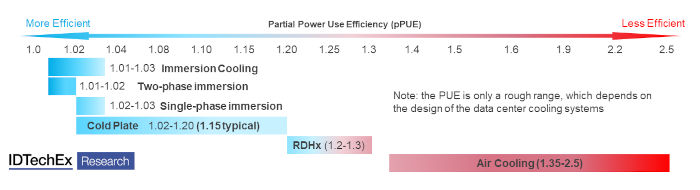
Collaboration between server vendors and cold plate manufacturers has accelerated the adoption of cold plate cooling. Integrated solutions (servers with pre-installed cold plates) are being offered directly to end users. While direct-to-chip cooling has demonstrated strong performance, the limited experience of end users in integrating cold plates into their off-the-shelf servers has been a limiting factor in its adoption. One example of this type of collaboration is CoolIT Systems' partnership with Intel to develop direct-to-chip cooling solutions specifically tailored for Intel Xeon Scalable CPUs. By leveraging these collaborations and integrated solutions, end users benefit from cold plate cooling, including improved efficiency and reduced partial power usage effectiveness (pPUE), without the complexities of integration.
Another emerging liquid cooling technology is immersion cooling, which offers excellent heat dissipation performance with demonstrated pPUEs as low as 1.01. However, several issues have limited the widespread adoption of immersion cooling:
Complexity: Immersion cooling requires significant modifications to existing server motherboards. Because the servers are immersed directly in the coolant, factors such as material compatibility between the servers and the coolant must be considered, adding complexity and additional costs to the implementation process.
Lack of experience: Immersion cooling is still in its early stages, and the market lacks sufficient knowledge and experience in implementing and managing this technology.
High initial and maintenance costs: Adapting existing air-cooled data centers to accommodate immersion cooling can be expensive. Immersion cooling also has the highest initial capital expenditure (CAPEX) in terms of cost per watt. In addition, ongoing maintenance and operating costs can also be higher compared to other cooling methods. However, due to the efficient heat dissipation, long-term energy savings make immersion cooling cost-effective for data center users.
Limited demand: Although data center power requirements have been increasing, IDTechEx believes that a combination of air cooling and direct-to-chip cooling can adequately meet short- and medium-term cooling demands for major applications. There is no urgent need for immersion cooling in the market at present.
Partial power use effectiveness (pPUE) for data center cooling approaches. Source: IDTechEx
In conclusion, the demand for greater cooling capacity is driving the rapid growth of liquid cooling, particularly in the form of direct chip/cold plate cooling. This growth presents numerous opportunities for server manufacturers, data center operators, coolant suppliers, and coolant distribution unit (CDU)/pump providers. On the other hand, immersion cooling is expected to be initially adopted by major players such as Microsoft and Meta. However, widespread adoption may take time due to factors such as high costs, limited technical expertise, and maintenance requirements. Collaboration among companies in the data center immersion cooling supply chain will be crucial for its more widespread implementation. Nevertheless, immersion cooling offers significant opportunities for various companies, including coolant suppliers. For more detailed information, please refer to IDTechEx's latest report on "Data Center Thermal Management 2023-2033."
Author: Yulin Wang, technology analyst at IDTechEx