 As demand for computing has increased over the past five years, the precision cooling market has also grown. According to Dell'Oro Group Principal Analyst Lucas Beran, this market reached $3.5 billion last year and is projected to reach $6 billion by 2026. This exceptional market growth reflects the fact that, in many cases, new technologies are needed to keep pace.
 Last October, Ben Coughlin (Colovore), Gerard Thibault (Kao Data), and Don Mitchell (Victaulic) joined me on a panel discussion, hosted by Lucas, at the OCP Global Summit to debate this topic. Our conversation made it clear that liquid cooling is the future of data centers, hoping to keep pace with the massive increase in computing demands, especially for colocation. As another OCP speaker put it: You're either using liquid cooling now, or you will be in the next 3-5 years.
What's driving the acceleration of data center cooling?
Over the past 12 years, servers and components have changed significantly. Blades and virtualization, which first emerged more than a decade ago, have increased dramatically in density, to the point that today's computing servers routinely consume between 750 watts and 1 kilowatt (kW) per rack unit. Even flash storage, historically low-density, now consumes between 400 and 600 watts per rack unit.
Liquid cooling has existed since the dawn of computers, but air cooling has dominated the industry because it was a simpler process before the recent surge in computing demand. Air cooling still dominates, particularly in the UK, but flexible data center infrastructures adhering to OCP guidelines are on the rise. Denser computing and some modern chips that cannot transfer their heat to the air have increased the consideration and adoption of liquid cooling options. From chassis-level liquid cooling to cold plate cooling, new liquid cooling technologies for data centers are driving the consideration and adoption of hybrid air/liquid configurations.
My colleagues on this OCP roundtable and I receive calls every week from current or potential customers wanting to know how to add liquid cooling to an air-cooled data center. Vertiv's answer: Start with backdoors, then consider direct chip cooling.
Liquid cooling systems meet the demands of high-density computing.
Liquid cooling has significantly higher heat transfer properties than air. Data center liquid cooling systems are substantially more efficient and a cost-effective cooling solution for high-density racks.
 Modern rack power requirements exceed 20 kW, and many installations are looking to implement racks with requirements of 50 kW or more. Established rear-door liquid heat exchanger cooling systems, such as the Vertiv Liebert® DCD, can handle densities above 20 kW. These liquid heat exchanger units replace the rack's rear door. A passive design exhausts hot air through a liquid-filled heat-absorbing coil mounted in place of the rack's rear door. An active design incorporates fans to draw air through the coils and remove heat from higher-density racks.
Air-based cooling systems lose their effectiveness when rack densities exceed 20 kW, at which point liquid cooling becomes the viable approach.
Rear door heat exchanger liquid cooling systems are a great first step toward direct chip cooling. Rear door panels work well in a hybrid air/liquid system with mixed rack densities. My colleague, Gerard Thibault, shared that Kao Data uses this hybrid approach in its 2-megawatt (MW) room. The company has 2 MW of air cooling and is adding 10 MW of liquid cooling to provide 12 MW of cooling.
In addition to improved efficiency and cost savings, liquid cooling also offers a more sustainable cooling method. At this Global Summit, OCP announced sustainability as its fifth principle, alongside efficiency, impact, openness, and scalability. Liquid cooling for data centers can help companies meet their sustainability goals in the coming years. Unlike air cooling, which continues to operate at increasing speed, the cooling mechanism of a back-door heat exchanger or a direct-to-chip liquid cooling solution produces better cooling results with less effort, leading to lower energy consumption and reduced carbon emissions. These technologies could even be used together to drive 100% of the heat load into the fluid!
The Look and Sound of a Liquid-Cooled High-Density Colocation Center
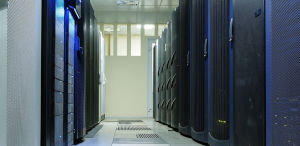
: Are liquid-cooled or hybrid data centers very different from air-cooled data centers? Ben Coughlin of Colovore shared his company's setup: an external cooling tower, plus pumps and piping. Each cabinet has two pipe connections: one for water delivery, one for water removal, and that's it. They have no chiller or refrigerant distribution units on the floor. Their fan-assisted "active" rear doors, from Vertiv, now work alongside several megawatts of direct liquid cooling, although this supply is limited by the installed piping. There's very little visual difference. The temperature and sound, however, are noticeable differences.
Colocation data centers with large compute and hybrid cooling maintain a comfortable ambient temperature of around 70 degrees Fahrenheit (21°C), rather than the cold aisle and hot aisle of a traditional air-cooled data center. High-performance computing infrastructure servers and artificial intelligence (AI) servers are very noisy, but the cooling components do not add any additional noise. Otherwise, these are perfectly "normal" data rooms with standard 45U racks, and customers access their servers in the same way.
Airflow within the cabinet is the most significant difference. Network switches are very short and therefore need to breathe from front to back. Larger power distribution units require "clean" cabling, as racks don't lengthen at the same rate as the servers they house. It's a tight fit inside the cabinet. Careful attention can easily resolve these issues during design and installation.
Plan Now for the Future of the Liquid-Cooled Data Center.
As my colleague Don said, “Don’t fear liquid cooling; plan for it.” Modern data centers are at a crossroads. Air cooling will be unable to meet the massive demands of high-density computing within the next 5 to 10 years—that is, “tomorrow” in the data center era. Now is the time to embrace the coming change and plan for it before it arrives.
I was delighted to join Ben, Gerard, Don, and Lucas at the OCP Empowering Open Global Summit to discuss the future of liquid cooling for data centers. Companies like ours (Dell'Oro Group, Colovore, Kao Data, Victaulic, and Vertiv) are happy to help our industry innovate and ensure the success of our customers' projects.
Fred Rebarber,
as Global Technical Director at Vertiv, serves as the corporate technical interface for large end users and consulting engineers specializing in mission-critical designs. A key function of this role is to provide input on product development based on customer needs and market demands. In his previous role with the OEM group, Fred worked with manufacturers and end users to drive adoption of existing Vertiv™ Liebert® products and create specifications for new products. Prior to his OEM role, Fred was Director of Sales and Marketing at Cooligy, a startup that designs and manufactures chip-level liquid cooling solutions for manufacturers. Fred holds a Bachelor of Science in Mechanical Engineering from the University of California, Berkeley.