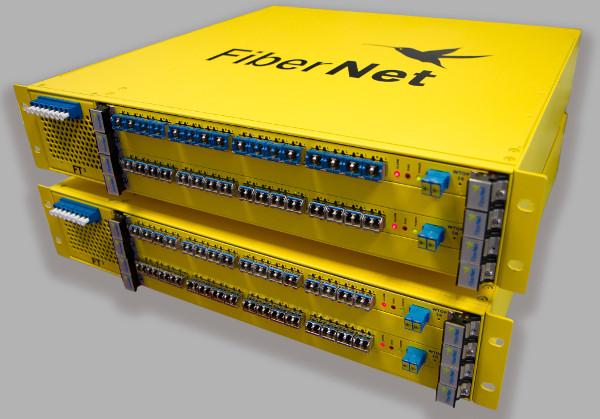
This new Fibernet data center solution addresses this problem with the FT 3 equipment , which will allow for the simplification or elimination of end-of-row aggregation equipment from the rooms. Additionally, the FT 3 system enables the detection, location, and tracking of physical fiber optic issues.
Currently, connections between peripheral racks and the centralized core of a data center are made using two alternative methods: physical connections with a vast number of optical fibers for the interconnection of each service, or the incorporation of Ethernet switches. The latter generates high and variable latency, which is very detrimental to SAN (Storage Area Network) services, as well as bandwidth bottlenecks. The Fibernet FT 3 system combines multiple services with different protocols and speeds onto the fewest possible fibers, respecting bandwidth, without data loss, eliminating latency, and allowing for a reduction in optical cabling (both copper and fiber), thus also eliminating data center bottlenecks.
Features:
These devices, which integrate xWDM and TDM transmission technologies, are compatible with all types of protocols (Fibre Channel, Ethernet, SCSI, Infiniband FDR, KVMs, PBXs, and E1 or T1 multiplexers) and support configurations for different speeds (currently 1G-16G, with 40G-100G planned for the future).
These 2U systems with 64 ports are installed in each data center rack, adapting to lower-cost interfaces (multimode, single-mode, copper-fiber, twinax), while always maintaining the total bandwidth for each channel. This Fibernet equipment offers lower power consumption while occupying less space, with a single fiber link per rack for all protocols and channels.
Features:
3 system enables real-time cabling monitoring and management, providing end-to-end channel status information (real-time event and alarm notifications via email, SMS, and event logs for both fiber and interface status). It also offers optional monitoring of other rack parameters, such as temperature, power consumption, and door openings. This equipment simplifies data center architecture and allows for easier network configuration of switches and servers. It supports 1+1 configurations: single EDAs, HDAs, ZDAs, and MDAs per tier, compliant with ANSI/TIA standards, and can be integrated with DCIM tools.


- Details
- Category: Data Centers
-
By Carlos Martinez
FT3 network tester for fiber optic infrastructures in data centers
Fibernet presents the new FT3, a unit designed for data center environments to reduce and simplify fiber optic infrastructure. Given the high connectivity between a large number of devices in data centers and the need for connection flexibility, installation and maintenance costs are very high.

-
-
Extreme Networks launches the new BlackDiamond 8900 modules for data centers
Extreme Networks introduces the new BlackDiamond 8900 modules for the BlackDiamond 8800 switch. This new architecture for next-generation data centers is the only one that combines scalability of up to 582 10Gb Ethernet ports in a single rack, with maximum energy efficiency and...
-
Fujitsu ETERNUS DX8900 S4 optimized for Flash
Fujitsu introduces the ETERNUS DX8900 S4 solution, offering petabyte-scale flash-optimized storage for the data center. This system reduces complexity by eliminating the need to vary storage tiers for different workloads and consolidates storage silos...
-
Powerful PDU with 8 IEC-C13 sockets and general overload protection
PDU-Rack presents its Powerfull PDU with 8 IEC-C13 sockets and General Overload Protection. Available in single-phase versions from 16 A to 64 A.
-
Will liquid cooling dominate thermal management in data centers?
Over the past 16 years, the thermal design power (TDP) of GPUs has quadrupled. With the growing demand for AI, cloud computing, and cryptocurrency mining, IDTechEx expects the power consumption of server and data center boards to continue increasing. With the lifespan...
-
Why is single-cable referencing crucial for efficient data center network deployment? #datacenternetwork #networkdeployment
In the world of data centers with high-speed, high-density fiber optic networks, efficiency and accuracy are paramount. As the demand for faster deployments increases, so does the need for tools and methodologies that optimize the process of...


Newsletter
Latest News
PowerON by Sonepar Spain brings together 6,000 professionals and 56 exhibitors in its first edition
PowerON by Sonepar Spain brings together 6,000 professionals and 56 exhibitors in its first edition...
Nokia agrees to sell its Enterprise Campus Edge business to AURELIU
Nokia has signed a definitive agreement for the planned sale of its Enterprise Campus Edge business...
83% of operators cite data as a barrier to autonomous networks
A new report on the evolution of broadband networks identifies the quality of...
Synology presents new products in storage, video surveillance and AI at Solution Day
Synology presented new solutions related to... at its Solution Day in Barcelona.
Broadband Forum will showcase autonomous networks, agentic AI, and L4S at Network X
Broadband Forum will present seven demonstrations at Network X, held in Vienna, Austria...
Social networks
 |
 |
 |
 |
 |

Subscribe to CONECtrónica magazine
You can subscribe to the Conectrónica magazine in 2 formats.
Digital Format: 5 downloadable PDF editions at an annual cost of 60 Euros (VAT included)
Paper Format: 5 editions to be received by mail at an annual cost of 180 Euros (VAT included).
Contact our subscription department at[email protected]
Payment via Bizum or bank transfer
Technical Courses and Seminars
D-Link announces its 30th season of free webinars on enterprise networking, Wi-Fi 7, and security
D-Link has announced the start of the 30th season of its D-Link Webinars, an online training program...

Factory Tomorrow analyzes networks and infrastructure for industrial AI and Industry 4.0
The season consists of three episodes and features Phoenix Contact and Belden....

Mouser drives IoT development with its LoRaWAN resource center and new wireless connectivity solutions
Mouser Electronics, Inc. highlights its comprehensive LoRa® resource center as the market accelerates...

DataCom: Technical guide for networks, fiber optics and structured cabling
Digital transformation has turned data networks into a critical infrastructure for...
Taoglas launches The Antenna Podcast, a new technical space about antenna design and innovation
Antennas remain one of the most critical and, at the same time, most misunderstood elements in...